

To obtain the BET surface area, it is advisable to use nitrogen at 77 K because of
its quadrupole moment, among other properties, facilitating the monolayer formation. In some cases, argon at 77 K can be used, but this adsorptive could not be
adopted instead of nitrogen. Mainly because at this temperature, the physical state of
argon is in doubt, although at low relative pressures, its state can be assumed as a
fluid, at higher relative pressures could be solid. Therefore, at these conditions, Ar
can be used to analyze micropores, but it not is advisable to analyze the complete
mesoporous range.
As an example, Fig. 10 shows nitrogen and argon isotherms at 77 K reported by
Mańko et al. [42], where these authors synthesized a Zeolite Y with the surfactant
CTAB to obtain a zeolite with micro- and mesopores (HY-CTAB). In this figure, it is
possible to see that argon fills the narrowest micropores at very low relative
pressures; this zone is harder to observe with nitrogen. Another feature is the
presence of hysteresis in the argon isotherm (Fig. 10b), indicating the presence of
mesopores. Besides, this figure shows the relative pressure ranges by the original
BET method and the IUPAC recommendations. In both isotherms, it is clear that the
original BET range is extend up to higher relative pressure values far from the zone
where the monolayer is formed.
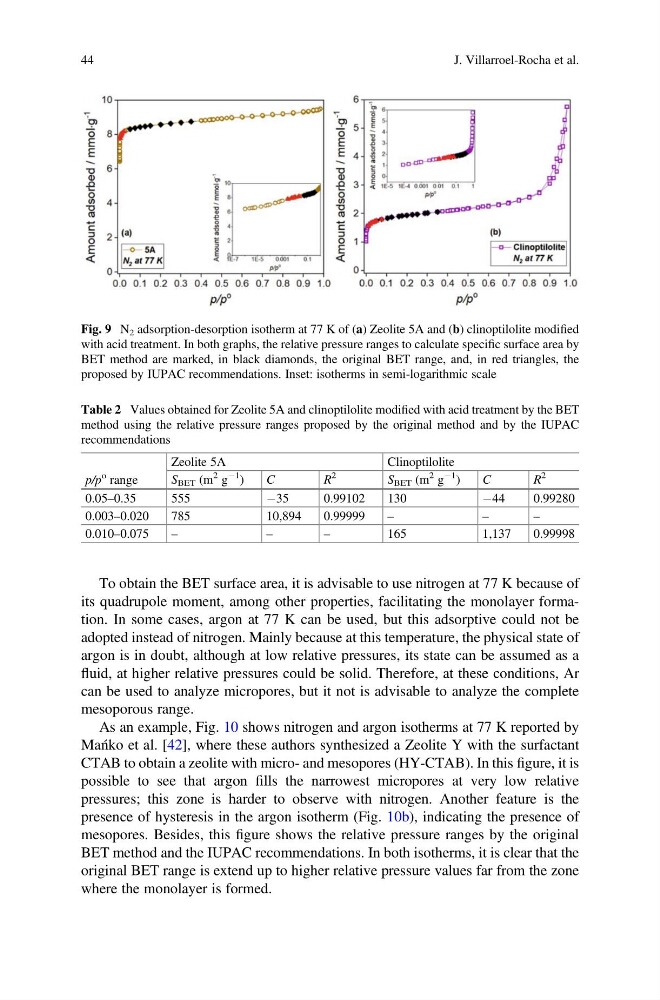
Fig. 9 N 2 adsorption-desorption isotherm at 77 K of (a) Zeolite 5A and (b) clinoptilolite modified
with acid treatment. In both graphs, the relative pressure ranges to calculate specific surface area by
BET method are marked, in black diamonds, the original BET range, and, in red triangles, the
proposed by IUPAC recommendations. Inset: isotherms in semi-logarithmic scale
Table 2 Values obtained for Zeolite 5A and clinoptilolite modified with acid treatment by the BET
method using the relative pressure ranges proposed by the original method and by the IUPAC
recommendations
p/p
o range
Zeolite 5A
Clinoptilolite
S BET (m
2 g
À1
)
C
R
2
S BET (m
2 g
À1
)
C
R
2
0.05–0.35
555
À35
0.99102
130
À44
0.99280
0.003–0.020
785
10,894
0.99999
–
–
–
0.010–0.075
–
–
–
165
1,137
0.99998
44
J. Villarroel-Rocha et al.
its quadrupole moment, among other properties, facilitating the monolayer formation. In some cases, argon at 77 K can be used, but this adsorptive could not be
adopted instead of nitrogen. Mainly because at this temperature, the physical state of
argon is in doubt, although at low relative pressures, its state can be assumed as a
fluid, at higher relative pressures could be solid. Therefore, at these conditions, Ar
can be used to analyze micropores, but it not is advisable to analyze the complete
mesoporous range.
As an example, Fig. 10 shows nitrogen and argon isotherms at 77 K reported by
Mańko et al. [42], where these authors synthesized a Zeolite Y with the surfactant
CTAB to obtain a zeolite with micro- and mesopores (HY-CTAB). In this figure, it is
possible to see that argon fills the narrowest micropores at very low relative
pressures; this zone is harder to observe with nitrogen. Another feature is the
presence of hysteresis in the argon isotherm (Fig. 10b), indicating the presence of
mesopores. Besides, this figure shows the relative pressure ranges by the original
BET method and the IUPAC recommendations. In both isotherms, it is clear that the
original BET range is extend up to higher relative pressure values far from the zone
where the monolayer is formed.
Fig. 9 N 2 adsorption-desorption isotherm at 77 K of (a) Zeolite 5A and (b) clinoptilolite modified
with acid treatment. In both graphs, the relative pressure ranges to calculate specific surface area by
BET method are marked, in black diamonds, the original BET range, and, in red triangles, the
proposed by IUPAC recommendations. Inset: isotherms in semi-logarithmic scale
Table 2 Values obtained for Zeolite 5A and clinoptilolite modified with acid treatment by the BET
method using the relative pressure ranges proposed by the original method and by the IUPAC
recommendations
p/p
o range
Zeolite 5A
Clinoptilolite
S BET (m
2 g
À1
)
C
R
2
S BET (m
2 g
À1
)
C
R
2
0.05–0.35
555
À35
0.99102
130
À44
0.99280
0.003–0.020
785
10,894
0.99999
–
–
–
0.010–0.075
–
–
–
165
1,137
0.99998
44
J. Villarroel-Rocha et al.