

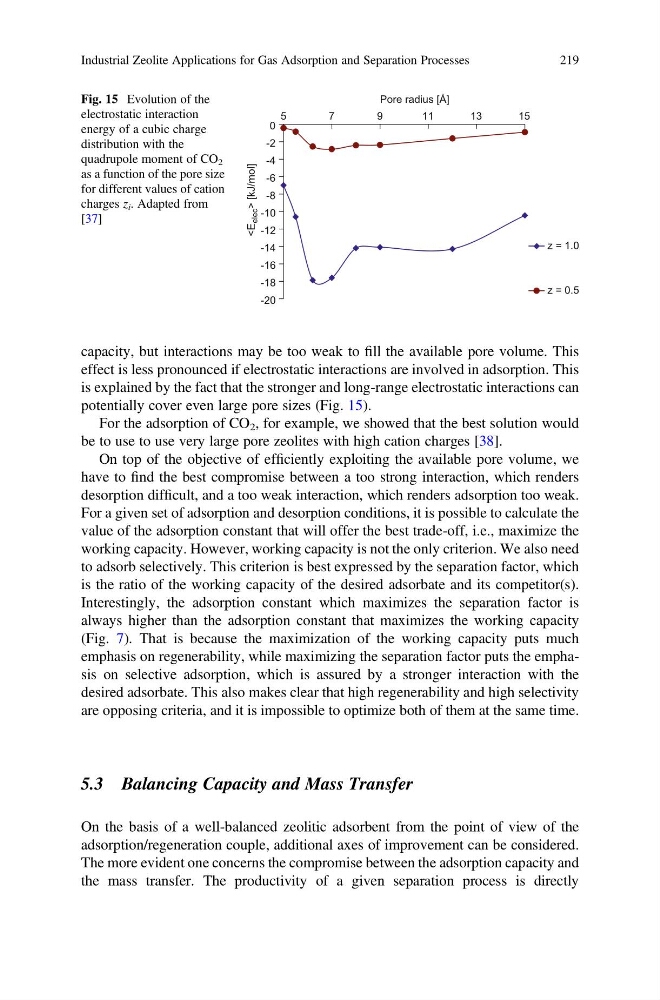
capacity, but interactions may be too weak to fill the available pore volume. This
effect is less pronounced if electrostatic interactions are involved in adsorption. This
is explained by the fact that the stronger and long-range electrostatic interactions can
potentially cover even large pore sizes (Fig. 15).
For the adsorption of CO 2 , for example, we showed that the best solution would
be to use to use very large pore zeolites with high cation charges [38].
On top of the objective of efficiently exploiting the available pore volume, we
have to find the best compromise between a too strong interaction, which renders
desorption difficult, and a too weak interaction, which renders adsorption too weak.
For a given set of adsorption and desorption conditions, it is possible to calculate the
value of the adsorption constant that will offer the best trade-off, i.e., maximize the
working capacity. However, working capacity is not the only criterion. We also need
to adsorb selectively. This criterion is best expressed by the separation factor, which
is the ratio of the working capacity of the desired adsorbate and its competitor(s).
Interestingly, the adsorption constant which maximizes the separation factor is
always higher than the adsorption constant that maximizes the working capacity
(Fig. 7). That is because the maximization of the working capacity puts much
emphasis on regenerability, while maximizing the separation factor puts the emphasis on selective adsorption, which is assured by a stronger interaction with the
desired adsorbate. This also makes clear that high regenerability and high selectivity
are opposing criteria, and it is impossible to optimize both of them at the same time.
5.3 Balancing Capacity and Mass Transfer
On the basis of a well-balanced zeolitic adsorbent from the point of view of the
adsorption/regeneration couple, additional axes of improvement can be considered.
The more evident one concerns the compromise between the adsorption capacity and
the mass transfer. The productivity of a given separation process is directly
-20
-18
-16
-14
-12
-10
-8
-6
-4
-2
0
5
7
9
1 1
1 3
1 5
Pore radius [Å]
z = 1.0
z = 0.5
Fig. 15 Evolution of the
electrostatic interaction
energy of a cubic charge
distribution with the
quadrupole moment of CO 2
as a function of the pore size
for different values of cation
charges z i . Adapted from
[37]
Industrial Zeolite Applications for Gas Adsorption and Separation Processes
219
effect is less pronounced if electrostatic interactions are involved in adsorption. This
is explained by the fact that the stronger and long-range electrostatic interactions can
potentially cover even large pore sizes (Fig. 15).
For the adsorption of CO 2 , for example, we showed that the best solution would
be to use to use very large pore zeolites with high cation charges [38].
On top of the objective of efficiently exploiting the available pore volume, we
have to find the best compromise between a too strong interaction, which renders
desorption difficult, and a too weak interaction, which renders adsorption too weak.
For a given set of adsorption and desorption conditions, it is possible to calculate the
value of the adsorption constant that will offer the best trade-off, i.e., maximize the
working capacity. However, working capacity is not the only criterion. We also need
to adsorb selectively. This criterion is best expressed by the separation factor, which
is the ratio of the working capacity of the desired adsorbate and its competitor(s).
Interestingly, the adsorption constant which maximizes the separation factor is
always higher than the adsorption constant that maximizes the working capacity
(Fig. 7). That is because the maximization of the working capacity puts much
emphasis on regenerability, while maximizing the separation factor puts the emphasis on selective adsorption, which is assured by a stronger interaction with the
desired adsorbate. This also makes clear that high regenerability and high selectivity
are opposing criteria, and it is impossible to optimize both of them at the same time.
5.3 Balancing Capacity and Mass Transfer
On the basis of a well-balanced zeolitic adsorbent from the point of view of the
adsorption/regeneration couple, additional axes of improvement can be considered.
The more evident one concerns the compromise between the adsorption capacity and
the mass transfer. The productivity of a given separation process is directly
-20
-18
-16
-14
-12
-10
-8
-6
-4
-2
0
5
7
9
1 1
1 3
1 5
Pore radius [Å]
z = 1.0
z = 0.5
Fig. 15 Evolution of the
electrostatic interaction
energy of a cubic charge
distribution with the
quadrupole moment of CO 2
as a function of the pore size
for different values of cation
charges z i . Adapted from
[37]
Industrial Zeolite Applications for Gas Adsorption and Separation Processes
219