

proportional to both selectivity and working capacity and inversely to the access
time (or the characteristic time of diffusion):
P / α Á W Á τ
À1
ð1Þ
As it is widely known, the industrial implementation of a zeolitic adsorbent
requires the use of adsorbent particles in the millimeter order of magnitude. Otherwise, the pressure drop generated in the bed limits the flow rates, particularly in the
case of liquid-phase separations. Consequently, the adsorbent particles exhibit a
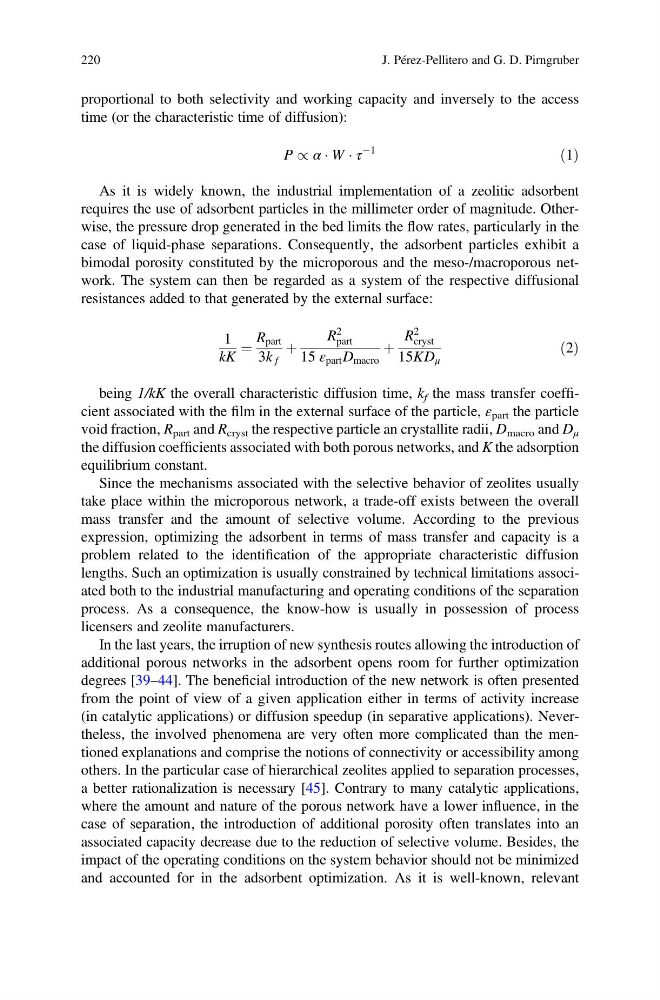
bimodal porosity constituted by the microporous and the meso-/macroporous network. The system can then be regarded as a system of the respective diffusional
resistances added to that generated by the external surface:
1
kK
¼
R part
3k f
þ
R
2
part
15 ε part D macro
þ
R
2
cryst
15KD μ
ð2Þ
being 1/kK the overall characteristic diffusion time, k f the mass transfer coefficient associated with the film in the external surface of the particle, ε part the particle
void fraction, R part and R cryst the respective particle an crystallite radii, D macro and D μ
the diffusion coefficients associated with both porous networks, and K the adsorption
equilibrium constant.
Since the mechanisms associated with the selective behavior of zeolites usually
take place within the microporous network, a trade-off exists between the overall
mass transfer and the amount of selective volume. According to the previous
expression, optimizing the adsorbent in terms of mass transfer and capacity is a
problem related to the identification of the appropriate characteristic diffusion
lengths. Such an optimization is usually constrained by technical limitations associated both to the industrial manufacturing and operating conditions of the separation
process. As a consequence, the know-how is usually in possession of process
licensers and zeolite manufacturers.
In the last years, the irruption of new synthesis routes allowing the introduction of
additional porous networks in the adsorbent opens room for further optimization
degrees [39–44]. The beneficial introduction of the new network is often presented
from the point of view of a given application either in terms of activity increase
(in catalytic applications) or diffusion speedup (in separative applications). Nevertheless, the involved phenomena are very often more complicated than the mentioned explanations and comprise the notions of connectivity or accessibility among
others. In the particular case of hierarchical zeolites applied to separation processes,
a better rationalization is necessary [45]. Contrary to many catalytic applications,
where the amount and nature of the porous network have a lower influence, in the
case of separation, the introduction of additional porosity often translates into an
associated capacity decrease due to the reduction of selective volume. Besides, the
impact of the operating conditions on the system behavior should not be minimized
and accounted for in the adsorbent optimization. As it is well-known, relevant
220
J. Pérez-Pellitero and G. D. Pirngruber
time (or the characteristic time of diffusion):
P / α Á W Á τ
À1
ð1Þ
As it is widely known, the industrial implementation of a zeolitic adsorbent
requires the use of adsorbent particles in the millimeter order of magnitude. Otherwise, the pressure drop generated in the bed limits the flow rates, particularly in the
case of liquid-phase separations. Consequently, the adsorbent particles exhibit a
bimodal porosity constituted by the microporous and the meso-/macroporous network. The system can then be regarded as a system of the respective diffusional
resistances added to that generated by the external surface:
1
kK
¼
R part
3k f
þ
R
2
part
15 ε part D macro
þ
R
2
cryst
15KD μ
ð2Þ
being 1/kK the overall characteristic diffusion time, k f the mass transfer coefficient associated with the film in the external surface of the particle, ε part the particle
void fraction, R part and R cryst the respective particle an crystallite radii, D macro and D μ
the diffusion coefficients associated with both porous networks, and K the adsorption
equilibrium constant.
Since the mechanisms associated with the selective behavior of zeolites usually
take place within the microporous network, a trade-off exists between the overall
mass transfer and the amount of selective volume. According to the previous
expression, optimizing the adsorbent in terms of mass transfer and capacity is a
problem related to the identification of the appropriate characteristic diffusion
lengths. Such an optimization is usually constrained by technical limitations associated both to the industrial manufacturing and operating conditions of the separation
process. As a consequence, the know-how is usually in possession of process
licensers and zeolite manufacturers.
In the last years, the irruption of new synthesis routes allowing the introduction of
additional porous networks in the adsorbent opens room for further optimization
degrees [39–44]. The beneficial introduction of the new network is often presented
from the point of view of a given application either in terms of activity increase
(in catalytic applications) or diffusion speedup (in separative applications). Nevertheless, the involved phenomena are very often more complicated than the mentioned explanations and comprise the notions of connectivity or accessibility among
others. In the particular case of hierarchical zeolites applied to separation processes,
a better rationalization is necessary [45]. Contrary to many catalytic applications,
where the amount and nature of the porous network have a lower influence, in the
case of separation, the introduction of additional porosity often translates into an
associated capacity decrease due to the reduction of selective volume. Besides, the
impact of the operating conditions on the system behavior should not be minimized
and accounted for in the adsorbent optimization. As it is well-known, relevant
220
J. Pérez-Pellitero and G. D. Pirngruber