

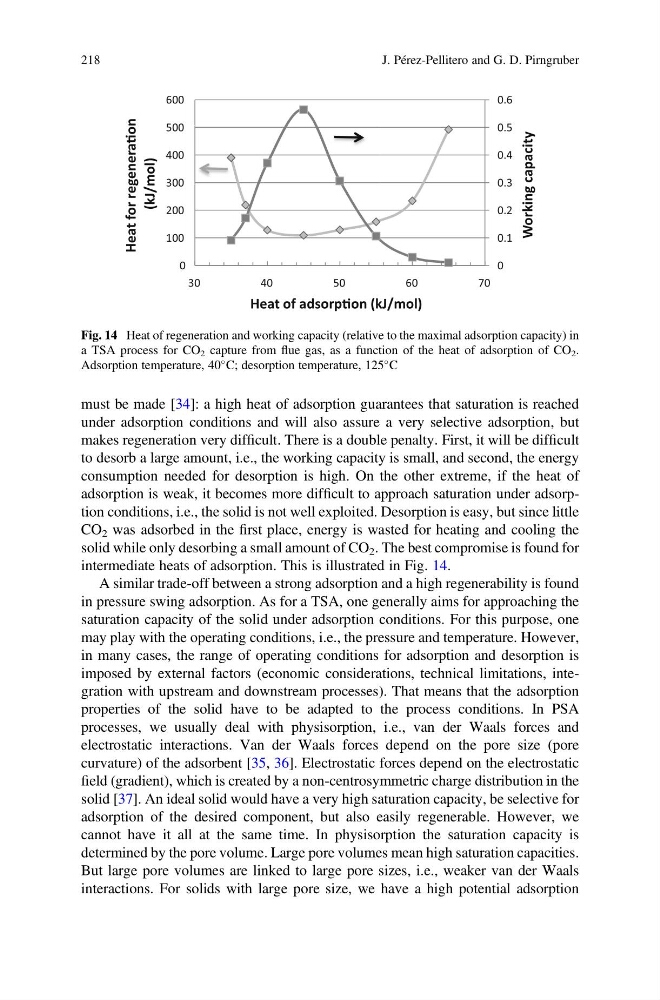
must be made [34]: a high heat of adsorption guarantees that saturation is reached
under adsorption conditions and will also assure a very selective adsorption, but
makes regeneration very difficult. There is a double penalty. First, it will be difficult
to desorb a large amount, i.e., the working capacity is small, and second, the energy
consumption needed for desorption is high. On the other extreme, if the heat of
adsorption is weak, it becomes more difficult to approach saturation under adsorption conditions, i.e., the solid is not well exploited. Desorption is easy, but since little
CO 2 was adsorbed in the first place, energy is wasted for heating and cooling the
solid while only desorbing a small amount of CO 2 . The best compromise is found for
intermediate heats of adsorption. This is illustrated in Fig. 14.
A similar trade-off between a strong adsorption and a high regenerability is found
in pressure swing adsorption. As for a TSA, one generally aims for approaching the
saturation capacity of the solid under adsorption conditions. For this purpose, one
may play with the operating conditions, i.e., the pressure and temperature. However,
in many cases, the range of operating conditions for adsorption and desorption is
imposed by external factors (economic considerations, technical limitations, integration with upstream and downstream processes). That means that the adsorption
properties of the solid have to be adapted to the process conditions. In PSA
processes, we usually deal with physisorption, i.e., van der Waals forces and
electrostatic interactions. Van der Waals forces depend on the pore size (pore
curvature) of the adsorbent [35, 36]. Electrostatic forces depend on the electrostatic
field (gradient), which is created by a non-centrosymmetric charge distribution in the
solid [37]. An ideal solid would have a very high saturation capacity, be selective for
adsorption of the desired component, but also easily regenerable. However, we
cannot have it all at the same time. In physisorption the saturation capacity is
determined by the pore volume. Large pore volumes mean high saturation capacities.
But large pore volumes are linked to large pore sizes, i.e., weaker van der Waals
interactions. For solids with large pore size, we have a high potential adsorption
0
0.1
0.2
0.3
0.4
0.5
0.6
0
100
200
300
400
500
600
30
40
50
60
70
Working capacity
Heat for regeneraƟon
(kJ/mol)
Heat of adsorpƟon (kJ/mol)
Fig. 14 Heat of regeneration and working capacity (relative to the maximal adsorption capacity) in
a TSA process for CO 2 capture from flue gas, as a function of the heat of adsorption of CO 2 .
Adsorption temperature, 40
C; desorption temperature, 125
C
218
J. Pérez-Pellitero and G. D. Pirngruber
under adsorption conditions and will also assure a very selective adsorption, but
makes regeneration very difficult. There is a double penalty. First, it will be difficult
to desorb a large amount, i.e., the working capacity is small, and second, the energy
consumption needed for desorption is high. On the other extreme, if the heat of
adsorption is weak, it becomes more difficult to approach saturation under adsorption conditions, i.e., the solid is not well exploited. Desorption is easy, but since little
CO 2 was adsorbed in the first place, energy is wasted for heating and cooling the
solid while only desorbing a small amount of CO 2 . The best compromise is found for
intermediate heats of adsorption. This is illustrated in Fig. 14.
A similar trade-off between a strong adsorption and a high regenerability is found
in pressure swing adsorption. As for a TSA, one generally aims for approaching the
saturation capacity of the solid under adsorption conditions. For this purpose, one
may play with the operating conditions, i.e., the pressure and temperature. However,
in many cases, the range of operating conditions for adsorption and desorption is
imposed by external factors (economic considerations, technical limitations, integration with upstream and downstream processes). That means that the adsorption
properties of the solid have to be adapted to the process conditions. In PSA
processes, we usually deal with physisorption, i.e., van der Waals forces and
electrostatic interactions. Van der Waals forces depend on the pore size (pore
curvature) of the adsorbent [35, 36]. Electrostatic forces depend on the electrostatic
field (gradient), which is created by a non-centrosymmetric charge distribution in the
solid [37]. An ideal solid would have a very high saturation capacity, be selective for
adsorption of the desired component, but also easily regenerable. However, we
cannot have it all at the same time. In physisorption the saturation capacity is
determined by the pore volume. Large pore volumes mean high saturation capacities.
But large pore volumes are linked to large pore sizes, i.e., weaker van der Waals
interactions. For solids with large pore size, we have a high potential adsorption
0
0.1
0.2
0.3
0.4
0.5
0.6
0
100
200
300
400
500
600
30
40
50
60
70
Working capacity
Heat for regeneraƟon
(kJ/mol)
Heat of adsorpƟon (kJ/mol)
Fig. 14 Heat of regeneration and working capacity (relative to the maximal adsorption capacity) in
a TSA process for CO 2 capture from flue gas, as a function of the heat of adsorption of CO 2 .
Adsorption temperature, 40
C; desorption temperature, 125
C
218
J. Pérez-Pellitero and G. D. Pirngruber