

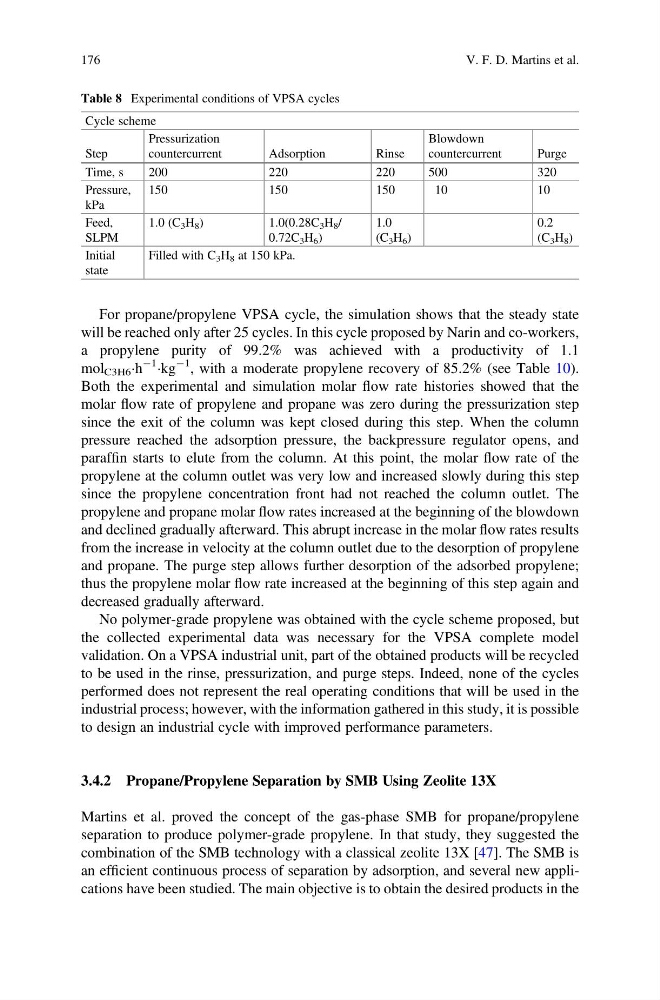
For propane/propylene VPSA cycle, the simulation shows that the steady state
will be reached only after 25 cycles. In this cycle proposed by Narin and co-workers,
a propylene purity of 99.2% was achieved with a productivity of 1.1
mol C3H6 Áh
À1
Ákg
À1 , with a moderate propylene recovery of 85.2% (see Table 10).
Both the experimental and simulation molar flow rate histories showed that the
molar flow rate of propylene and propane was zero during the pressurization step
since the exit of the column was kept closed during this step. When the column
pressure reached the adsorption pressure, the backpressure regulator opens, and
paraffin starts to elute from the column. At this point, the molar flow rate of the
propylene at the column outlet was very low and increased slowly during this step
since the propylene concentration front had not reached the column outlet. The
propylene and propane molar flow rates increased at the beginning of the blowdown
and declined gradually afterward. This abrupt increase in the molar flow rates results
from the increase in velocity at the column outlet due to the desorption of propylene
and propane. The purge step allows further desorption of the adsorbed propylene;
thus the propylene molar flow rate increased at the beginning of this step again and
decreased gradually afterward.
No polymer-grade propylene was obtained with the cycle scheme proposed, but
the collected experimental data was necessary for the VPSA complete model
validation. On a VPSA industrial unit, part of the obtained products will be recycled
to be used in the rinse, pressurization, and purge steps. Indeed, none of the cycles
performed does not represent the real operating conditions that will be used in the
industrial process; however, with the information gathered in this study, it is possible
to design an industrial cycle with improved performance parameters.
3.4.2 Propane/Propylene Separation by SMB Using Zeolite 13X
Martins et al. proved the concept of the gas-phase SMB for propane/propylene
separation to produce polymer-grade propylene. In that study, they suggested the
combination of the SMB technology with a classical zeolite 13X [47]. The SMB is
an efficient continuous process of separation by adsorption, and several new applications have been studied. The main objective is to obtain the desired products in the
Table 8 Experimental conditions of VPSA cycles
Cycle scheme
Step
Pressurization
countercurrent
Adsorption
Rinse
Blowdown
countercurrent
Purge
Time, s
200
220
220
500
320
Pressure,
kPa
150
150
150
10
10
Feed,
SLPM
1.0 (C 3 H 8 )
1.0(0.28C 3 H 8 /
0.72C 3 H 6 )
1.0
(C 3 H 6 )
0.2
(C 3 H 8 )
Initial
state
Filled with C 3 H 8 at 150 kPa.
176
V. F. D. Martins et al.
will be reached only after 25 cycles. In this cycle proposed by Narin and co-workers,
a propylene purity of 99.2% was achieved with a productivity of 1.1
mol C3H6 Áh
À1
Ákg
À1 , with a moderate propylene recovery of 85.2% (see Table 10).
Both the experimental and simulation molar flow rate histories showed that the
molar flow rate of propylene and propane was zero during the pressurization step
since the exit of the column was kept closed during this step. When the column
pressure reached the adsorption pressure, the backpressure regulator opens, and
paraffin starts to elute from the column. At this point, the molar flow rate of the
propylene at the column outlet was very low and increased slowly during this step
since the propylene concentration front had not reached the column outlet. The
propylene and propane molar flow rates increased at the beginning of the blowdown
and declined gradually afterward. This abrupt increase in the molar flow rates results
from the increase in velocity at the column outlet due to the desorption of propylene
and propane. The purge step allows further desorption of the adsorbed propylene;
thus the propylene molar flow rate increased at the beginning of this step again and
decreased gradually afterward.
No polymer-grade propylene was obtained with the cycle scheme proposed, but
the collected experimental data was necessary for the VPSA complete model
validation. On a VPSA industrial unit, part of the obtained products will be recycled
to be used in the rinse, pressurization, and purge steps. Indeed, none of the cycles
performed does not represent the real operating conditions that will be used in the
industrial process; however, with the information gathered in this study, it is possible
to design an industrial cycle with improved performance parameters.
3.4.2 Propane/Propylene Separation by SMB Using Zeolite 13X
Martins et al. proved the concept of the gas-phase SMB for propane/propylene
separation to produce polymer-grade propylene. In that study, they suggested the
combination of the SMB technology with a classical zeolite 13X [47]. The SMB is
an efficient continuous process of separation by adsorption, and several new applications have been studied. The main objective is to obtain the desired products in the
Table 8 Experimental conditions of VPSA cycles
Cycle scheme
Step
Pressurization
countercurrent
Adsorption
Rinse
Blowdown
countercurrent
Purge
Time, s
200
220
220
500
320
Pressure,
kPa
150
150
150
10
10
Feed,
SLPM
1.0 (C 3 H 8 )
1.0(0.28C 3 H 8 /
0.72C 3 H 6 )
1.0
(C 3 H 6 )
0.2
(C 3 H 8 )
Initial
state
Filled with C 3 H 8 at 150 kPa.
176
V. F. D. Martins et al.