

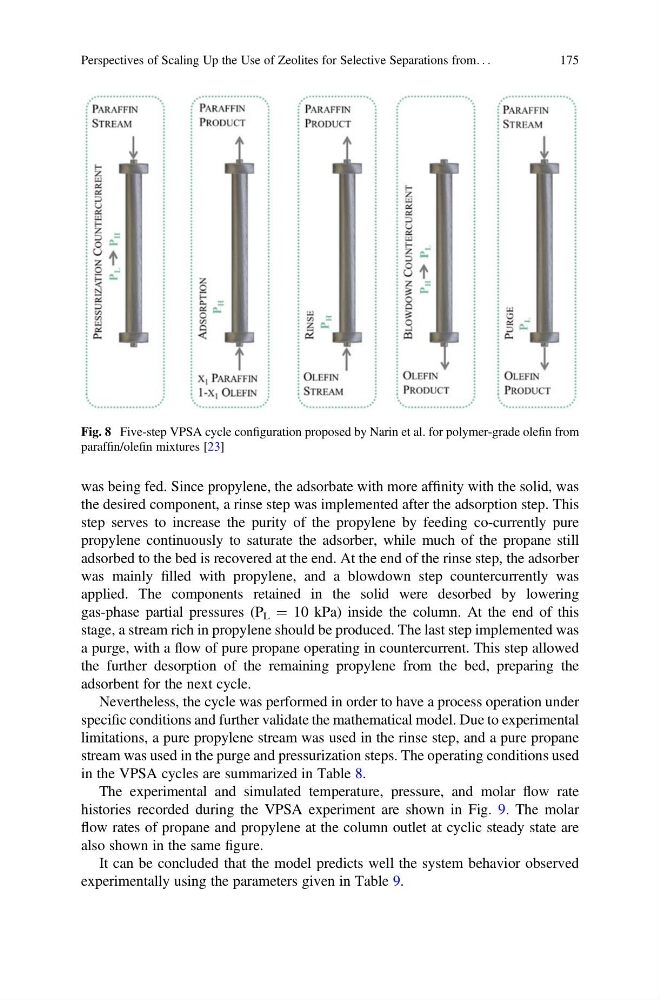
was being fed. Since propylene, the adsorbate with more affinity with the solid, was
the desired component, a rinse step was implemented after the adsorption step. This
step serves to increase the purity of the propylene by feeding co-currently pure
propylene continuously to saturate the adsorber, while much of the propane still
adsorbed to the bed is recovered at the end. At the end of the rinse step, the adsorber
was mainly filled with propylene, and a blowdown step countercurrently was
applied. The components retained in the solid were desorbed by lowering
gas-phase partial pressures (P L ¼ 10 kPa) inside the column. At the end of this
stage, a stream rich in propylene should be produced. The last step implemented was
a purge, with a flow of pure propane operating in countercurrent. This step allowed
the further desorption of the remaining propylene from the bed, preparing the
adsorbent for the next cycle.
Nevertheless, the cycle was performed in order to have a process operation under
specific conditions and further validate the mathematical model. Due to experimental
limitations, a pure propylene stream was used in the rinse step, and a pure propane
stream was used in the purge and pressurization steps. The operating conditions used
in the VPSA cycles are summarized in Table 8.
The experimental and simulated temperature, pressure, and molar flow rate
histories recorded during the VPSA experiment are shown in Fig. 9. The molar
flow rates of propane and propylene at the column outlet at cyclic steady state are
also shown in the same figure.
It can be concluded that the model predicts well the system behavior observed
experimentally using the parameters given in Table 9.
Fig. 8 Five-step VPSA cycle configuration proposed by Narin et al. for polymer-grade olefin from
paraffin/olefin mixtures [23]
Perspectives of Scaling Up the Use of Zeolites for Selective Separations from. . .
175
the desired component, a rinse step was implemented after the adsorption step. This
step serves to increase the purity of the propylene by feeding co-currently pure
propylene continuously to saturate the adsorber, while much of the propane still
adsorbed to the bed is recovered at the end. At the end of the rinse step, the adsorber
was mainly filled with propylene, and a blowdown step countercurrently was
applied. The components retained in the solid were desorbed by lowering
gas-phase partial pressures (P L ¼ 10 kPa) inside the column. At the end of this
stage, a stream rich in propylene should be produced. The last step implemented was
a purge, with a flow of pure propane operating in countercurrent. This step allowed
the further desorption of the remaining propylene from the bed, preparing the
adsorbent for the next cycle.
Nevertheless, the cycle was performed in order to have a process operation under
specific conditions and further validate the mathematical model. Due to experimental
limitations, a pure propylene stream was used in the rinse step, and a pure propane
stream was used in the purge and pressurization steps. The operating conditions used
in the VPSA cycles are summarized in Table 8.
The experimental and simulated temperature, pressure, and molar flow rate
histories recorded during the VPSA experiment are shown in Fig. 9. The molar
flow rates of propane and propylene at the column outlet at cyclic steady state are
also shown in the same figure.
It can be concluded that the model predicts well the system behavior observed
experimentally using the parameters given in Table 9.
Fig. 8 Five-step VPSA cycle configuration proposed by Narin et al. for polymer-grade olefin from
paraffin/olefin mixtures [23]
Perspectives of Scaling Up the Use of Zeolites for Selective Separations from. . .
175