

cryogenic temperatures and high pressures in the C 3 -splitter distillation towers
containing over 100 trays. A particularly efficient distillation column is required
due to the close relative volatilities and molecular sizes of the two compounds
presented in the mixture. These extreme operating conditions make this separation
one of the most cost- and energy-intensive process in the petrochemical
industry [109].
3.4.1 Propane/Propylene Separation by PSA Using Binderless Zeolite
13X
In a recent study, Narin et al. show an example with high potential to transform the
propane/propylene separation to produce polymer-grade propylene less demanding.
In that study, they suggested the combination of the VPSA technology with the
enhanced binderless zeolite 13X [23].
In the PSA technology, the adsorption step is typically performed at a pressure
above the atmospheric (P H ). In the adsorbent regeneration, the retained components
are desorbed by lowering the partial pressures (P L ) inside the column. This process
usually is performed without providing any external heat [1]. In the literature,
numerous distinct nomenclatures are found to define the most varied concepts
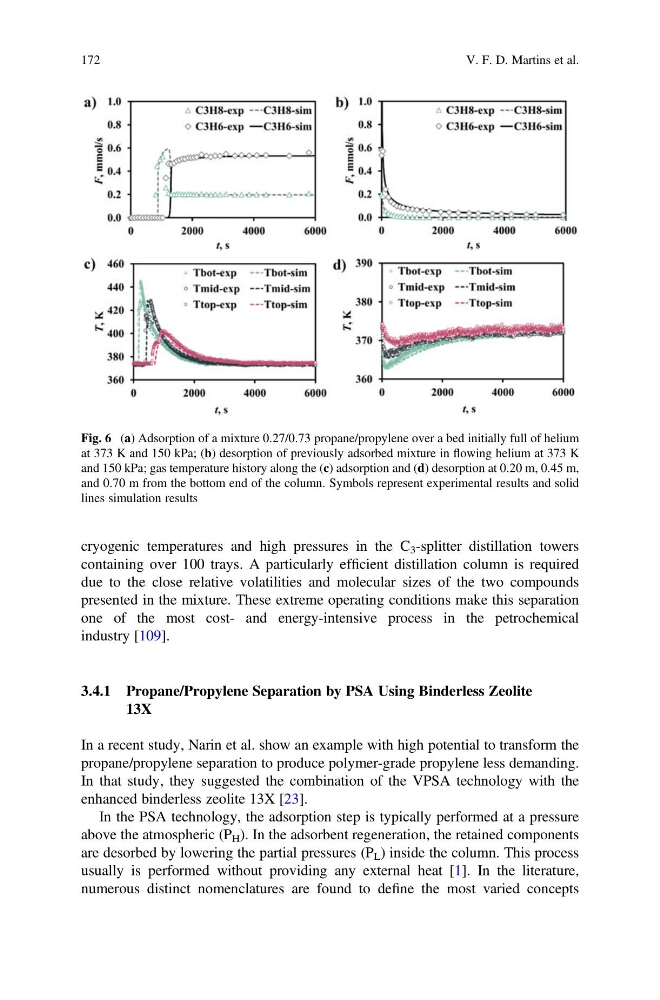
Fig. 6 (a) Adsorption of a mixture 0.27/0.73 propane/propylene over a bed initially full of helium
at 373 K and 150 kPa; (b) desorption of previously adsorbed mixture in flowing helium at 373 K
and 150 kPa; gas temperature history along the (c) adsorption and (d) desorption at 0.20 m, 0.45 m,
and 0.70 m from the bottom end of the column. Symbols represent experimental results and solid
lines simulation results
172
V. F. D. Martins et al.
containing over 100 trays. A particularly efficient distillation column is required
due to the close relative volatilities and molecular sizes of the two compounds
presented in the mixture. These extreme operating conditions make this separation
one of the most cost- and energy-intensive process in the petrochemical
industry [109].
3.4.1 Propane/Propylene Separation by PSA Using Binderless Zeolite
13X
In a recent study, Narin et al. show an example with high potential to transform the
propane/propylene separation to produce polymer-grade propylene less demanding.
In that study, they suggested the combination of the VPSA technology with the
enhanced binderless zeolite 13X [23].
In the PSA technology, the adsorption step is typically performed at a pressure
above the atmospheric (P H ). In the adsorbent regeneration, the retained components
are desorbed by lowering the partial pressures (P L ) inside the column. This process
usually is performed without providing any external heat [1]. In the literature,
numerous distinct nomenclatures are found to define the most varied concepts
Fig. 6 (a) Adsorption of a mixture 0.27/0.73 propane/propylene over a bed initially full of helium
at 373 K and 150 kPa; (b) desorption of previously adsorbed mixture in flowing helium at 373 K
and 150 kPa; gas temperature history along the (c) adsorption and (d) desorption at 0.20 m, 0.45 m,
and 0.70 m from the bottom end of the column. Symbols represent experimental results and solid
lines simulation results
172
V. F. D. Martins et al.