

[63, 110, 111]. As mentioned above, the adsorption step in the PSA is carried out at a
pressure above the atmospheric, and the regeneration is achieved at pressures near
the atmospheric. In a vacuum swing adsorption (VSA) process, the adsorption step is
achieved at pressures near the atmospheric, and the regeneration is achieved under
vacuum. In the case of a VPSA process, both concepts – PSA and VSA – are
combined. These processes are complex due to the multi-column design, where the
adsorbent beds operate under a cyclic steady state, in a sequence of non-isothermal,
nonisobaric, and non-steady-state steps. A series of steps are designed to follow a
specific configuration that allows the improvement of product purity and recovery
and the overall separation performance optimization.
The modeling of cyclic adsorption processes such as VPSA includes the combination of the necessary steps in a sequence that forms the desired cycle. Each step
corresponds to a dynamic process model with specific boundary and initial conditions, according to the characteristics of that step. It is important to note that the final
state of a given step is set as the initial condition of the following step. The model
equations were described previously, and the boundary conditions employed for the
different steps of the VPSA cycle simulation are given by the equations detailed in
the literature [112].
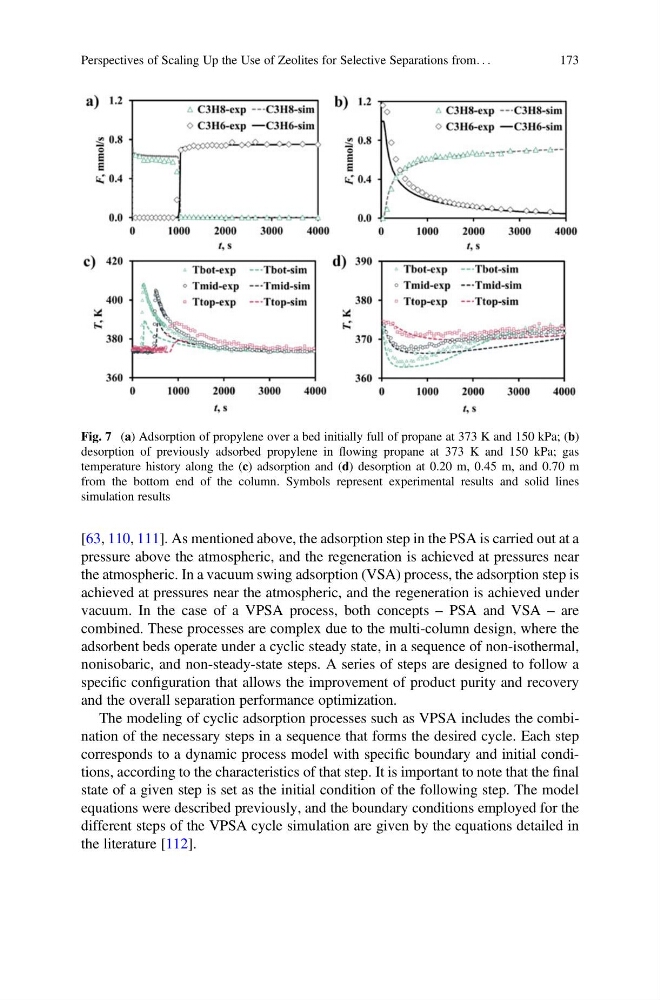
Fig. 7 (a) Adsorption of propylene over a bed initially full of propane at 373 K and 150 kPa; (b)
desorption of previously adsorbed propylene in flowing propane at 373 K and 150 kPa; gas
temperature history along the (c) adsorption and (d) desorption at 0.20 m, 0.45 m, and 0.70 m
from the bottom end of the column. Symbols represent experimental results and solid lines
simulation results
Perspectives of Scaling Up the Use of Zeolites for Selective Separations from. . .
173
pressure above the atmospheric, and the regeneration is achieved at pressures near
the atmospheric. In a vacuum swing adsorption (VSA) process, the adsorption step is
achieved at pressures near the atmospheric, and the regeneration is achieved under
vacuum. In the case of a VPSA process, both concepts – PSA and VSA – are
combined. These processes are complex due to the multi-column design, where the
adsorbent beds operate under a cyclic steady state, in a sequence of non-isothermal,
nonisobaric, and non-steady-state steps. A series of steps are designed to follow a
specific configuration that allows the improvement of product purity and recovery
and the overall separation performance optimization.
The modeling of cyclic adsorption processes such as VPSA includes the combination of the necessary steps in a sequence that forms the desired cycle. Each step
corresponds to a dynamic process model with specific boundary and initial conditions, according to the characteristics of that step. It is important to note that the final
state of a given step is set as the initial condition of the following step. The model
equations were described previously, and the boundary conditions employed for the
different steps of the VPSA cycle simulation are given by the equations detailed in
the literature [112].
Fig. 7 (a) Adsorption of propylene over a bed initially full of propane at 373 K and 150 kPa; (b)
desorption of previously adsorbed propylene in flowing propane at 373 K and 150 kPa; gas
temperature history along the (c) adsorption and (d) desorption at 0.20 m, 0.45 m, and 0.70 m
from the bottom end of the column. Symbols represent experimental results and solid lines
simulation results
Perspectives of Scaling Up the Use of Zeolites for Selective Separations from. . .
173