

the model (Fig. 7). This is rather pertinent for VPSA cycle design since it allows the
accurate simulation of rinse and purge steps, which are counter-adsorption steps.
3.4 VPSA and SMB at Pilot Scale Using Zeolites
The steam cracking of naphtha produces light olefins, such as propylene and
ethylene. Alternatively, they can be obtained by the steam cracking of ethane or as
a by-product of fluid catalytic cracking of gas oils in refineries [106]. The two main
processes achieve different propane/propylene mixtures; a mixture containing
50–60% of propylene is usually obtained by steam cracking, while the alternative
process performed in the refineries produces a mixture containing 80–87% of
propylene. None of these processes produces propylene pure enough that can be
used directly in the polymer industry since it requires propylene with a purity grade
above 99.5% [47]. This grade is needed for polymer production as the impurities
lead to the formation of side products, which affect the properties of the final
polymer [107]. To obtain the polymer-grade propylene, the separation of the propylene from the uncracked propane is required [108]. Nowadays, the propane/
propylene separation after the steam cracking process is commonly performed at
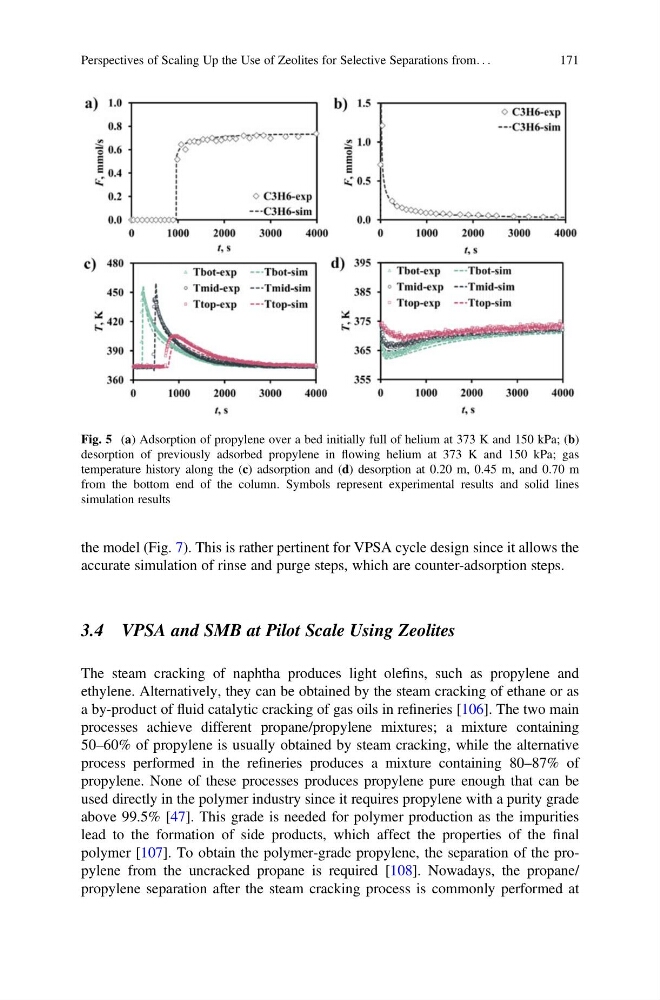
Fig. 5 (a) Adsorption of propylene over a bed initially full of helium at 373 K and 150 kPa; (b)
desorption of previously adsorbed propylene in flowing helium at 373 K and 150 kPa; gas
temperature history along the (c) adsorption and (d) desorption at 0.20 m, 0.45 m, and 0.70 m
from the bottom end of the column. Symbols represent experimental results and solid lines
simulation results
Perspectives of Scaling Up the Use of Zeolites for Selective Separations from. . .
171
accurate simulation of rinse and purge steps, which are counter-adsorption steps.
3.4 VPSA and SMB at Pilot Scale Using Zeolites
The steam cracking of naphtha produces light olefins, such as propylene and
ethylene. Alternatively, they can be obtained by the steam cracking of ethane or as
a by-product of fluid catalytic cracking of gas oils in refineries [106]. The two main
processes achieve different propane/propylene mixtures; a mixture containing
50–60% of propylene is usually obtained by steam cracking, while the alternative
process performed in the refineries produces a mixture containing 80–87% of
propylene. None of these processes produces propylene pure enough that can be
used directly in the polymer industry since it requires propylene with a purity grade
above 99.5% [47]. This grade is needed for polymer production as the impurities
lead to the formation of side products, which affect the properties of the final
polymer [107]. To obtain the polymer-grade propylene, the separation of the propylene from the uncracked propane is required [108]. Nowadays, the propane/
propylene separation after the steam cracking process is commonly performed at
Fig. 5 (a) Adsorption of propylene over a bed initially full of helium at 373 K and 150 kPa; (b)
desorption of previously adsorbed propylene in flowing helium at 373 K and 150 kPa; gas
temperature history along the (c) adsorption and (d) desorption at 0.20 m, 0.45 m, and 0.70 m
from the bottom end of the column. Symbols represent experimental results and solid lines
simulation results
Perspectives of Scaling Up the Use of Zeolites for Selective Separations from. . .
171