

150 kPa. For the multicomponent breakthrough curves, the bed was initially saturated with one of the components, and the feed was the other component (pseudobinary). It is essential to get this data in dynamic, not only to corroborate the
equilibrium data but also collect bed information for further experiments by
PSA/SMB. After all these analyses, it is possible to decide whether the material is
competitive to be applied for the target separation by PSA or SMB technology.
3.3 Mathematical Modeling and Validation
Based on the mode of operation, the processes under study are classified as dynamic
adsorption processes, since these are open processes where the adsorbate continuously passes through a column packed with an adsorbent. For the fixed bed, the way
to determine the breakthrough curves is a crucial issue, because it provides essential
information for the design of a column adsorption system. To predict the adsorption
and desorption behavior of the single- and multicomponent breakthrough curves on
selected material, proper software is used to implement the model assuming the
necessary conditions [103].
For the cases discussed above using zeolite as an adsorbent for olefin/paraffin and
CO 2 /CH 4 separation, the model considered describes an adsorption bed, and it was
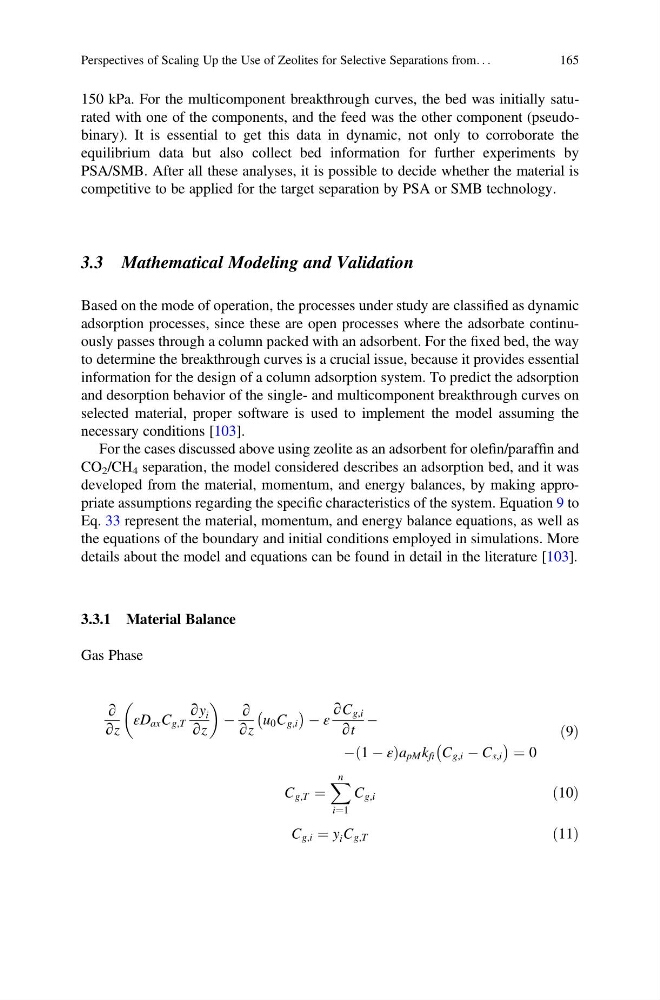
developed from the material, momentum, and energy balances, by making appropriate assumptions regarding the specific characteristics of the system. Equation 9 to
Eq. 33 represent the material, momentum, and energy balance equations, as well as
the equations of the boundary and initial conditions employed in simulations. More
details about the model and equations can be found in detail in the literature [103].
3.3.1 Material Balance
Gas Phase
∂
∂z
εD ax C g,T
∂y i
∂z
À
∂
∂z
u 0 C g,i
À
Á À ε
∂C g,i
∂t
À
À 1 À ε
ð
Þa pM k fi C g,i À C s,i
À
Á ¼ 0
ð9Þ
C g,T ¼
X n
i¼1
C g,i
ð10Þ
C g,i ¼ y i C g,T
ð11Þ
Perspectives of Scaling Up the Use of Zeolites for Selective Separations from. . .
165
equilibrium data but also collect bed information for further experiments by
PSA/SMB. After all these analyses, it is possible to decide whether the material is
competitive to be applied for the target separation by PSA or SMB technology.
3.3 Mathematical Modeling and Validation
Based on the mode of operation, the processes under study are classified as dynamic
adsorption processes, since these are open processes where the adsorbate continuously passes through a column packed with an adsorbent. For the fixed bed, the way
to determine the breakthrough curves is a crucial issue, because it provides essential
information for the design of a column adsorption system. To predict the adsorption
and desorption behavior of the single- and multicomponent breakthrough curves on
selected material, proper software is used to implement the model assuming the
necessary conditions [103].
For the cases discussed above using zeolite as an adsorbent for olefin/paraffin and
CO 2 /CH 4 separation, the model considered describes an adsorption bed, and it was
developed from the material, momentum, and energy balances, by making appropriate assumptions regarding the specific characteristics of the system. Equation 9 to
Eq. 33 represent the material, momentum, and energy balance equations, as well as
the equations of the boundary and initial conditions employed in simulations. More
details about the model and equations can be found in detail in the literature [103].
3.3.1 Material Balance
Gas Phase
∂
∂z
εD ax C g,T
∂y i
∂z
À
∂
∂z
u 0 C g,i
À
Á À ε
∂C g,i
∂t
À
À 1 À ε
ð
Þa pM k fi C g,i À C s,i
À
Á ¼ 0
ð9Þ
C g,T ¼
X n
i¼1
C g,i
ð10Þ
C g,i ¼ y i C g,T
ð11Þ
Perspectives of Scaling Up the Use of Zeolites for Selective Separations from. . .
165