

by feeding a mixture comprising 0.60CH 4 /0.20CO 2 /0.20N 2 on the same sample. The
authors only proceeded to the design of a pilot-scale separation process, after the
mathematical modeling based on the data obtained up to this point and adequately
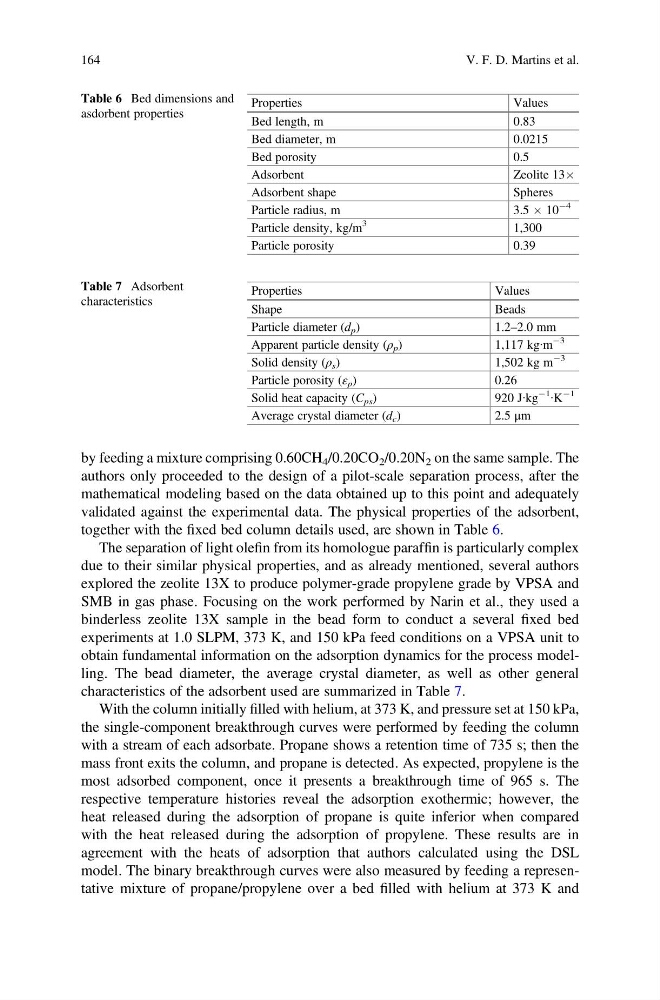
validated against the experimental data. The physical properties of the adsorbent,
together with the fixed bed column details used, are shown in Table 6.
The separation of light olefin from its homologue paraffin is particularly complex
due to their similar physical properties, and as already mentioned, several authors
explored the zeolite 13X to produce polymer-grade propylene grade by VPSA and
SMB in gas phase. Focusing on the work performed by Narin et al., they used a
binderless zeolite 13X sample in the bead form to conduct a several fixed bed
experiments at 1.0 SLPM, 373 K, and 150 kPa feed conditions on a VPSA unit to
obtain fundamental information on the adsorption dynamics for the process modelling. The bead diameter, the average crystal diameter, as well as other general
characteristics of the adsorbent used are summarized in Table 7.
With the column initially filled with helium, at 373 K, and pressure set at 150 kPa,
the single-component breakthrough curves were performed by feeding the column
with a stream of each adsorbate. Propane shows a retention time of 735 s; then the
mass front exits the column, and propane is detected. As expected, propylene is the
most adsorbed component, once it presents a breakthrough time of 965 s. The
respective temperature histories reveal the adsorption exothermic; however, the
heat released during the adsorption of propane is quite inferior when compared
with the heat released during the adsorption of propylene. These results are in
agreement with the heats of adsorption that authors calculated using the DSL
model. The binary breakthrough curves were also measured by feeding a representative mixture of propane/propylene over a bed filled with helium at 373 K and
Table 6 Bed dimensions and
asdorbent properties
Properties
Values
Bed length, m
0.83
Bed diameter, m
0.0215
Bed porosity
0.5
Adsorbent
Zeolite 13Â
Adsorbent shape
Spheres
Particle radius, m
3.5 Â 10
À4
Particle density, kg/m
3
1,300
Particle porosity
0.39
Table 7 Adsorbent
characteristics
Properties
Values
Shape
Beads
Particle diameter (d p )
1.2–2.0 mm
Apparent particle density (ρ p )
1,117 kg∙m
À3
Solid density (ρ s )
1,502 kg m
À3
Particle porosity (ε p )
0.26
Solid heat capacity (C ps )
920 J∙kg
À1
∙K
À1
Average crystal diameter (d c )
2.5 μm
164
V. F. D. Martins et al.
authors only proceeded to the design of a pilot-scale separation process, after the
mathematical modeling based on the data obtained up to this point and adequately
validated against the experimental data. The physical properties of the adsorbent,
together with the fixed bed column details used, are shown in Table 6.
The separation of light olefin from its homologue paraffin is particularly complex
due to their similar physical properties, and as already mentioned, several authors
explored the zeolite 13X to produce polymer-grade propylene grade by VPSA and
SMB in gas phase. Focusing on the work performed by Narin et al., they used a
binderless zeolite 13X sample in the bead form to conduct a several fixed bed
experiments at 1.0 SLPM, 373 K, and 150 kPa feed conditions on a VPSA unit to
obtain fundamental information on the adsorption dynamics for the process modelling. The bead diameter, the average crystal diameter, as well as other general
characteristics of the adsorbent used are summarized in Table 7.
With the column initially filled with helium, at 373 K, and pressure set at 150 kPa,
the single-component breakthrough curves were performed by feeding the column
with a stream of each adsorbate. Propane shows a retention time of 735 s; then the
mass front exits the column, and propane is detected. As expected, propylene is the
most adsorbed component, once it presents a breakthrough time of 965 s. The
respective temperature histories reveal the adsorption exothermic; however, the
heat released during the adsorption of propane is quite inferior when compared
with the heat released during the adsorption of propylene. These results are in
agreement with the heats of adsorption that authors calculated using the DSL
model. The binary breakthrough curves were also measured by feeding a representative mixture of propane/propylene over a bed filled with helium at 373 K and
Table 6 Bed dimensions and
asdorbent properties
Properties
Values
Bed length, m
0.83
Bed diameter, m
0.0215
Bed porosity
0.5
Adsorbent
Zeolite 13Â
Adsorbent shape
Spheres
Particle radius, m
3.5 Â 10
À4
Particle density, kg/m
3
1,300
Particle porosity
0.39
Table 7 Adsorbent
characteristics
Properties
Values
Shape
Beads
Particle diameter (d p )
1.2–2.0 mm
Apparent particle density (ρ p )
1,117 kg∙m
À3
Solid density (ρ s )
1,502 kg m
À3
Particle porosity (ε p )
0.26
Solid heat capacity (C ps )
920 J∙kg
À1
∙K
À1
Average crystal diameter (d c )
2.5 μm
164
V. F. D. Martins et al.