

desorption steps were determined to feed each mixture against a bed filled with a
third component, which can be the desorbent.
After collecting all the information, we proceed to the mathematical modeling for
the design, analysis, and optimization of processes. Nowadays, mathematical modeling is becoming essential in the industry since it offers many advantages over
traditional trial-and-error design methodologies. For the fixed bed, the way to
determine the breakthrough curves is a crucial issue, because it provides the basic,
yet essential information for the design of a column adsorption system.
Cavenati and co-workers developed a study for CH 4 /CO 2 separation by
VSA-PSA using zeolite 13X as the selective adsorbent for CO 2 and followed this
methodology. Before the cycle design, they performed a set of fixed bed experiments
to obtain the information for modeling. The physical properties of the adsorbent,
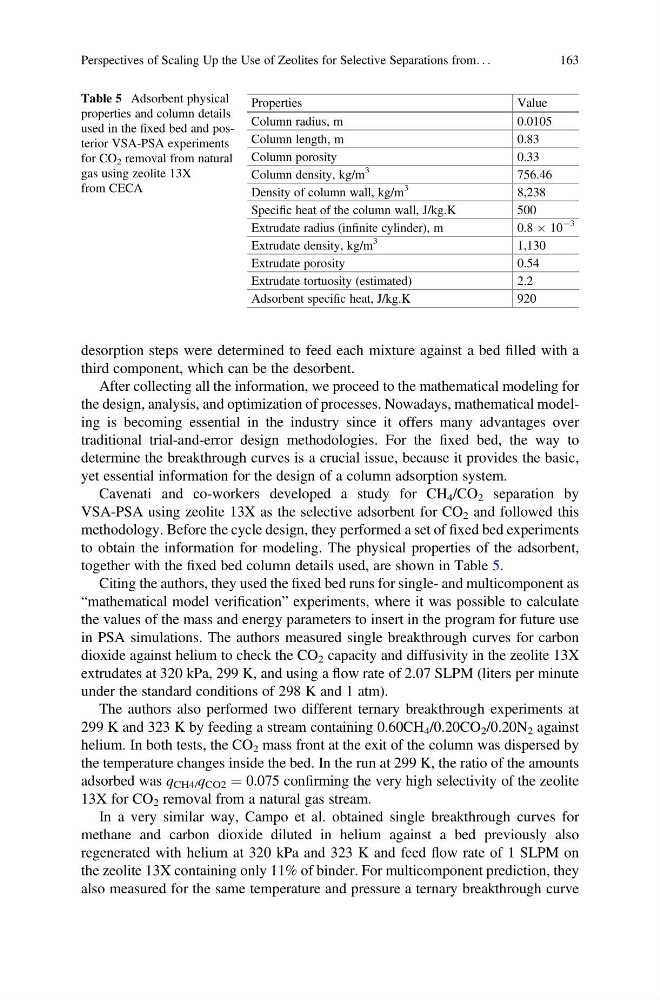
together with the fixed bed column details used, are shown in Table 5.
Citing the authors, they used the fixed bed runs for single- and multicomponent as
“mathematical model verification” experiments, where it was possible to calculate
the values of the mass and energy parameters to insert in the program for future use
in PSA simulations. The authors measured single breakthrough curves for carbon
dioxide against helium to check the CO 2 capacity and diffusivity in the zeolite 13X
extrudates at 320 kPa, 299 K, and using a flow rate of 2.07 SLPM (liters per minute
under the standard conditions of 298 K and 1 atm).
The authors also performed two different ternary breakthrough experiments at
299 K and 323 K by feeding a stream containing 0.60CH 4 /0.20CO 2 /0.20N 2 against
helium. In both tests, the CO 2 mass front at the exit of the column was dispersed by
the temperature changes inside the bed. In the run at 299 K, the ratio of the amounts
adsorbed was q CH4/ q CO2 ¼ 0.075 confirming the very high selectivity of the zeolite
13X for CO 2 removal from a natural gas stream.
In a very similar way, Campo et al. obtained single breakthrough curves for
methane and carbon dioxide diluted in helium against a bed previously also
regenerated with helium at 320 kPa and 323 K and feed flow rate of 1 SLPM on
the zeolite 13X containing only 11% of binder. For multicomponent prediction, they
also measured for the same temperature and pressure a ternary breakthrough curve
Table 5 Adsorbent physical
properties and column details
used in the fixed bed and posterior VSA-PSA experiments
for CO 2 removal from natural
gas using zeolite 13X
from CECA
Properties
Value
Column radius, m
0.0105
Column length, m
0.83
Column porosity
0.33
Column density, kg/m
3
756.46
Density of column wall, kg/m
3
8,238
Specific heat of the column wall, J/kg.K
500
Extrudate radius (infinite cylinder), m
0.8 Â 10
À3
Extrudate density, kg/m
3
1,130
Extrudate porosity
0.54
Extrudate tortuosity (estimated)
2.2
Adsorbent specific heat, J/kg.K
920
Perspectives of Scaling Up the Use of Zeolites for Selective Separations from. . .
163
third component, which can be the desorbent.
After collecting all the information, we proceed to the mathematical modeling for
the design, analysis, and optimization of processes. Nowadays, mathematical modeling is becoming essential in the industry since it offers many advantages over
traditional trial-and-error design methodologies. For the fixed bed, the way to
determine the breakthrough curves is a crucial issue, because it provides the basic,
yet essential information for the design of a column adsorption system.
Cavenati and co-workers developed a study for CH 4 /CO 2 separation by
VSA-PSA using zeolite 13X as the selective adsorbent for CO 2 and followed this
methodology. Before the cycle design, they performed a set of fixed bed experiments
to obtain the information for modeling. The physical properties of the adsorbent,
together with the fixed bed column details used, are shown in Table 5.
Citing the authors, they used the fixed bed runs for single- and multicomponent as
“mathematical model verification” experiments, where it was possible to calculate
the values of the mass and energy parameters to insert in the program for future use
in PSA simulations. The authors measured single breakthrough curves for carbon
dioxide against helium to check the CO 2 capacity and diffusivity in the zeolite 13X
extrudates at 320 kPa, 299 K, and using a flow rate of 2.07 SLPM (liters per minute
under the standard conditions of 298 K and 1 atm).
The authors also performed two different ternary breakthrough experiments at
299 K and 323 K by feeding a stream containing 0.60CH 4 /0.20CO 2 /0.20N 2 against
helium. In both tests, the CO 2 mass front at the exit of the column was dispersed by
the temperature changes inside the bed. In the run at 299 K, the ratio of the amounts
adsorbed was q CH4/ q CO2 ¼ 0.075 confirming the very high selectivity of the zeolite
13X for CO 2 removal from a natural gas stream.
In a very similar way, Campo et al. obtained single breakthrough curves for
methane and carbon dioxide diluted in helium against a bed previously also
regenerated with helium at 320 kPa and 323 K and feed flow rate of 1 SLPM on
the zeolite 13X containing only 11% of binder. For multicomponent prediction, they
also measured for the same temperature and pressure a ternary breakthrough curve
Table 5 Adsorbent physical
properties and column details
used in the fixed bed and posterior VSA-PSA experiments
for CO 2 removal from natural
gas using zeolite 13X
from CECA
Properties
Value
Column radius, m
0.0105
Column length, m
0.83
Column porosity
0.33
Column density, kg/m
3
756.46
Density of column wall, kg/m
3
8,238
Specific heat of the column wall, J/kg.K
500
Extrudate radius (infinite cylinder), m
0.8 Â 10
À3
Extrudate density, kg/m
3
1,130
Extrudate porosity
0.54
Extrudate tortuosity (estimated)
2.2
Adsorbent specific heat, J/kg.K
920
Perspectives of Scaling Up the Use of Zeolites for Selective Separations from. . .
163