

The design of industrial adsorption equipment requires the availability of reliable
equilibrium data and theoretical models for accurate prediction of these data.
Multicomponent adsorption equilibrium data is of the utmost importance in the
modeling of adsorption separation processes, once these data reflect the competition
between components for the different adsorption sites.
The multicomponent adsorption equilibrium for the olefin/paraffin mixtures was
estimated for in some studies by the extended SSL (ExSSL) model. The assumptions
of the SSL model apply to the multicomponent mixtures of N components. The
adsorbed amount of component i in the multicomponent mixture is given by [54]:
q i ¼ q i,sat
b i P i
1 þ
P N
i¼1
b i P i
ð
Þ
, i ¼ 1, 2 . . . N
ð7Þ
where q i,sat is the adsorption saturation capacity for component i (i ¼ 1, 2 . . . N ), the
parameter b i is the affinity constant of component i, and P i is the partial pressure of
component i.
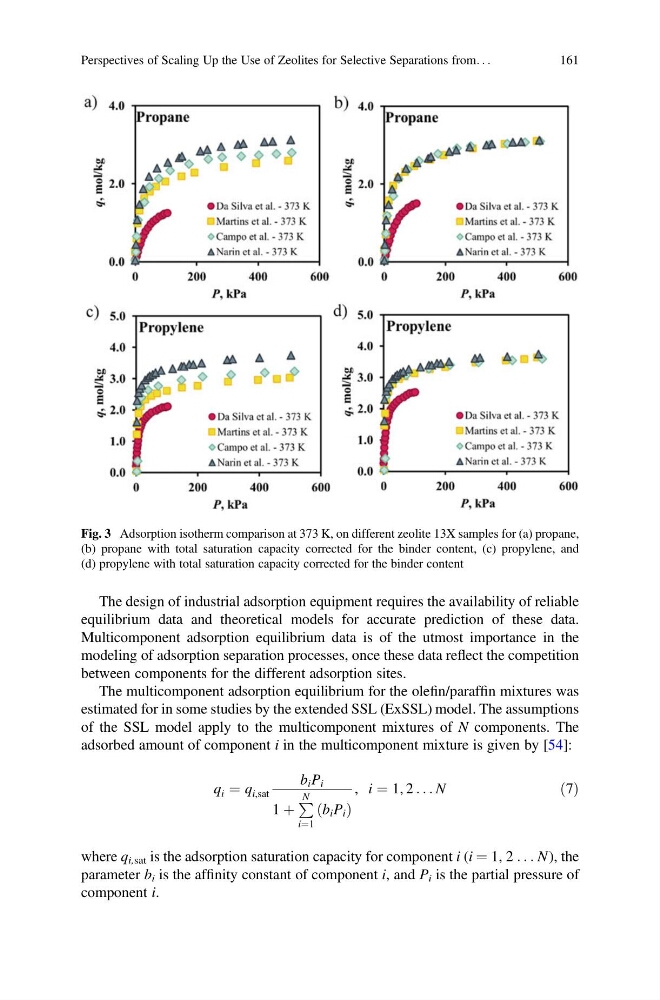
Fig. 3 Adsorption isotherm comparison at 373 K, on different zeolite 13X samples for (a) propane,
(b) propane with total saturation capacity corrected for the binder content, (c) propylene, and
(d) propylene with total saturation capacity corrected for the binder content
Perspectives of Scaling Up the Use of Zeolites for Selective Separations from. . .
161
equilibrium data and theoretical models for accurate prediction of these data.
Multicomponent adsorption equilibrium data is of the utmost importance in the
modeling of adsorption separation processes, once these data reflect the competition
between components for the different adsorption sites.
The multicomponent adsorption equilibrium for the olefin/paraffin mixtures was
estimated for in some studies by the extended SSL (ExSSL) model. The assumptions
of the SSL model apply to the multicomponent mixtures of N components. The
adsorbed amount of component i in the multicomponent mixture is given by [54]:
q i ¼ q i,sat
b i P i
1 þ
P N
i¼1
b i P i
ð
Þ
, i ¼ 1, 2 . . . N
ð7Þ
where q i,sat is the adsorption saturation capacity for component i (i ¼ 1, 2 . . . N ), the
parameter b i is the affinity constant of component i, and P i is the partial pressure of
component i.
Fig. 3 Adsorption isotherm comparison at 373 K, on different zeolite 13X samples for (a) propane,
(b) propane with total saturation capacity corrected for the binder content, (c) propylene, and
(d) propylene with total saturation capacity corrected for the binder content
Perspectives of Scaling Up the Use of Zeolites for Selective Separations from. . .
161