

[100]. The adsorption equilibrium isotherms of propane and propylene on binderless
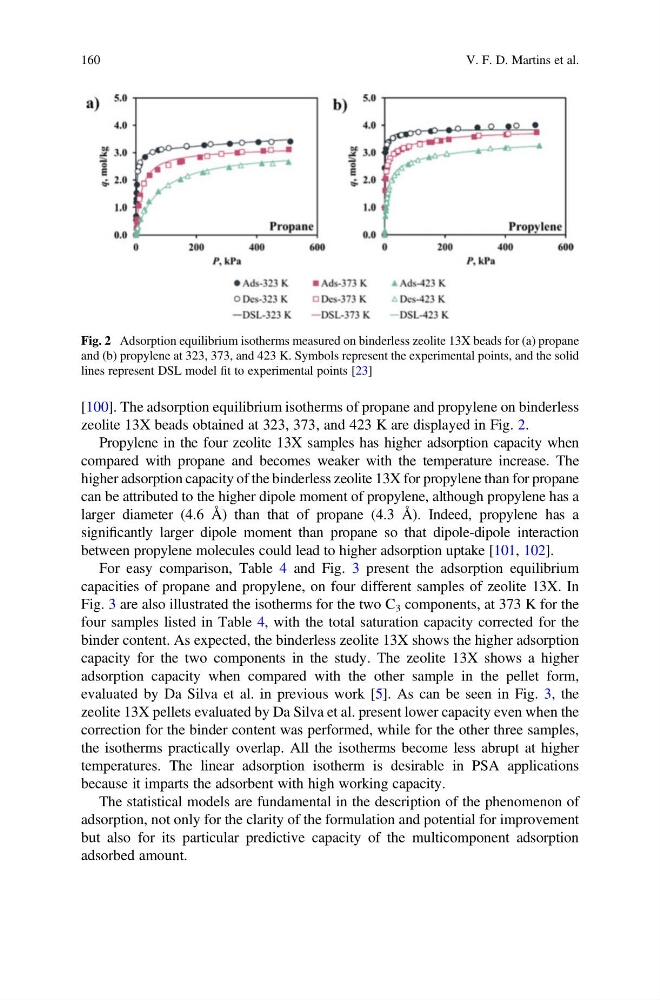
zeolite 13X beads obtained at 323, 373, and 423 K are displayed in Fig. 2.
Propylene in the four zeolite 13X samples has higher adsorption capacity when
compared with propane and becomes weaker with the temperature increase. The
higher adsorption capacity of the binderless zeolite 13X for propylene than for propane
can be attributed to the higher dipole moment of propylene, although propylene has a
larger diameter (4.6 Å) than that of propane (4.3 Å). Indeed, propylene has a
significantly larger dipole moment than propane so that dipole-dipole interaction
between propylene molecules could lead to higher adsorption uptake [101, 102].
For easy comparison, Table 4 and Fig. 3 present the adsorption equilibrium
capacities of propane and propylene, on four different samples of zeolite 13X. In
Fig. 3 are also illustrated the isotherms for the two C 3 components, at 373 K for the
four samples listed in Table 4, with the total saturation capacity corrected for the
binder content. As expected, the binderless zeolite 13X shows the higher adsorption
capacity for the two components in the study. The zeolite 13X shows a higher
adsorption capacity when compared with the other sample in the pellet form,
evaluated by Da Silva et al. in previous work [5]. As can be seen in Fig. 3, the
zeolite 13X pellets evaluated by Da Silva et al. present lower capacity even when the
correction for the binder content was performed, while for the other three samples,
the isotherms practically overlap. All the isotherms become less abrupt at higher
temperatures. The linear adsorption isotherm is desirable in PSA applications
because it imparts the adsorbent with high working capacity.
The statistical models are fundamental in the description of the phenomenon of
adsorption, not only for the clarity of the formulation and potential for improvement
but also for its particular predictive capacity of the multicomponent adsorption
adsorbed amount.
Fig. 2 Adsorption equilibrium isotherms measured on binderless zeolite 13X beads for (a) propane
and (b) propylene at 323, 373, and 423 K. Symbols represent the experimental points, and the solid
lines represent DSL model fit to experimental points [23]
160
V. F. D. Martins et al.
zeolite 13X beads obtained at 323, 373, and 423 K are displayed in Fig. 2.
Propylene in the four zeolite 13X samples has higher adsorption capacity when
compared with propane and becomes weaker with the temperature increase. The
higher adsorption capacity of the binderless zeolite 13X for propylene than for propane
can be attributed to the higher dipole moment of propylene, although propylene has a
larger diameter (4.6 Å) than that of propane (4.3 Å). Indeed, propylene has a
significantly larger dipole moment than propane so that dipole-dipole interaction
between propylene molecules could lead to higher adsorption uptake [101, 102].
For easy comparison, Table 4 and Fig. 3 present the adsorption equilibrium
capacities of propane and propylene, on four different samples of zeolite 13X. In
Fig. 3 are also illustrated the isotherms for the two C 3 components, at 373 K for the
four samples listed in Table 4, with the total saturation capacity corrected for the
binder content. As expected, the binderless zeolite 13X shows the higher adsorption
capacity for the two components in the study. The zeolite 13X shows a higher
adsorption capacity when compared with the other sample in the pellet form,
evaluated by Da Silva et al. in previous work [5]. As can be seen in Fig. 3, the
zeolite 13X pellets evaluated by Da Silva et al. present lower capacity even when the
correction for the binder content was performed, while for the other three samples,
the isotherms practically overlap. All the isotherms become less abrupt at higher
temperatures. The linear adsorption isotherm is desirable in PSA applications
because it imparts the adsorbent with high working capacity.
The statistical models are fundamental in the description of the phenomenon of
adsorption, not only for the clarity of the formulation and potential for improvement
but also for its particular predictive capacity of the multicomponent adsorption
adsorbed amount.
Fig. 2 Adsorption equilibrium isotherms measured on binderless zeolite 13X beads for (a) propane
and (b) propylene at 323, 373, and 423 K. Symbols represent the experimental points, and the solid
lines represent DSL model fit to experimental points [23]
160
V. F. D. Martins et al.