

This material was posteriorly used to separate propane/propylene mixtures by PSA
and VSA [43, 44]. Martins et al. investigated another zeolite 13X from CECA, but
with a different shaping, in the extrudate form. The authors determined gravimetrically the adsorption equilibrium isotherms for propane and propylene. The experimental adsorption equilibrium isotherms were well represented by the DSL model.
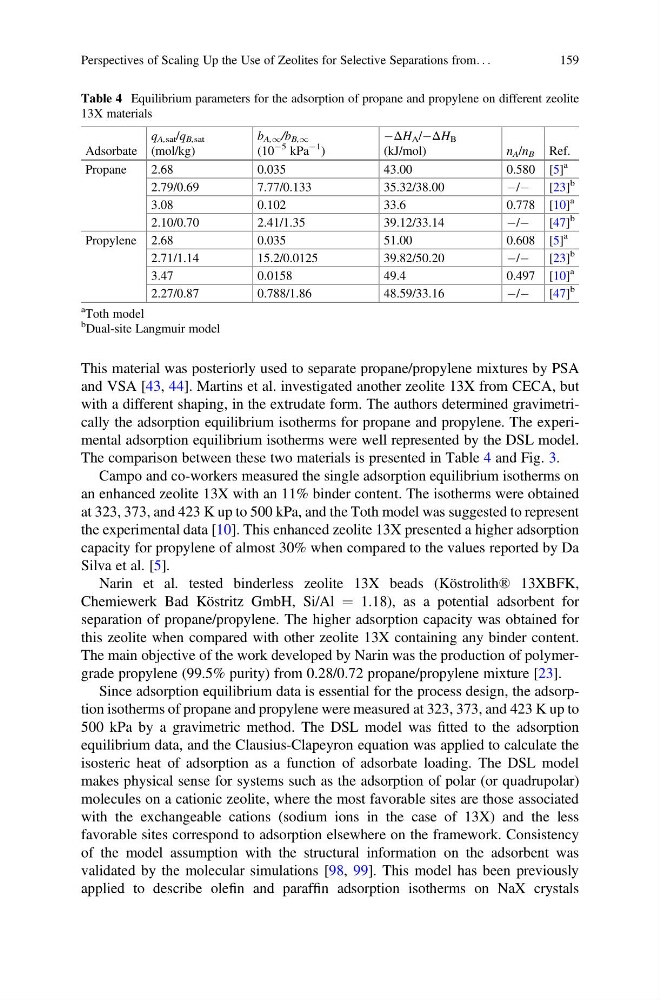
The comparison between these two materials is presented in Table 4 and Fig. 3.
Campo and co-workers measured the single adsorption equilibrium isotherms on
an enhanced zeolite 13X with an 11% binder content. The isotherms were obtained
at 323, 373, and 423 K up to 500 kPa, and the Toth model was suggested to represent
the experimental data [10]. This enhanced zeolite 13X presented a higher adsorption
capacity for propylene of almost 30% when compared to the values reported by Da
Silva et al. [5].
Narin et al. tested binderless zeolite 13X beads (Köstrolith® 13XBFK,
Chemiewerk Bad Köstritz GmbH, Si/Al ¼ 1.18), as a potential adsorbent for
separation of propane/propylene. The higher adsorption capacity was obtained for
this zeolite when compared with other zeolite 13X containing any binder content.
The main objective of the work developed by Narin was the production of polymergrade propylene (99.5% purity) from 0.28/0.72 propane/propylene mixture [23].
Since adsorption equilibrium data is essential for the process design, the adsorption isotherms of propane and propylene were measured at 323, 373, and 423 K up to
500 kPa by a gravimetric method. The DSL model was fitted to the adsorption
equilibrium data, and the Clausius-Clapeyron equation was applied to calculate the
isosteric heat of adsorption as a function of adsorbate loading. The DSL model
makes physical sense for systems such as the adsorption of polar (or quadrupolar)
molecules on a cationic zeolite, where the most favorable sites are those associated
with the exchangeable cations (sodium ions in the case of 13X) and the less
favorable sites correspond to adsorption elsewhere on the framework. Consistency
of the model assumption with the structural information on the adsorbent was
validated by the molecular simulations [98, 99]. This model has been previously
applied to describe olefin and paraffin adsorption isotherms on NaX crystals
Table 4 Equilibrium parameters for the adsorption of propane and propylene on different zeolite
13X materials
Adsorbate
q A,sat /q B,sat
(mol/kg)
b A,1 /b B,1
(10
À5 kPa
À1 )
ÀΔH A /ÀΔH B
(kJ/mol)
n A /n B Ref.
Propane
2.68
0.035
43.00
0.580 [5]
a
2.79/0.69
7.77/0.133
35.32/38.00
À/À
[23]
b
3.08
0.102
33.6
0.778 [10]
a
2.10/0.70
2.41/1.35
39.12/33.14
À/À
[47]
b
Propylene 2.68
0.035
51.00
0.608 [5]
a
2.71/1.14
15.2/0.0125
39.82/50.20
À/À
[23]
b
3.47
0.0158
49.4
0.497 [10]
a
2.27/0.87
0.788/1.86
48.59/33.16
À/À
[47]
b
a Toth model
b
Dual-site Langmuir model
Perspectives of Scaling Up the Use of Zeolites for Selective Separations from. . .
159
and VSA [43, 44]. Martins et al. investigated another zeolite 13X from CECA, but
with a different shaping, in the extrudate form. The authors determined gravimetrically the adsorption equilibrium isotherms for propane and propylene. The experimental adsorption equilibrium isotherms were well represented by the DSL model.
The comparison between these two materials is presented in Table 4 and Fig. 3.
Campo and co-workers measured the single adsorption equilibrium isotherms on
an enhanced zeolite 13X with an 11% binder content. The isotherms were obtained
at 323, 373, and 423 K up to 500 kPa, and the Toth model was suggested to represent
the experimental data [10]. This enhanced zeolite 13X presented a higher adsorption
capacity for propylene of almost 30% when compared to the values reported by Da
Silva et al. [5].
Narin et al. tested binderless zeolite 13X beads (Köstrolith® 13XBFK,
Chemiewerk Bad Köstritz GmbH, Si/Al ¼ 1.18), as a potential adsorbent for
separation of propane/propylene. The higher adsorption capacity was obtained for
this zeolite when compared with other zeolite 13X containing any binder content.
The main objective of the work developed by Narin was the production of polymergrade propylene (99.5% purity) from 0.28/0.72 propane/propylene mixture [23].
Since adsorption equilibrium data is essential for the process design, the adsorption isotherms of propane and propylene were measured at 323, 373, and 423 K up to
500 kPa by a gravimetric method. The DSL model was fitted to the adsorption
equilibrium data, and the Clausius-Clapeyron equation was applied to calculate the
isosteric heat of adsorption as a function of adsorbate loading. The DSL model
makes physical sense for systems such as the adsorption of polar (or quadrupolar)
molecules on a cationic zeolite, where the most favorable sites are those associated
with the exchangeable cations (sodium ions in the case of 13X) and the less
favorable sites correspond to adsorption elsewhere on the framework. Consistency
of the model assumption with the structural information on the adsorbent was
validated by the molecular simulations [98, 99]. This model has been previously
applied to describe olefin and paraffin adsorption isotherms on NaX crystals
Table 4 Equilibrium parameters for the adsorption of propane and propylene on different zeolite
13X materials
Adsorbate
q A,sat /q B,sat
(mol/kg)
b A,1 /b B,1
(10
À5 kPa
À1 )
ÀΔH A /ÀΔH B
(kJ/mol)
n A /n B Ref.
Propane
2.68
0.035
43.00
0.580 [5]
a
2.79/0.69
7.77/0.133
35.32/38.00
À/À
[23]
b
3.08
0.102
33.6
0.778 [10]
a
2.10/0.70
2.41/1.35
39.12/33.14
À/À
[47]
b
Propylene 2.68
0.035
51.00
0.608 [5]
a
2.71/1.14
15.2/0.0125
39.82/50.20
À/À
[23]
b
3.47
0.0158
49.4
0.497 [10]
a
2.27/0.87
0.788/1.86
48.59/33.16
À/À
[47]
b
a Toth model
b
Dual-site Langmuir model
Perspectives of Scaling Up the Use of Zeolites for Selective Separations from. . .
159