

500 kPa and 323 K, than the zeolite 13 X used by Cavenati et al. For methane, it can
be seen that the adsorbed amounts obtained for the three samples are quite similar;
however, both enhanced materials present slightly higher adsorption capacity, as can
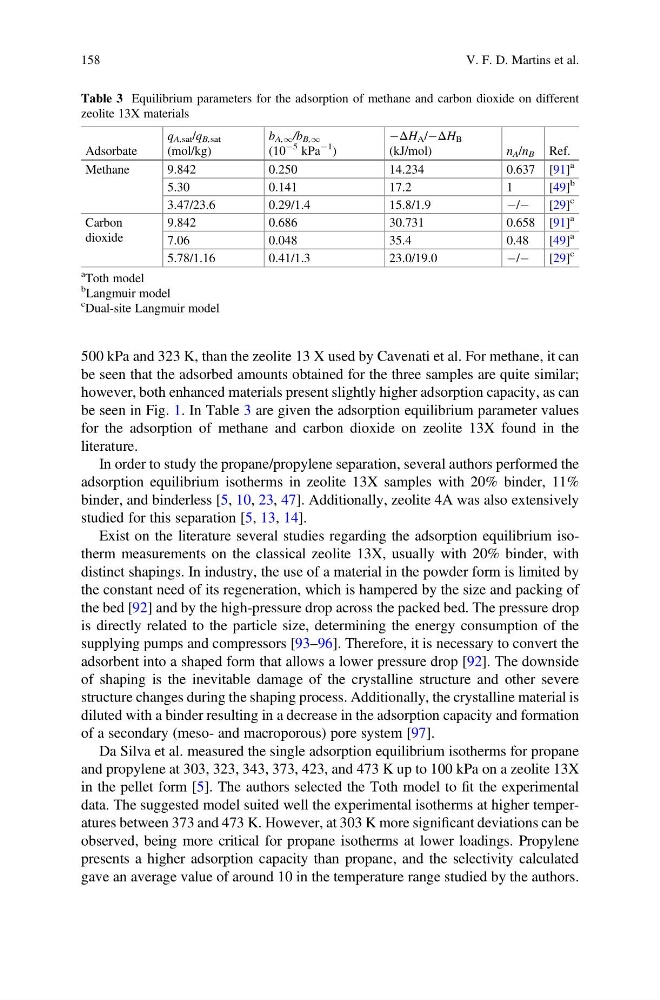
be seen in Fig. 1. In Table 3 are given the adsorption equilibrium parameter values
for the adsorption of methane and carbon dioxide on zeolite 13X found in the
literature.
In order to study the propane/propylene separation, several authors performed the
adsorption equilibrium isotherms in zeolite 13X samples with 20% binder, 11%
binder, and binderless [5, 10, 23, 47]. Additionally, zeolite 4A was also extensively
studied for this separation [5, 13, 14].
Exist on the literature several studies regarding the adsorption equilibrium isotherm measurements on the classical zeolite 13X, usually with 20% binder, with
distinct shapings. In industry, the use of a material in the powder form is limited by
the constant need of its regeneration, which is hampered by the size and packing of
the bed [92] and by the high-pressure drop across the packed bed. The pressure drop
is directly related to the particle size, determining the energy consumption of the
supplying pumps and compressors [93–96]. Therefore, it is necessary to convert the
adsorbent into a shaped form that allows a lower pressure drop [92]. The downside
of shaping is the inevitable damage of the crystalline structure and other severe
structure changes during the shaping process. Additionally, the crystalline material is
diluted with a binder resulting in a decrease in the adsorption capacity and formation
of a secondary (meso- and macroporous) pore system [97].
Da Silva et al. measured the single adsorption equilibrium isotherms for propane
and propylene at 303, 323, 343, 373, 423, and 473 K up to 100 kPa on a zeolite 13X
in the pellet form [5]. The authors selected the Toth model to fit the experimental
data. The suggested model suited well the experimental isotherms at higher temperatures between 373 and 473 K. However, at 303 K more significant deviations can be
observed, being more critical for propane isotherms at lower loadings. Propylene
presents a higher adsorption capacity than propane, and the selectivity calculated
gave an average value of around 10 in the temperature range studied by the authors.
Table 3 Equilibrium parameters for the adsorption of methane and carbon dioxide on different
zeolite 13X materials
Adsorbate
q A,sat /q B,sat
(mol/kg)
b A,1 /b B,1
(10
À5 kPa
À1
)
ÀΔH A /ÀΔH B
(kJ/mol)
n A /n B Ref.
Methane
9.842
0.250
14.234
0.637 [91]
a
5.30
0.141
17.2
1
[49]
b
3.47/23.6
0.29/1.4
15.8/1.9
À/À
[29]
c
Carbon
dioxide
9.842
0.686
30.731
0.658 [91]
a
7.06
0.048
35.4
0.48
[49]
a
5.78/1.16
0.41/1.3
23.0/19.0
À/À
[29]
c
a Toth model
b
Langmuir model
c Dual-site Langmuir model
158
V. F. D. Martins et al.
be seen that the adsorbed amounts obtained for the three samples are quite similar;
however, both enhanced materials present slightly higher adsorption capacity, as can
be seen in Fig. 1. In Table 3 are given the adsorption equilibrium parameter values
for the adsorption of methane and carbon dioxide on zeolite 13X found in the
literature.
In order to study the propane/propylene separation, several authors performed the
adsorption equilibrium isotherms in zeolite 13X samples with 20% binder, 11%
binder, and binderless [5, 10, 23, 47]. Additionally, zeolite 4A was also extensively
studied for this separation [5, 13, 14].
Exist on the literature several studies regarding the adsorption equilibrium isotherm measurements on the classical zeolite 13X, usually with 20% binder, with
distinct shapings. In industry, the use of a material in the powder form is limited by
the constant need of its regeneration, which is hampered by the size and packing of
the bed [92] and by the high-pressure drop across the packed bed. The pressure drop
is directly related to the particle size, determining the energy consumption of the
supplying pumps and compressors [93–96]. Therefore, it is necessary to convert the
adsorbent into a shaped form that allows a lower pressure drop [92]. The downside
of shaping is the inevitable damage of the crystalline structure and other severe
structure changes during the shaping process. Additionally, the crystalline material is
diluted with a binder resulting in a decrease in the adsorption capacity and formation
of a secondary (meso- and macroporous) pore system [97].
Da Silva et al. measured the single adsorption equilibrium isotherms for propane
and propylene at 303, 323, 343, 373, 423, and 473 K up to 100 kPa on a zeolite 13X
in the pellet form [5]. The authors selected the Toth model to fit the experimental
data. The suggested model suited well the experimental isotherms at higher temperatures between 373 and 473 K. However, at 303 K more significant deviations can be
observed, being more critical for propane isotherms at lower loadings. Propylene
presents a higher adsorption capacity than propane, and the selectivity calculated
gave an average value of around 10 in the temperature range studied by the authors.
Table 3 Equilibrium parameters for the adsorption of methane and carbon dioxide on different
zeolite 13X materials
Adsorbate
q A,sat /q B,sat
(mol/kg)
b A,1 /b B,1
(10
À5 kPa
À1
)
ÀΔH A /ÀΔH B
(kJ/mol)
n A /n B Ref.
Methane
9.842
0.250
14.234
0.637 [91]
a
5.30
0.141
17.2
1
[49]
b
3.47/23.6
0.29/1.4
15.8/1.9
À/À
[29]
c
Carbon
dioxide
9.842
0.686
30.731
0.658 [91]
a
7.06
0.048
35.4
0.48
[49]
a
5.78/1.16
0.41/1.3
23.0/19.0
À/À
[29]
c
a Toth model
b
Langmuir model
c Dual-site Langmuir model
158
V. F. D. Martins et al.