

Campo et al. measured the adsorption equilibrium isotherms on an improved
zeolite 13X with 11% binder, provided by CECA, in the spheres form by a
gravimetric method. Single-component adsorption equilibrium isotherms were
determined experimentally at 308, 323, and 348 K, up to 500 kPa for methane and
carbon dioxide over the zeolite 13X with 11% binder [49]. The experimental data
were fitted by the SSL model for CH 4 , as this model described well the experimental
data. The authors fitted the experimental data for CO 2 using the Toth model due to
the higher CO 2 affinity on this zeolite and to describe adequately the equilibrium
data taking into consideration the adsorbent surface heterogeneity [49].
Cavenati et al. obtained the adsorption equilibrium data over a classical zeolite
13X pellets, containing 20% binder for CO 2 and CH 4 at 298, 308, and 323 K up to
5,000 kPa [48, 91]. The equilibrium data were measured for pure gases also by a
gravimetric method using a magnetic suspension microbalance (Rubotherm, Germany) operated as a closed system. The authors used two different models to fit the
experimental results, and they conclude that the Toth equation can predict better this
system when compared with the fitting provided with the DSL model. However,
only small differences between the two models were observed for both components.
The DSL model is a straightforward model, easy to implement, and describes several
systems under study quite well, being therefore so attractive for the use in mathematical modeling [91].
Moreira and co-workers selected a binderless zeolite 13X beads to perform
measurements over a wide range of temperatures and pressure, thus obtaining the
adsorption equilibrium data for methane and carbon dioxide at 180, 220, 269, 323,
373, and 473 K, up to 8,000 kPa. The experimental data were regressed using the
DSL model, and the experimental data were accurately described by this model [29].
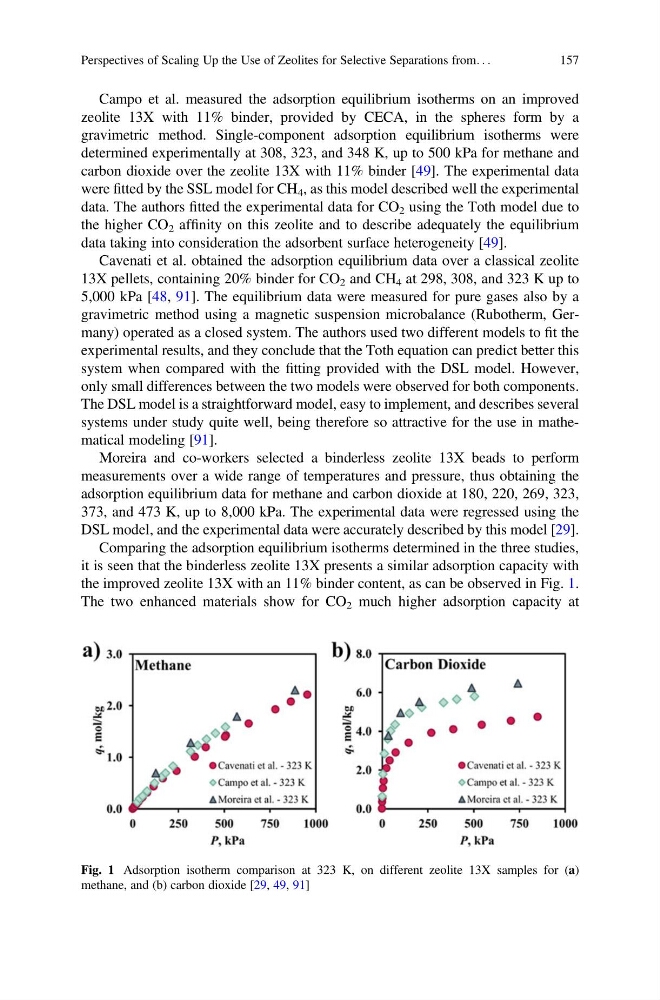
Comparing the adsorption equilibrium isotherms determined in the three studies,
it is seen that the binderless zeolite 13X presents a similar adsorption capacity with
the improved zeolite 13X with an 11% binder content, as can be observed in Fig. 1.
The two enhanced materials show for CO 2 much higher adsorption capacity at
Fig. 1 Adsorption isotherm comparison at 323 K, on different zeolite 13X samples for (a)
methane, and (b) carbon dioxide [29, 49, 91]
Perspectives of Scaling Up the Use of Zeolites for Selective Separations from. . .
157
zeolite 13X with 11% binder, provided by CECA, in the spheres form by a
gravimetric method. Single-component adsorption equilibrium isotherms were
determined experimentally at 308, 323, and 348 K, up to 500 kPa for methane and
carbon dioxide over the zeolite 13X with 11% binder [49]. The experimental data
were fitted by the SSL model for CH 4 , as this model described well the experimental
data. The authors fitted the experimental data for CO 2 using the Toth model due to
the higher CO 2 affinity on this zeolite and to describe adequately the equilibrium
data taking into consideration the adsorbent surface heterogeneity [49].
Cavenati et al. obtained the adsorption equilibrium data over a classical zeolite
13X pellets, containing 20% binder for CO 2 and CH 4 at 298, 308, and 323 K up to
5,000 kPa [48, 91]. The equilibrium data were measured for pure gases also by a
gravimetric method using a magnetic suspension microbalance (Rubotherm, Germany) operated as a closed system. The authors used two different models to fit the
experimental results, and they conclude that the Toth equation can predict better this
system when compared with the fitting provided with the DSL model. However,
only small differences between the two models were observed for both components.
The DSL model is a straightforward model, easy to implement, and describes several
systems under study quite well, being therefore so attractive for the use in mathematical modeling [91].
Moreira and co-workers selected a binderless zeolite 13X beads to perform
measurements over a wide range of temperatures and pressure, thus obtaining the
adsorption equilibrium data for methane and carbon dioxide at 180, 220, 269, 323,
373, and 473 K, up to 8,000 kPa. The experimental data were regressed using the
DSL model, and the experimental data were accurately described by this model [29].
Comparing the adsorption equilibrium isotherms determined in the three studies,
it is seen that the binderless zeolite 13X presents a similar adsorption capacity with
the improved zeolite 13X with an 11% binder content, as can be observed in Fig. 1.
The two enhanced materials show for CO 2 much higher adsorption capacity at
Fig. 1 Adsorption isotherm comparison at 323 K, on different zeolite 13X samples for (a)
methane, and (b) carbon dioxide [29, 49, 91]
Perspectives of Scaling Up the Use of Zeolites for Selective Separations from. . .
157