

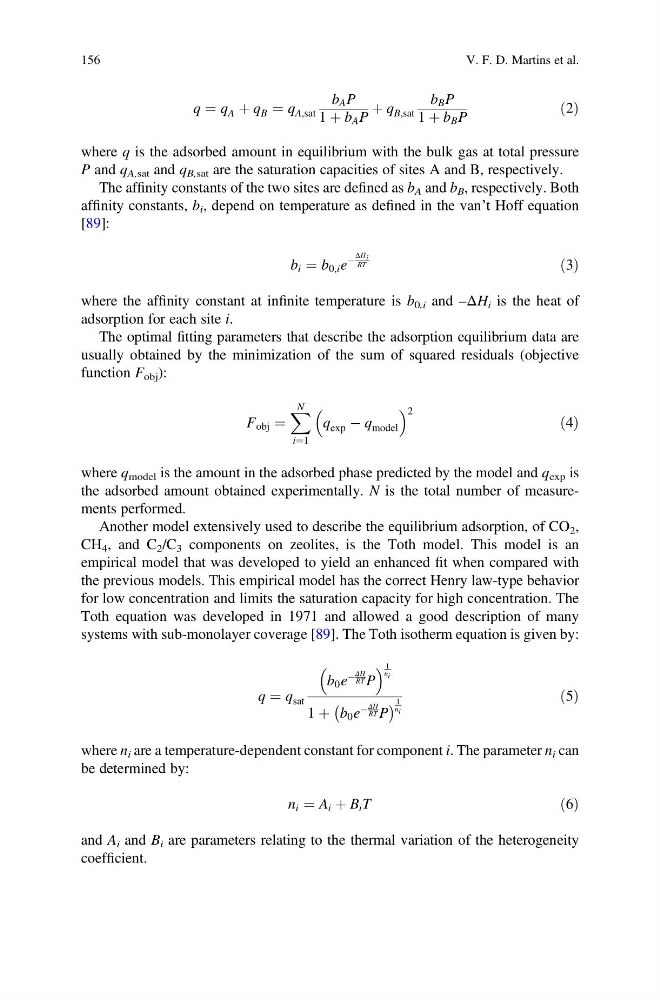
q ¼ q A þ q B ¼ q A,sat
b A P
1 þ b A P
þ q B,sat
b B P
1 þ b B P
ð2Þ
where q is the adsorbed amount in equilibrium with the bulk gas at total pressure
P and q A,sat and q B,sat are the saturation capacities of sites A and B, respectively.
The affinity constants of the two sites are defined as b A and b B , respectively. Both
affinity constants, b i , depend on temperature as defined in the van’t Hoff equation
[89]:
b i ¼ b 0,i e
À
ΔH i
RT
ð3Þ
where the affinity constant at infinite temperature is b 0,i and –ΔH i is the heat of
adsorption for each site i.
The optimal fitting parameters that describe the adsorption equilibrium data are
usually obtained by the minimization of the sum of squared residuals (objective
function F obj ):
F obj ¼
X N
i¼1
q exp À q model
2
ð4Þ
where q model is the amount in the adsorbed phase predicted by the model and q exp is
the adsorbed amount obtained experimentally. N is the total number of measurements performed.
Another model extensively used to describe the equilibrium adsorption, of CO 2 ,
CH 4 , and C 2 /C 3 components on zeolites, is the Toth model. This model is an
empirical model that was developed to yield an enhanced fit when compared with
the previous models. This empirical model has the correct Henry law-type behavior
for low concentration and limits the saturation capacity for high concentration. The
Toth equation was developed in 1971 and allowed a good description of many
systems with sub-monolayer coverage [89]. The Toth isotherm equation is given by:
q ¼ q sat
b 0 e
À
ΔH
RT P
1
n i
1 þ b 0 e À
ΔH
RT P
À
Á 1
n i
ð5Þ
where n i are a temperature-dependent constant for component i. The parameter n i can
be determined by:
n i ¼ A i þ B i T
ð6Þ
and A i and B i are parameters relating to the thermal variation of the heterogeneity
coefficient.
156
V. F. D. Martins et al.
b A P
1 þ b A P
þ q B,sat
b B P
1 þ b B P
ð2Þ
where q is the adsorbed amount in equilibrium with the bulk gas at total pressure
P and q A,sat and q B,sat are the saturation capacities of sites A and B, respectively.
The affinity constants of the two sites are defined as b A and b B , respectively. Both
affinity constants, b i , depend on temperature as defined in the van’t Hoff equation
[89]:
b i ¼ b 0,i e
À
ΔH i
RT
ð3Þ
where the affinity constant at infinite temperature is b 0,i and –ΔH i is the heat of
adsorption for each site i.
The optimal fitting parameters that describe the adsorption equilibrium data are
usually obtained by the minimization of the sum of squared residuals (objective
function F obj ):
F obj ¼
X N
i¼1
q exp À q model
2
ð4Þ
where q model is the amount in the adsorbed phase predicted by the model and q exp is
the adsorbed amount obtained experimentally. N is the total number of measurements performed.
Another model extensively used to describe the equilibrium adsorption, of CO 2 ,
CH 4 , and C 2 /C 3 components on zeolites, is the Toth model. This model is an
empirical model that was developed to yield an enhanced fit when compared with
the previous models. This empirical model has the correct Henry law-type behavior
for low concentration and limits the saturation capacity for high concentration. The
Toth equation was developed in 1971 and allowed a good description of many
systems with sub-monolayer coverage [89]. The Toth isotherm equation is given by:
q ¼ q sat
b 0 e
À
ΔH
RT P
1
n i
1 þ b 0 e À
ΔH
RT P
À
Á 1
n i
ð5Þ
where n i are a temperature-dependent constant for component i. The parameter n i can
be determined by:
n i ¼ A i þ B i T
ð6Þ
and A i and B i are parameters relating to the thermal variation of the heterogeneity
coefficient.
156
V. F. D. Martins et al.