

isotherms for the pure components and then the selection of a model that can best fit
the data.
When an adsorbate is contacted with the porous adsorbent, the molecules tend to
flow from the gaseous phase to the pore surface of the adsorbent until the pressure
(P) remains constant. At this stage, the system reached the equilibrium, and the
adsorption capacity of the adsorbent (q) is determined for that same pressure. Graphs
involving the q versus P can be obtained from experimental data. Then the relation
q versus P can be expressed in a mathematical form.
Several thermodynamic models have arisen to describe the adsorbent-adsorbate
equilibrium. The simplest case is Henry’s law, whose equation describes linear
behavior and should apply to any isotherm at low pressures (when the pressure
tends to zero) [89].
The choice of the most suitable isotherm model to represent the adsorption
equilibrium appears as a prerequisite for the adsorption process modeling since it
affects the multicomponent behavior prediction of the overall process.
From a wide range of existing models able to describe the equilibrium data, the
single-site Langmuir and dual-site Langmuir models are often chosen to represent
the behavior of the single-component adsorption equilibrium on the several materials. These models provide a simplified quantitative description of the surface
framework and can be easily implemented for non-isothermal system modeling.
These choices, in some cases, are supported on previous works for similar systems
and whose modeling was successful considering these models.
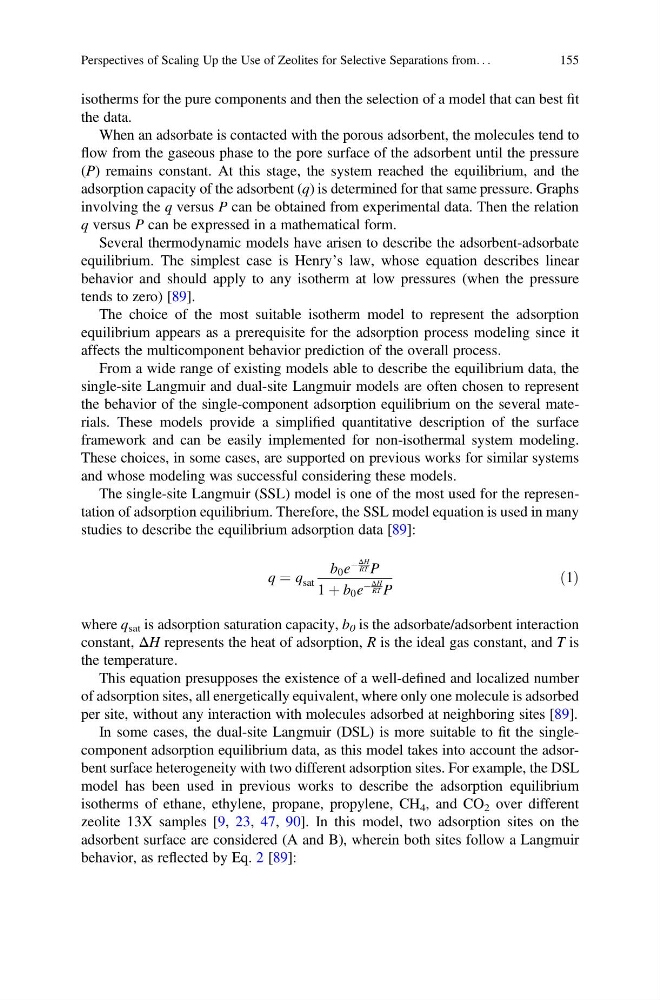
The single-site Langmuir (SSL) model is one of the most used for the representation of adsorption equilibrium. Therefore, the SSL model equation is used in many
studies to describe the equilibrium adsorption data [89]:
q ¼ q sat
b 0 e
À
ΔH
RT P
1 þ b 0 e À
ΔH
RT P
ð1Þ
where q sat is adsorption saturation capacity, b 0 is the adsorbate/adsorbent interaction
constant, ΔH represents the heat of adsorption, R is the ideal gas constant, and T is
the temperature.
This equation presupposes the existence of a well-defined and localized number
of adsorption sites, all energetically equivalent, where only one molecule is adsorbed
per site, without any interaction with molecules adsorbed at neighboring sites [89].
In some cases, the dual-site Langmuir (DSL) is more suitable to fit the singlecomponent adsorption equilibrium data, as this model takes into account the adsorbent surface heterogeneity with two different adsorption sites. For example, the DSL
model has been used in previous works to describe the adsorption equilibrium
isotherms of ethane, ethylene, propane, propylene, CH 4 , and CO 2 over different
zeolite 13X samples [9, 23, 47, 90]. In this model, two adsorption sites on the
adsorbent surface are considered (A and B), wherein both sites follow a Langmuir
behavior, as reflected by Eq. 2 [89]:
Perspectives of Scaling Up the Use of Zeolites for Selective Separations from. . .
155
the data.
When an adsorbate is contacted with the porous adsorbent, the molecules tend to
flow from the gaseous phase to the pore surface of the adsorbent until the pressure
(P) remains constant. At this stage, the system reached the equilibrium, and the
adsorption capacity of the adsorbent (q) is determined for that same pressure. Graphs
involving the q versus P can be obtained from experimental data. Then the relation
q versus P can be expressed in a mathematical form.
Several thermodynamic models have arisen to describe the adsorbent-adsorbate
equilibrium. The simplest case is Henry’s law, whose equation describes linear
behavior and should apply to any isotherm at low pressures (when the pressure
tends to zero) [89].
The choice of the most suitable isotherm model to represent the adsorption
equilibrium appears as a prerequisite for the adsorption process modeling since it
affects the multicomponent behavior prediction of the overall process.
From a wide range of existing models able to describe the equilibrium data, the
single-site Langmuir and dual-site Langmuir models are often chosen to represent
the behavior of the single-component adsorption equilibrium on the several materials. These models provide a simplified quantitative description of the surface
framework and can be easily implemented for non-isothermal system modeling.
These choices, in some cases, are supported on previous works for similar systems
and whose modeling was successful considering these models.
The single-site Langmuir (SSL) model is one of the most used for the representation of adsorption equilibrium. Therefore, the SSL model equation is used in many
studies to describe the equilibrium adsorption data [89]:
q ¼ q sat
b 0 e
À
ΔH
RT P
1 þ b 0 e À
ΔH
RT P
ð1Þ
where q sat is adsorption saturation capacity, b 0 is the adsorbate/adsorbent interaction
constant, ΔH represents the heat of adsorption, R is the ideal gas constant, and T is
the temperature.
This equation presupposes the existence of a well-defined and localized number
of adsorption sites, all energetically equivalent, where only one molecule is adsorbed
per site, without any interaction with molecules adsorbed at neighboring sites [89].
In some cases, the dual-site Langmuir (DSL) is more suitable to fit the singlecomponent adsorption equilibrium data, as this model takes into account the adsorbent surface heterogeneity with two different adsorption sites. For example, the DSL
model has been used in previous works to describe the adsorption equilibrium
isotherms of ethane, ethylene, propane, propylene, CH 4 , and CO 2 over different
zeolite 13X samples [9, 23, 47, 90]. In this model, two adsorption sites on the
adsorbent surface are considered (A and B), wherein both sites follow a Langmuir
behavior, as reflected by Eq. 2 [89]:
Perspectives of Scaling Up the Use of Zeolites for Selective Separations from. . .
155