

136
M. S. Miswan et al.
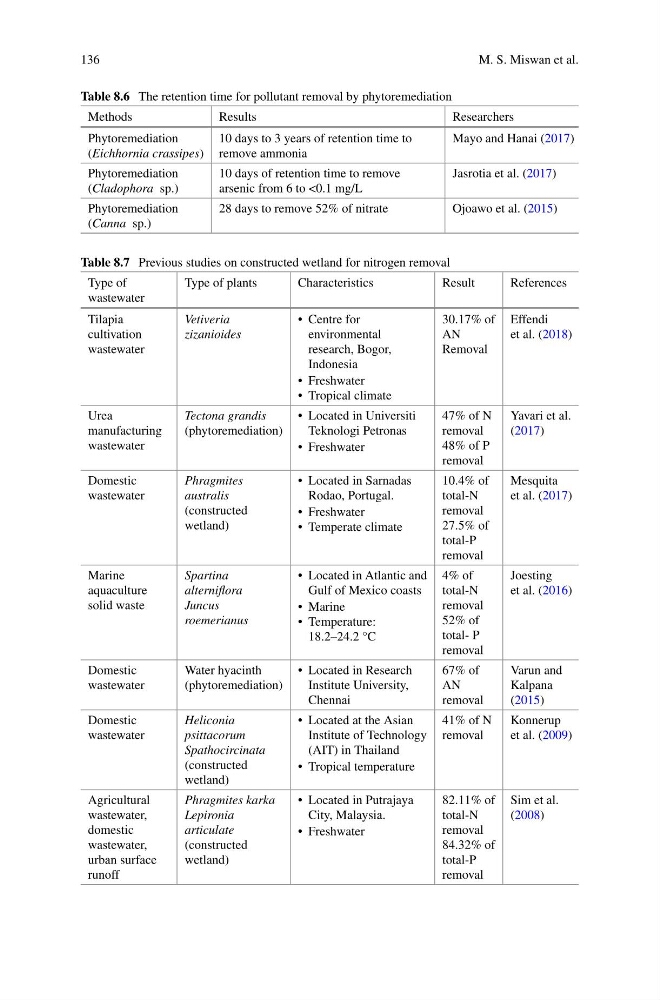
Table 8.6 The retention time for pollutant removal by phytoremediation
Methods
Results
Researchers
Phytoremediation
(Eichhornia crassipes)
10 days to 3 years of retention time to
remove ammonia
Mayo and Hanai (2017)
Phytoremediation
(Cladophora sp.)
10 days of retention time to remove
arsenic from 6 to <0.1 mg/L
Jasrotia et al. (2017)
Phytoremediation
(Canna sp.)
28 days to remove 52% of nitrate
Ojoawo et al. (2015)
Table 8.7 Previous studies on constructed wetland for nitrogen removal
Type of
wastewater
Type of plants
Characteristics
Result
References
Tilapia
cultivation
wastewater
Vetiveria
zizanioides
• Centre for
environmental
research, Bogor,
Indonesia
• Freshwater
• Tropical climate
30.17% of
AN
Removal
Effendi
et al. (2018)
Urea
manufacturing
wastewater
Tectona grandis
(phytoremediation)
• Located in Universiti
Teknologi Petronas
• Freshwater
47% of N
removal
48% of P
removal
Yavari et al.
(2017)
Domestic
wastewater
Phragmites
australis
(constructed
wetland)
• Located in Sarnadas
Rodao, Portugal.
• Freshwater
• Temperate climate
10.4% of
total-N
removal
27.5% of
total-P
removal
Mesquita
et al. (2017)
Marine
aquaculture
solid waste
Spartina
alterniflora
Juncus
roemerianus
• Located in Atlantic and
Gulf of Mexico coasts
• Marine
• Temperature:
18.2–24.2 °C
4% of
total-N
removal
52% of
total- P
removal
Joesting
et al. (2016)
Domestic
wastewater
Water hyacinth
(phytoremediation)
• Located in Research
Institute University,
Chennai
67% of
AN
removal
Varun and
Kalpana
(2015)
Domestic
wastewater
Heliconia
psittacorum
Spathocircinata
(constructed
wetland)
• Located at the Asian
Institute of Technology
(AIT) in Thailand
• Tropical temperature
41% of N
removal
Konnerup
et al. (2009)
Agricultural
wastewater,
domestic
wastewater,
urban surface
runoff
Phragmites karka
Lepironia
articulate
(constructed
wetland)
• Located in Putrajaya
City, Malaysia.
• Freshwater
82.11% of
total-N
removal
84.32% of
total-P
removal
Sim et al.
(2008)
M. S. Miswan et al.
Table 8.6 The retention time for pollutant removal by phytoremediation
Methods
Results
Researchers
Phytoremediation
(Eichhornia crassipes)
10 days to 3 years of retention time to
remove ammonia
Mayo and Hanai (2017)
Phytoremediation
(Cladophora sp.)
10 days of retention time to remove
arsenic from 6 to <0.1 mg/L
Jasrotia et al. (2017)
Phytoremediation
(Canna sp.)
28 days to remove 52% of nitrate
Ojoawo et al. (2015)
Table 8.7 Previous studies on constructed wetland for nitrogen removal
Type of
wastewater
Type of plants
Characteristics
Result
References
Tilapia
cultivation
wastewater
Vetiveria
zizanioides
• Centre for
environmental
research, Bogor,
Indonesia
• Freshwater
• Tropical climate
30.17% of
AN
Removal
Effendi
et al. (2018)
Urea
manufacturing
wastewater
Tectona grandis
(phytoremediation)
• Located in Universiti
Teknologi Petronas
• Freshwater
47% of N
removal
48% of P
removal
Yavari et al.
(2017)
Domestic
wastewater
Phragmites
australis
(constructed
wetland)
• Located in Sarnadas
Rodao, Portugal.
• Freshwater
• Temperate climate
10.4% of
total-N
removal
27.5% of
total-P
removal
Mesquita
et al. (2017)
Marine
aquaculture
solid waste
Spartina
alterniflora
Juncus
roemerianus
• Located in Atlantic and
Gulf of Mexico coasts
• Marine
• Temperature:
18.2–24.2 °C
4% of
total-N
removal
52% of
total- P
removal
Joesting
et al. (2016)
Domestic
wastewater
Water hyacinth
(phytoremediation)
• Located in Research
Institute University,
Chennai
67% of
AN
removal
Varun and
Kalpana
(2015)
Domestic
wastewater
Heliconia
psittacorum
Spathocircinata
(constructed
wetland)
• Located at the Asian
Institute of Technology
(AIT) in Thailand
• Tropical temperature
41% of N
removal
Konnerup
et al. (2009)
Agricultural
wastewater,
domestic
wastewater,
urban surface
runoff
Phragmites karka
Lepironia
articulate
(constructed
wetland)
• Located in Putrajaya
City, Malaysia.
• Freshwater
82.11% of
total-N
removal
84.32% of
total-P
removal
Sim et al.
(2008)