

8 Biofilter Aquaponic System for Nutrients …
135
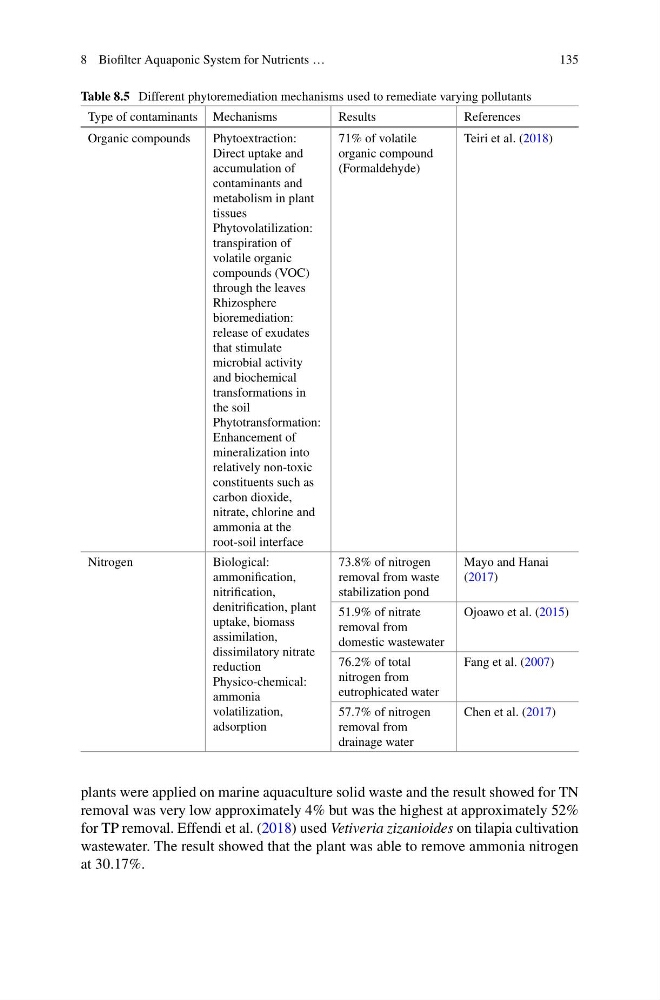
Table 8.5 Different phytoremediation mechanisms used to remediate varying pollutants
Type of contaminants Mechanisms
Results
References
Organic compounds
Phytoextraction:
Direct uptake and
accumulation of
contaminants and
metabolism in plant
tissues
Phytovolatilization:
transpiration of
volatile organic
compounds (VOC)
through the leaves
Rhizosphere
bioremediation:
release of exudates
that stimulate
microbial activity
and biochemical
transformations in
the soil
Phytotransformation:
Enhancement of
mineralization into
relatively non-toxic
constituents such as
carbon dioxide,
nitrate, chlorine and
ammonia at the
root-soil interface
71% of volatile
organic compound
(Formaldehyde)
Teiri et al. (2018)
Nitrogen
Biological:
ammonification,
nitrification,
denitrification, plant
uptake, biomass
assimilation,
dissimilatory nitrate
reduction
Physico-chemical:
ammonia
volatilization,
adsorption
73.8% of nitrogen
removal from waste
stabilization pond
Mayo and Hanai
(2017)
51.9% of nitrate
removal from
domestic wastewater
Ojoawo et al. (2015)
76.2% of total
nitrogen from
eutrophicated water
Fang et al. (2007)
57.7% of nitrogen
removal from
drainage water
Chen et al. (2017)
plants were applied on marine aquaculture solid waste and the result showed for TN
removal was very low approximately 4% but was the highest at approximately 52%
for TP removal. Effendi et al. (2018) used Vetiveria zizanioides on tilapia cultivation
wastewater. The result showed that the plant was able to remove ammonia nitrogen
at 30.17%.
135
Table 8.5 Different phytoremediation mechanisms used to remediate varying pollutants
Type of contaminants Mechanisms
Results
References
Organic compounds
Phytoextraction:
Direct uptake and
accumulation of
contaminants and
metabolism in plant
tissues
Phytovolatilization:
transpiration of
volatile organic
compounds (VOC)
through the leaves
Rhizosphere
bioremediation:
release of exudates
that stimulate
microbial activity
and biochemical
transformations in
the soil
Phytotransformation:
Enhancement of
mineralization into
relatively non-toxic
constituents such as
carbon dioxide,
nitrate, chlorine and
ammonia at the
root-soil interface
71% of volatile
organic compound
(Formaldehyde)
Teiri et al. (2018)
Nitrogen
Biological:
ammonification,
nitrification,
denitrification, plant
uptake, biomass
assimilation,
dissimilatory nitrate
reduction
Physico-chemical:
ammonia
volatilization,
adsorption
73.8% of nitrogen
removal from waste
stabilization pond
Mayo and Hanai
(2017)
51.9% of nitrate
removal from
domestic wastewater
Ojoawo et al. (2015)
76.2% of total
nitrogen from
eutrophicated water
Fang et al. (2007)
57.7% of nitrogen
removal from
drainage water
Chen et al. (2017)
plants were applied on marine aquaculture solid waste and the result showed for TN
removal was very low approximately 4% but was the highest at approximately 52%
for TP removal. Effendi et al. (2018) used Vetiveria zizanioides on tilapia cultivation
wastewater. The result showed that the plant was able to remove ammonia nitrogen
at 30.17%.