

8 Biofilter Aquaponic System for Nutrients …
125
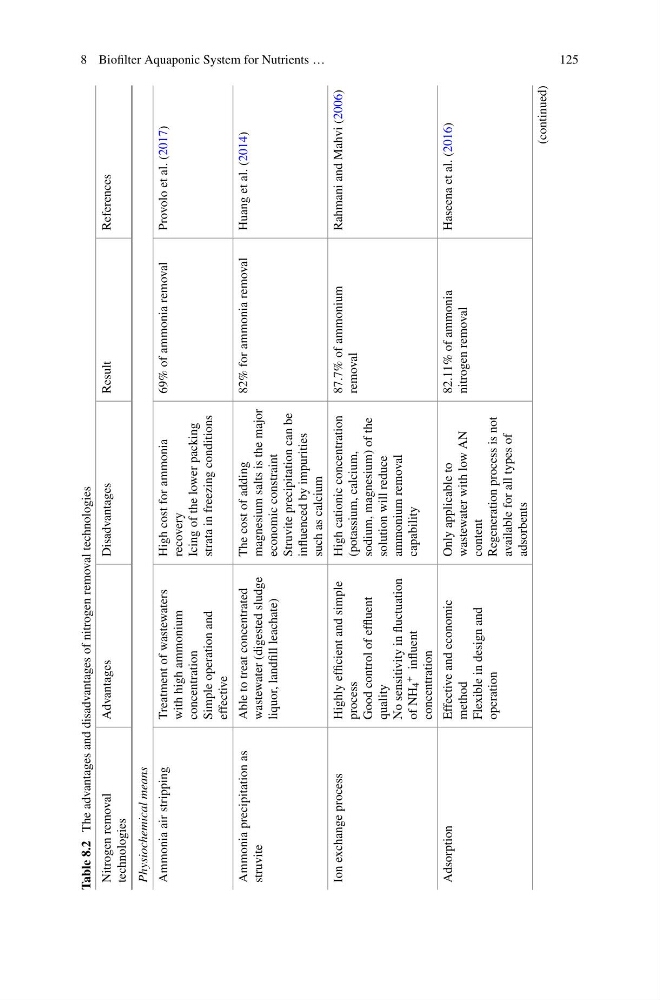
Table 8.2
The advantages and disadvantages of nitrogen removal technologies
Nitrogen removal
technologies
Advantages
Disadvantages
Result
References
Physiochemical means
Ammonia air stripping
Treatment of wastewaters
with high ammonium
concentration
Simple operation and
effective
High cost for ammonia
recovery
Icing of the lower packing
strata in freezing conditions
69% of ammonia removal
Provolo et al. (2017)
Ammonia precipitation as
struvite
Able to treat concentrated
wastewater (digested sludge
liquor, landfill leachate)
The cost of adding
magnesium salts is the major
economic constraint
Struvite precipitation can be
influenced by impurities
such as calcium
82% for ammonia removal
Huang et al. (2014)
Ion exchange process
Highly efficient and simple
process
Good control of effluent
quality
No sensitivity in fluctuation
of NH
4
+
influent
concentration
High cationic concentration
(potassium, calcium,
sodium, magnesium) of the
solution will reduce
ammonium removal
capability
87.7% of ammonium
removal
Rahmani and Mahvi (2006)
Adsorption
Effective and economic
method
Flexible in design and
operation
Only applicable to
wastewater with low AN
content
Regeneration process is not
available for all types of
adsorbents
82.11% of ammonia
nitrogen removal
Haseena et al. (2016)
(continued)
125
Table 8.2
The advantages and disadvantages of nitrogen removal technologies
Nitrogen removal
technologies
Advantages
Disadvantages
Result
References
Physiochemical means
Ammonia air stripping
Treatment of wastewaters
with high ammonium
concentration
Simple operation and
effective
High cost for ammonia
recovery
Icing of the lower packing
strata in freezing conditions
69% of ammonia removal
Provolo et al. (2017)
Ammonia precipitation as
struvite
Able to treat concentrated
wastewater (digested sludge
liquor, landfill leachate)
The cost of adding
magnesium salts is the major
economic constraint
Struvite precipitation can be
influenced by impurities
such as calcium
82% for ammonia removal
Huang et al. (2014)
Ion exchange process
Highly efficient and simple
process
Good control of effluent
quality
No sensitivity in fluctuation
of NH
4
+
influent
concentration
High cationic concentration
(potassium, calcium,
sodium, magnesium) of the
solution will reduce
ammonium removal
capability
87.7% of ammonium
removal
Rahmani and Mahvi (2006)
Adsorption
Effective and economic
method
Flexible in design and
operation
Only applicable to
wastewater with low AN
content
Regeneration process is not
available for all types of
adsorbents
82.11% of ammonia
nitrogen removal
Haseena et al. (2016)
(continued)