

124
M. S. Miswan et al.
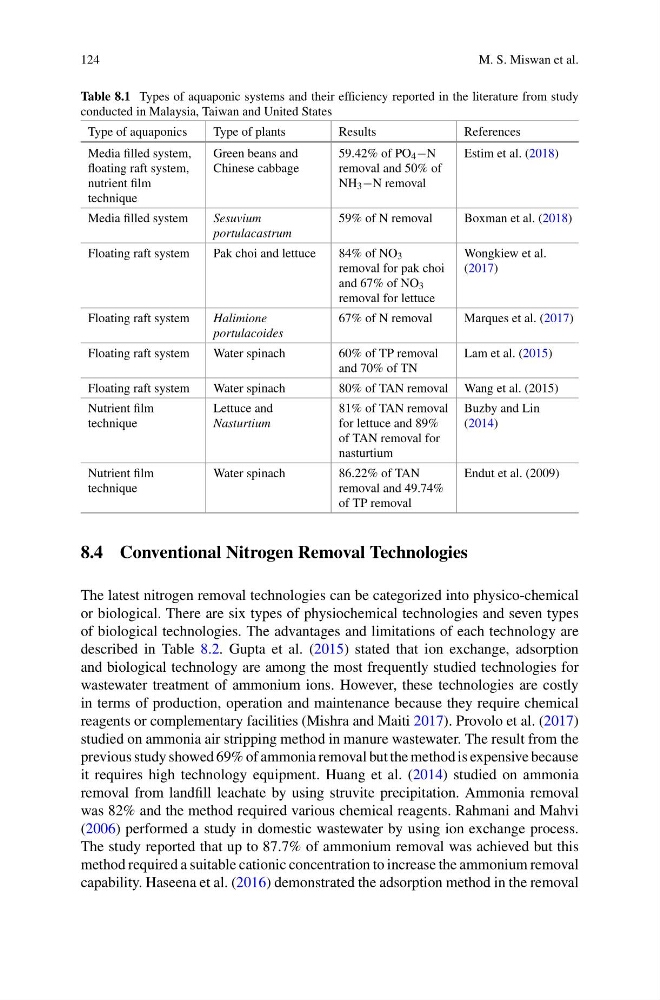
Table 8.1 Types of aquaponic systems and their efficiency reported in the literature from study
conducted in Malaysia, Taiwan and United States
Type of aquaponics
Type of plants
Results
References
Media filled system,
floating raft system,
nutrient film
technique
Green beans and
Chinese cabbage
59.42% of PO 4 −N
removal and 50% of
NH 3 −N removal
Estim et al. (2018)
Media filled system
Sesuvium
portulacastrum
59% of N removal
Boxman et al. (2018)
Floating raft system
Pak choi and lettuce
84% of NO 3
removal for pak choi
and 67% of NO 3
removal for lettuce
Wongkiew et al.
(2017)
Floating raft system
Halimione
portulacoides
67% of N removal
Marques et al. (2017)
Floating raft system
Water spinach
60% of TP removal
and 70% of TN
Lam et al. (2015)
Floating raft system
Water spinach
80% of TAN removal Wang et al. (2015)
Nutrient film
technique
Lettuce and
Nasturtium
81% of TAN removal
for lettuce and 89%
of TAN removal for
nasturtium
Buzby and Lin
(2014)
Nutrient film
technique
Water spinach
86.22% of TAN
removal and 49.74%
of TP removal
Endut et al. (2009)
8.4 Conventional Nitrogen Removal Technologies
The latest nitrogen removal technologies can be categorized into physico-chemical
or biological. There are six types of physiochemical technologies and seven types
of biological technologies. The advantages and limitations of each technology are
described in Table 8.2. Gupta et al. (2015) stated that ion exchange, adsorption
and biological technology are among the most frequently studied technologies for
wastewater treatment of ammonium ions. However, these technologies are costly
in terms of production, operation and maintenance because they require chemical
reagents or complementary facilities (Mishra and Maiti 2017). Provolo et al. (2017)
studied on ammonia air stripping method in manure wastewater. The result from the
previous study showed 69% of ammonia removal but the method is expensive because
it requires high technology equipment. Huang et al. (2014) studied on ammonia
removal from landfill leachate by using struvite precipitation. Ammonia removal
was 82% and the method required various chemical reagents. Rahmani and Mahvi
(2006) performed a study in domestic wastewater by using ion exchange process.
The study reported that up to 87.7% of ammonium removal was achieved but this
method required a suitable cationic concentration to increase the ammonium removal
capability. Haseena et al. (2016) demonstrated the adsorption method in the removal
M. S. Miswan et al.
Table 8.1 Types of aquaponic systems and their efficiency reported in the literature from study
conducted in Malaysia, Taiwan and United States
Type of aquaponics
Type of plants
Results
References
Media filled system,
floating raft system,
nutrient film
technique
Green beans and
Chinese cabbage
59.42% of PO 4 −N
removal and 50% of
NH 3 −N removal
Estim et al. (2018)
Media filled system
Sesuvium
portulacastrum
59% of N removal
Boxman et al. (2018)
Floating raft system
Pak choi and lettuce
84% of NO 3
removal for pak choi
and 67% of NO 3
removal for lettuce
Wongkiew et al.
(2017)
Floating raft system
Halimione
portulacoides
67% of N removal
Marques et al. (2017)
Floating raft system
Water spinach
60% of TP removal
and 70% of TN
Lam et al. (2015)
Floating raft system
Water spinach
80% of TAN removal Wang et al. (2015)
Nutrient film
technique
Lettuce and
Nasturtium
81% of TAN removal
for lettuce and 89%
of TAN removal for
nasturtium
Buzby and Lin
(2014)
Nutrient film
technique
Water spinach
86.22% of TAN
removal and 49.74%
of TP removal
Endut et al. (2009)
8.4 Conventional Nitrogen Removal Technologies
The latest nitrogen removal technologies can be categorized into physico-chemical
or biological. There are six types of physiochemical technologies and seven types
of biological technologies. The advantages and limitations of each technology are
described in Table 8.2. Gupta et al. (2015) stated that ion exchange, adsorption
and biological technology are among the most frequently studied technologies for
wastewater treatment of ammonium ions. However, these technologies are costly
in terms of production, operation and maintenance because they require chemical
reagents or complementary facilities (Mishra and Maiti 2017). Provolo et al. (2017)
studied on ammonia air stripping method in manure wastewater. The result from the
previous study showed 69% of ammonia removal but the method is expensive because
it requires high technology equipment. Huang et al. (2014) studied on ammonia
removal from landfill leachate by using struvite precipitation. Ammonia removal
was 82% and the method required various chemical reagents. Rahmani and Mahvi
(2006) performed a study in domestic wastewater by using ion exchange process.
The study reported that up to 87.7% of ammonium removal was achieved but this
method required a suitable cationic concentration to increase the ammonium removal
capability. Haseena et al. (2016) demonstrated the adsorption method in the removal