

112
B. R. Baker et al.
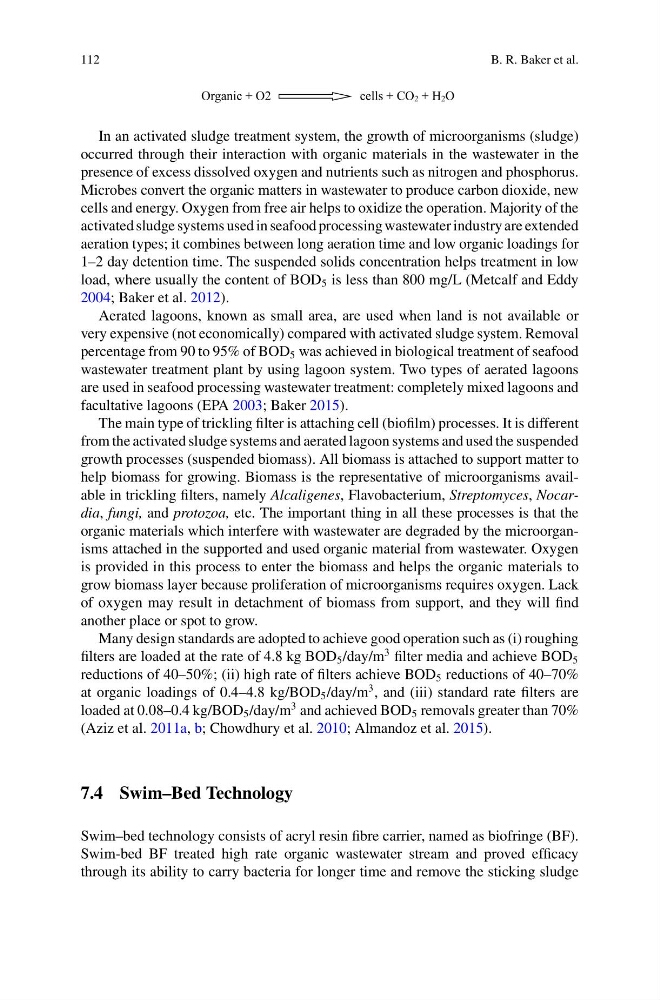
Organic + O2
cells + CO 2 H
+ 2 O
In an activated sludge treatment system, the growth of microorganisms (sludge)
occurred through their interaction with organic materials in the wastewater in the
presence of excess dissolved oxygen and nutrients such as nitrogen and phosphorus.
Microbes convert the organic matters in wastewater to produce carbon dioxide, new
cells and energy. Oxygen from free air helps to oxidize the operation. Majority of the
activated sludge systems used in seafood processing wastewater industry are extended
aeration types; it combines between long aeration time and low organic loadings for
1–2 day detention time. The suspended solids concentration helps treatment in low
load, where usually the content of BOD 5 is less than 800 mg/L (Metcalf and Eddy
2004; Baker et al. 2012).
Aerated lagoons, known as small area, are used when land is not available or
very expensive (not economically) compared with activated sludge system. Removal
percentage from 90 to 95% of BOD 5 was achieved in biological treatment of seafood
wastewater treatment plant by using lagoon system. Two types of aerated lagoons
are used in seafood processing wastewater treatment: completely mixed lagoons and
facultative lagoons (EPA 2003; Baker 2015).
The main type of trickling filter is attaching cell (biofilm) processes. It is different
from the activated sludge systems and aerated lagoon systems and used the suspended
growth processes (suspended biomass). All biomass is attached to support matter to
help biomass for growing. Biomass is the representative of microorganisms available in trickling filters, namely Alcaligenes, Flavobacterium, Streptomyces, Nocardia, fungi, and protozoa, etc. The important thing in all these processes is that the
organic materials which interfere with wastewater are degraded by the microorganisms attached in the supported and used organic material from wastewater. Oxygen
is provided in this process to enter the biomass and helps the organic materials to
grow biomass layer because proliferation of microorganisms requires oxygen. Lack
of oxygen may result in detachment of biomass from support, and they will find
another place or spot to grow.
Many design standards are adopted to achieve good operation such as (i) roughing
filters are loaded at the rate of 4.8 kg BOD 5 /day/m
3 filter media and achieve BOD 5
reductions of 40–50%; (ii) high rate of filters achieve BOD 5 reductions of 40–70%
at organic loadings of 0.4–4.8 kg/BOD 5 /day/m
3 , and (iii) standard rate filters are
loaded at 0.08–0.4 kg/BOD 5 /day/m
3 and achieved BOD 5 removals greater than 70%
(Aziz et al. 2011a, b; Chowdhury et al. 2010; Almandoz et al. 2015).
7.4 Swim–Bed Technology
Swim–bed technology consists of acryl resin fibre carrier, named as biofringe (BF).
Swim-bed BF treated high rate organic wastewater stream and proved efficacy
through its ability to carry bacteria for longer time and remove the sticking sludge
B. R. Baker et al.
Organic + O2
cells + CO 2 H
+ 2 O
In an activated sludge treatment system, the growth of microorganisms (sludge)
occurred through their interaction with organic materials in the wastewater in the
presence of excess dissolved oxygen and nutrients such as nitrogen and phosphorus.
Microbes convert the organic matters in wastewater to produce carbon dioxide, new
cells and energy. Oxygen from free air helps to oxidize the operation. Majority of the
activated sludge systems used in seafood processing wastewater industry are extended
aeration types; it combines between long aeration time and low organic loadings for
1–2 day detention time. The suspended solids concentration helps treatment in low
load, where usually the content of BOD 5 is less than 800 mg/L (Metcalf and Eddy
2004; Baker et al. 2012).
Aerated lagoons, known as small area, are used when land is not available or
very expensive (not economically) compared with activated sludge system. Removal
percentage from 90 to 95% of BOD 5 was achieved in biological treatment of seafood
wastewater treatment plant by using lagoon system. Two types of aerated lagoons
are used in seafood processing wastewater treatment: completely mixed lagoons and
facultative lagoons (EPA 2003; Baker 2015).
The main type of trickling filter is attaching cell (biofilm) processes. It is different
from the activated sludge systems and aerated lagoon systems and used the suspended
growth processes (suspended biomass). All biomass is attached to support matter to
help biomass for growing. Biomass is the representative of microorganisms available in trickling filters, namely Alcaligenes, Flavobacterium, Streptomyces, Nocardia, fungi, and protozoa, etc. The important thing in all these processes is that the
organic materials which interfere with wastewater are degraded by the microorganisms attached in the supported and used organic material from wastewater. Oxygen
is provided in this process to enter the biomass and helps the organic materials to
grow biomass layer because proliferation of microorganisms requires oxygen. Lack
of oxygen may result in detachment of biomass from support, and they will find
another place or spot to grow.
Many design standards are adopted to achieve good operation such as (i) roughing
filters are loaded at the rate of 4.8 kg BOD 5 /day/m
3 filter media and achieve BOD 5
reductions of 40–50%; (ii) high rate of filters achieve BOD 5 reductions of 40–70%
at organic loadings of 0.4–4.8 kg/BOD 5 /day/m
3 , and (iii) standard rate filters are
loaded at 0.08–0.4 kg/BOD 5 /day/m
3 and achieved BOD 5 removals greater than 70%
(Aziz et al. 2011a, b; Chowdhury et al. 2010; Almandoz et al. 2015).
7.4 Swim–Bed Technology
Swim–bed technology consists of acryl resin fibre carrier, named as biofringe (BF).
Swim-bed BF treated high rate organic wastewater stream and proved efficacy
through its ability to carry bacteria for longer time and remove the sticking sludge