

74
3 The Reactivity of Nitrile Imines
N
N
R
1
R
2
N
R
3
R
3
R
4
N N
N
R
3
R
3
R
4
R
2
R
1
N N
R
4
R
2
R
1
N
N
N
R
1
R
2
R
4
R
3
R
3
+
Concerted cycloaddition
or
Step-wise Ring Closure
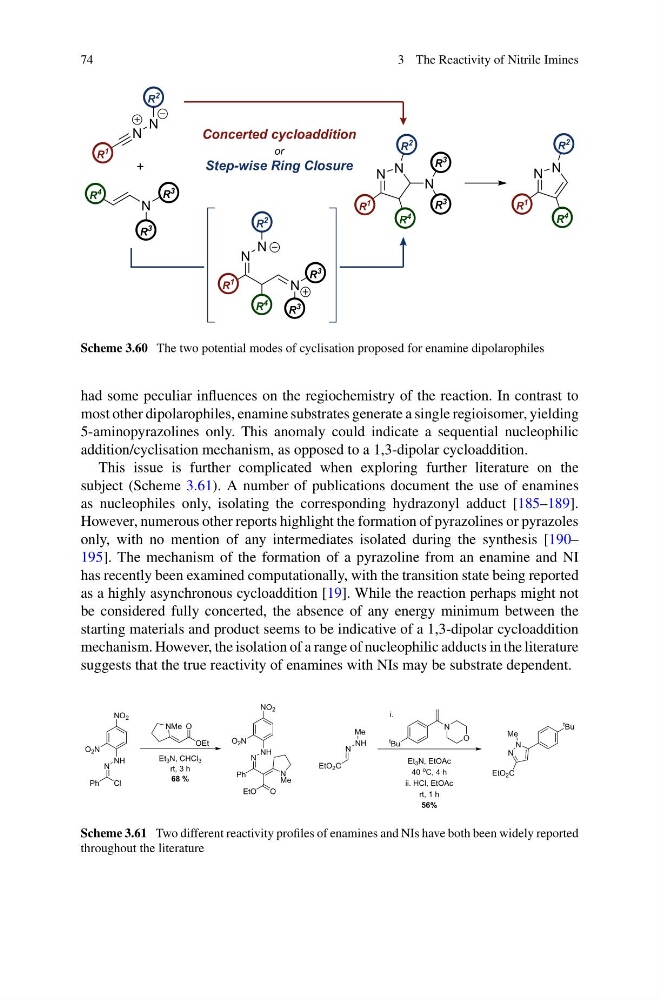
Scheme 3.60 The two potential modes of cyclisation proposed for enamine dipolarophiles
had some peculiar influences on the regiochemistry of the reaction. In contrast to
most other dipolarophiles, enamine substrates generate a single regioisomer, yielding
5-aminopyrazolines only. This anomaly could indicate a sequential nucleophilic
addition/cyclisation mechanism, as opposed to a 1,3-dipolar cycloaddition.
This issue is further complicated when exploring further literature on the
subject (Scheme 3.61). A number of publications document the use of enamines
as nucleophiles only, isolating the corresponding hydrazonyl adduct [185–189].
However, numerous other reports highlight the formation of pyrazolines or pyrazoles
only, with no mention of any intermediates isolated during the synthesis [190–
195]. The mechanism of the formation of a pyrazoline from an enamine and NI
has recently been examined computationally, with the transition state being reported
as a highly asynchronous cycloaddition [19]. While the reaction perhaps might not
be considered fully concerted, the absence of any energy minimum between the
starting materials and product seems to be indicative of a 1,3-dipolar cycloaddition
mechanism. However, the isolation of a range of nucleophilic adducts in the literature
suggests that the true reactivity of enamines with NIs may be substrate dependent.
NMe
Ph
Cl
N
NH
O 2 N
NO 2
Ph
N
NH
O 2 N
NO 2
N
Me
EtO
O
O
OEt
Et 3 N, CHCl 3
rt, 3 h
68 %
EtO 2 C
N
NH
Me
Et 3 N, EtOAc
40
o C, 4 h
ii. HCl, EtOAc
rt, 1 h
56%
N
O
t Bu
i.
EtO 2 C
N
N
Me
t Bu
Scheme 3.61 Two different reactivity profiles of enamines and NIs have both been widely reported
throughout the literature
3 The Reactivity of Nitrile Imines
N
N
R
1
R
2
N
R
3
R
3
R
4
N N
N
R
3
R
3
R
4
R
2
R
1
N N
R
4
R
2
R
1
N
N
N
R
1
R
2
R
4
R
3
R
3
+
Concerted cycloaddition
or
Step-wise Ring Closure
Scheme 3.60 The two potential modes of cyclisation proposed for enamine dipolarophiles
had some peculiar influences on the regiochemistry of the reaction. In contrast to
most other dipolarophiles, enamine substrates generate a single regioisomer, yielding
5-aminopyrazolines only. This anomaly could indicate a sequential nucleophilic
addition/cyclisation mechanism, as opposed to a 1,3-dipolar cycloaddition.
This issue is further complicated when exploring further literature on the
subject (Scheme 3.61). A number of publications document the use of enamines
as nucleophiles only, isolating the corresponding hydrazonyl adduct [185–189].
However, numerous other reports highlight the formation of pyrazolines or pyrazoles
only, with no mention of any intermediates isolated during the synthesis [190–
195]. The mechanism of the formation of a pyrazoline from an enamine and NI
has recently been examined computationally, with the transition state being reported
as a highly asynchronous cycloaddition [19]. While the reaction perhaps might not
be considered fully concerted, the absence of any energy minimum between the
starting materials and product seems to be indicative of a 1,3-dipolar cycloaddition
mechanism. However, the isolation of a range of nucleophilic adducts in the literature
suggests that the true reactivity of enamines with NIs may be substrate dependent.
NMe
Ph
Cl
N
NH
O 2 N
NO 2
Ph
N
NH
O 2 N
NO 2
N
Me
EtO
O
O
OEt
Et 3 N, CHCl 3
rt, 3 h
68 %
EtO 2 C
N
NH
Me
Et 3 N, EtOAc
40
o C, 4 h
ii. HCl, EtOAc
rt, 1 h
56%
N
O
t Bu
i.
EtO 2 C
N
N
Me
t Bu
Scheme 3.61 Two different reactivity profiles of enamines and NIs have both been widely reported
throughout the literature