

3.2 Nucleophiles
73
K 3 PO 4 , DCM
3 h, 40
o C
80 %
B(OH) 2
MeO
Ph
N
HN
Ph
OMe
Ph
Cl
N
NH
Ph
70:30 Z:E
B(OH) 2
BocHN
hν, THF, 3 Å MS
16 h, rt
92 %
57:43 Z:E
Ph
N
HN
Ph
NHBoc
N
N
N
N
Ph
Ph
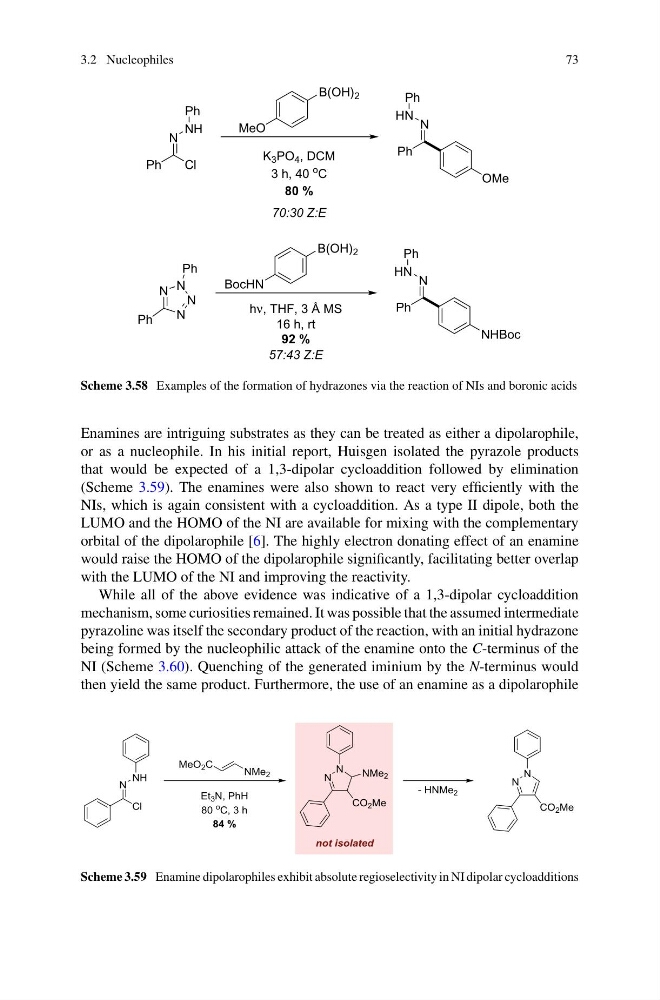
Scheme 3.58 Examples of the formation of hydrazones via the reaction of NIs and boronic acids
Enamines are intriguing substrates as they can be treated as either a dipolarophile,
or as a nucleophile. In his initial report, Huisgen isolated the pyrazole products
that would be expected of a 1,3-dipolar cycloaddition followed by elimination
(Scheme 3.59). The enamines were also shown to react very efficiently with the
NIs, which is again consistent with a cycloaddition. As a type II dipole, both the
LUMO and the HOMO of the NI are available for mixing with the complementary
orbital of the dipolarophile [6]. The highly electron donating effect of an enamine
would raise the HOMO of the dipolarophile significantly, facilitating better overlap
with the LUMO of the NI and improving the reactivity.
While all of the above evidence was indicative of a 1,3-dipolar cycloaddition
mechanism, some curiosities remained. It was possible that the assumed intermediate
pyrazoline was itself the secondary product of the reaction, with an initial hydrazone
being formed by the nucleophilic attack of the enamine onto the C-terminus of the
NI (Scheme 3.60). Quenching of the generated iminium by the N-terminus would
then yield the same product. Furthermore, the use of an enamine as a dipolarophile
N
N
NMe 2
Cl
N
NH
Et 3 N, PhH
80
o C, 3 h
84 %
NMe 2
MeO 2 C
CO 2 Me
- HNMe 2
N
N
CO 2 Me
not isolated
Scheme 3.59 Enamine dipolarophiles exhibit absolute regioselectivity in NI dipolar cycloadditions
73
K 3 PO 4 , DCM
3 h, 40
o C
80 %
B(OH) 2
MeO
Ph
N
HN
Ph
OMe
Ph
Cl
N
NH
Ph
70:30 Z:E
B(OH) 2
BocHN
hν, THF, 3 Å MS
16 h, rt
92 %
57:43 Z:E
Ph
N
HN
Ph
NHBoc
N
N
N
N
Ph
Ph
Scheme 3.58 Examples of the formation of hydrazones via the reaction of NIs and boronic acids
Enamines are intriguing substrates as they can be treated as either a dipolarophile,
or as a nucleophile. In his initial report, Huisgen isolated the pyrazole products
that would be expected of a 1,3-dipolar cycloaddition followed by elimination
(Scheme 3.59). The enamines were also shown to react very efficiently with the
NIs, which is again consistent with a cycloaddition. As a type II dipole, both the
LUMO and the HOMO of the NI are available for mixing with the complementary
orbital of the dipolarophile [6]. The highly electron donating effect of an enamine
would raise the HOMO of the dipolarophile significantly, facilitating better overlap
with the LUMO of the NI and improving the reactivity.
While all of the above evidence was indicative of a 1,3-dipolar cycloaddition
mechanism, some curiosities remained. It was possible that the assumed intermediate
pyrazoline was itself the secondary product of the reaction, with an initial hydrazone
being formed by the nucleophilic attack of the enamine onto the C-terminus of the
NI (Scheme 3.60). Quenching of the generated iminium by the N-terminus would
then yield the same product. Furthermore, the use of an enamine as a dipolarophile
N
N
NMe 2
Cl
N
NH
Et 3 N, PhH
80
o C, 3 h
84 %
NMe 2
MeO 2 C
CO 2 Me
- HNMe 2
N
N
CO 2 Me
not isolated
Scheme 3.59 Enamine dipolarophiles exhibit absolute regioselectivity in NI dipolar cycloadditions