

70
3 The Reactivity of Nitrile Imines
Cl
N
NH
Ph
CN
Me
Me
N
O
O
N
NH
Ph
Me
N
Me
N
O
O
N
NH
Ph
Me
N
Me
N
O
O
Et 3 N, DCM
rt, 16 h
75 %
Cl
N
NH
Ph
Et 3 N, DCM
rt, 20 h
65 %
I
NC
CO 2 H
OH
N
NH
Ph
I
H
N
O
+
N
NH
Ph
I
N
CO 2 H
OH
N
NH
Ph
I
N
O
O
OH
H
+
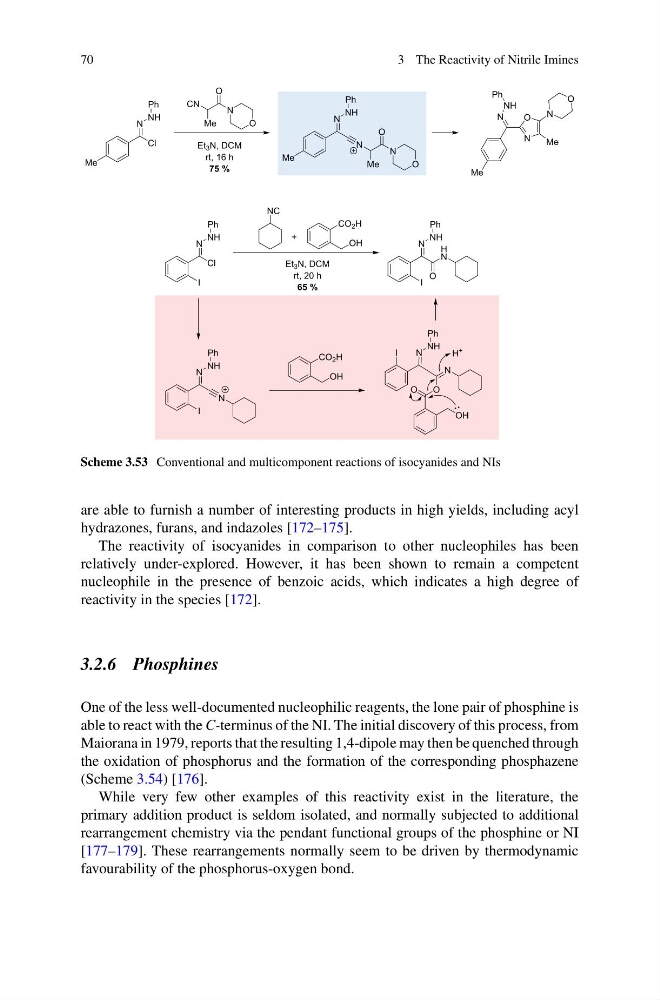
Scheme 3.53 Conventional and multicomponent reactions of isocyanides and NIs
are able to furnish a number of interesting products in high yields, including acyl
hydrazones, furans, and indazoles [172–175].
The reactivity of isocyanides in comparison to other nucleophiles has been
relatively under-explored. However, it has been shown to remain a competent
nucleophile in the presence of benzoic acids, which indicates a high degree of
reactivity in the species [172].
3.2.6 Phosphines
One of the less well-documented nucleophilic reagents, the lone pair of phosphine is
able to react with the C-terminus of the NI. The initial discovery of this process, from
Maiorana in 1979, reports that the resulting 1,4-dipole may then be quenched through
the oxidation of phosphorus and the formation of the corresponding phosphazene
(Scheme 3.54) [176].
While very few other examples of this reactivity exist in the literature, the
primary addition product is seldom isolated, and normally subjected to additional
rearrangement chemistry via the pendant functional groups of the phosphine or NI
[177–179]. These rearrangements normally seem to be driven by thermodynamic
favourability of the phosphorus-oxygen bond.
3 The Reactivity of Nitrile Imines
Cl
N
NH
Ph
CN
Me
Me
N
O
O
N
NH
Ph
Me
N
Me
N
O
O
N
NH
Ph
Me
N
Me
N
O
O
Et 3 N, DCM
rt, 16 h
75 %
Cl
N
NH
Ph
Et 3 N, DCM
rt, 20 h
65 %
I
NC
CO 2 H
OH
N
NH
Ph
I
H
N
O
+
N
NH
Ph
I
N
CO 2 H
OH
N
NH
Ph
I
N
O
O
OH
H
+
Scheme 3.53 Conventional and multicomponent reactions of isocyanides and NIs
are able to furnish a number of interesting products in high yields, including acyl
hydrazones, furans, and indazoles [172–175].
The reactivity of isocyanides in comparison to other nucleophiles has been
relatively under-explored. However, it has been shown to remain a competent
nucleophile in the presence of benzoic acids, which indicates a high degree of
reactivity in the species [172].
3.2.6 Phosphines
One of the less well-documented nucleophilic reagents, the lone pair of phosphine is
able to react with the C-terminus of the NI. The initial discovery of this process, from
Maiorana in 1979, reports that the resulting 1,4-dipole may then be quenched through
the oxidation of phosphorus and the formation of the corresponding phosphazene
(Scheme 3.54) [176].
While very few other examples of this reactivity exist in the literature, the
primary addition product is seldom isolated, and normally subjected to additional
rearrangement chemistry via the pendant functional groups of the phosphine or NI
[177–179]. These rearrangements normally seem to be driven by thermodynamic
favourability of the phosphorus-oxygen bond.