

3.2 Nucleophiles
69
3.2.5 Isocyanides
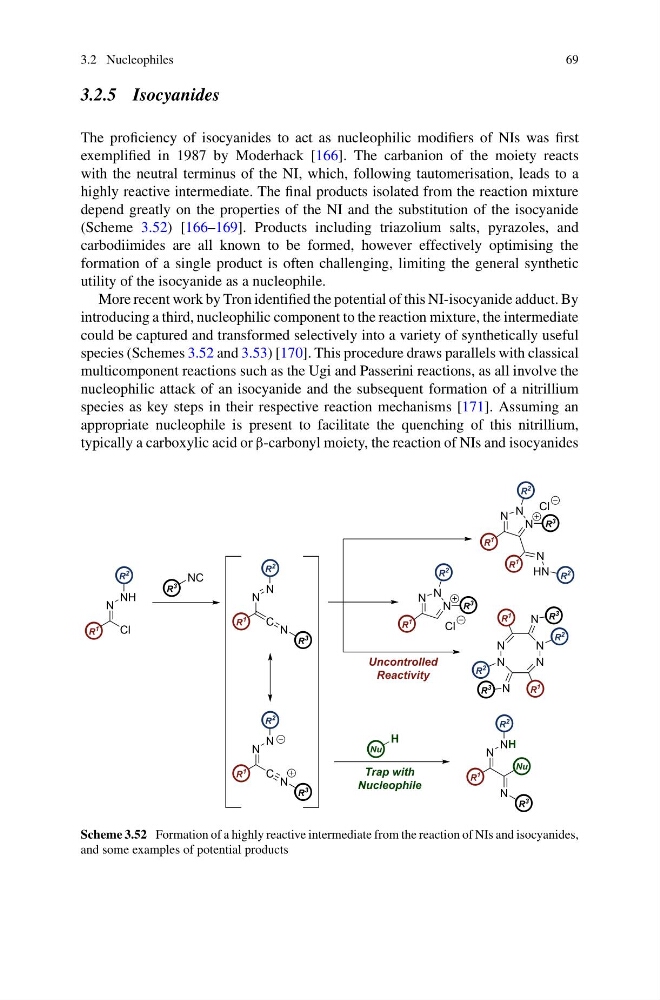
The proficiency of isocyanides to act as nucleophilic modifiers of NIs was first
exemplified in 1987 by Moderhack [166]. The carbanion of the moiety reacts
with the neutral terminus of the NI, which, following tautomerisation, leads to a
highly reactive intermediate. The final products isolated from the reaction mixture
depend greatly on the properties of the NI and the substitution of the isocyanide
(Scheme 3.52) [166–169]. Products including triazolium salts, pyrazoles, and
carbodiimides are all known to be formed, however effectively optimising the
formation of a single product is often challenging, limiting the general synthetic
utility of the isocyanide as a nucleophile.
More recent work by Tron identified the potential of this NI-isocyanide adduct. By
introducing a third, nucleophilic component to the reaction mixture, the intermediate
could be captured and transformed selectively into a variety of synthetically useful
species (Schemes 3.52 and 3.53) [170]. This procedure draws parallels with classical
multicomponent reactions such as the Ugi and Passerini reactions, as all involve the
nucleophilic attack of an isocyanide and the subsequent formation of a nitrillium
species as key steps in their respective reaction mechanisms [171]. Assuming an
appropriate nucleophile is present to facilitate the quenching of this nitrillium,
typically a carboxylic acid or β-carbonyl moiety, the reaction of NIs and isocyanides
Cl
N
NH
C
N
N
N
R
1
R
1
R
2
R
2
NC
R
3
R
3
N N
N
R
1
R
2
R
3
Cl
N N
N
R
1
R
2
R
3
N
HN
R
1
R
2
Cl
N
N
N
N
N
N
R
1
R
1
R
2
R
2
R
3
R
3
C
N
N
N
R
1
R
2
R
3
H
Nu
Uncontrolled
Reactivity
Trap with
Nucleophile
N
NH
R
1
R
2
R
3
N
Nu
Scheme 3.52 Formation of a highly reactive intermediate from the reaction of NIs and isocyanides,
and some examples of potential products
69
3.2.5 Isocyanides
The proficiency of isocyanides to act as nucleophilic modifiers of NIs was first
exemplified in 1987 by Moderhack [166]. The carbanion of the moiety reacts
with the neutral terminus of the NI, which, following tautomerisation, leads to a
highly reactive intermediate. The final products isolated from the reaction mixture
depend greatly on the properties of the NI and the substitution of the isocyanide
(Scheme 3.52) [166–169]. Products including triazolium salts, pyrazoles, and
carbodiimides are all known to be formed, however effectively optimising the
formation of a single product is often challenging, limiting the general synthetic
utility of the isocyanide as a nucleophile.
More recent work by Tron identified the potential of this NI-isocyanide adduct. By
introducing a third, nucleophilic component to the reaction mixture, the intermediate
could be captured and transformed selectively into a variety of synthetically useful
species (Schemes 3.52 and 3.53) [170]. This procedure draws parallels with classical
multicomponent reactions such as the Ugi and Passerini reactions, as all involve the
nucleophilic attack of an isocyanide and the subsequent formation of a nitrillium
species as key steps in their respective reaction mechanisms [171]. Assuming an
appropriate nucleophile is present to facilitate the quenching of this nitrillium,
typically a carboxylic acid or β-carbonyl moiety, the reaction of NIs and isocyanides
Cl
N
NH
C
N
N
N
R
1
R
1
R
2
R
2
NC
R
3
R
3
N N
N
R
1
R
2
R
3
Cl
N N
N
R
1
R
2
R
3
N
HN
R
1
R
2
Cl
N
N
N
N
N
N
R
1
R
1
R
2
R
2
R
3
R
3
C
N
N
N
R
1
R
2
R
3
H
Nu
Uncontrolled
Reactivity
Trap with
Nucleophile
N
NH
R
1
R
2
R
3
N
Nu
Scheme 3.52 Formation of a highly reactive intermediate from the reaction of NIs and isocyanides,
and some examples of potential products