

3.1 1,3-Dipolar Cycloaddition
61
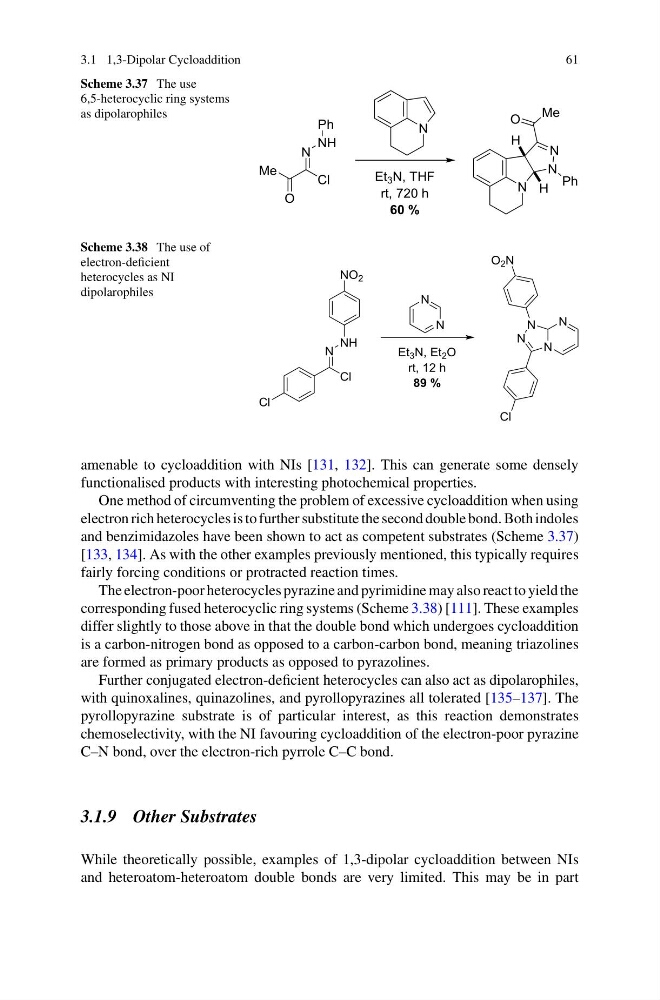
Scheme 3.37 The use
6,5-heterocyclic ring systems
as dipolarophiles
Et 3 N, THF
rt, 720 h
60 %
N
NH
Ph
Cl
N
N
N
N
Ph
H
H
O
Me
O
Me
Scheme 3.38 The use of
electron-deficient
heterocycles as NI
dipolarophiles
Et 3 N, Et 2 O
rt, 12 h
89 %
N
NH
Cl
N
N
NO 2
Cl
N
N
O 2 N
Cl
N
N
amenable to cycloaddition with NIs [131, 132]. This can generate some densely
functionalised products with interesting photochemical properties.
One method of circumventing the problem of excessive cycloaddition when using
electron rich heterocycles is to further substitute the second double bond. Both indoles
and benzimidazoles have been shown to act as competent substrates (Scheme 3.37)
[133, 134]. As with the other examples previously mentioned, this typically requires
fairly forcing conditions or protracted reaction times.
The electron-poor heterocycles pyrazine and pyrimidine may also react to yield the
corresponding fused heterocyclic ring systems (Scheme 3.38) [111]. These examples
differ slightly to those above in that the double bond which undergoes cycloaddition
is a carbon-nitrogen bond as opposed to a carbon-carbon bond, meaning triazolines
are formed as primary products as opposed to pyrazolines.
Further conjugated electron-deficient heterocycles can also act as dipolarophiles,
with quinoxalines, quinazolines, and pyrollopyrazines all tolerated [135–137]. The
pyrollopyrazine substrate is of particular interest, as this reaction demonstrates
chemoselectivity, with the NI favouring cycloaddition of the electron-poor pyrazine
C–N bond, over the electron-rich pyrrole C–C bond.
3.1.9 Other Substrates
While theoretically possible, examples of 1,3-dipolar cycloaddition between NIs
and heteroatom-heteroatom double bonds are very limited. This may be in part
61
Scheme 3.37 The use
6,5-heterocyclic ring systems
as dipolarophiles
Et 3 N, THF
rt, 720 h
60 %
N
NH
Ph
Cl
N
N
N
N
Ph
H
H
O
Me
O
Me
Scheme 3.38 The use of
electron-deficient
heterocycles as NI
dipolarophiles
Et 3 N, Et 2 O
rt, 12 h
89 %
N
NH
Cl
N
N
NO 2
Cl
N
N
O 2 N
Cl
N
N
amenable to cycloaddition with NIs [131, 132]. This can generate some densely
functionalised products with interesting photochemical properties.
One method of circumventing the problem of excessive cycloaddition when using
electron rich heterocycles is to further substitute the second double bond. Both indoles
and benzimidazoles have been shown to act as competent substrates (Scheme 3.37)
[133, 134]. As with the other examples previously mentioned, this typically requires
fairly forcing conditions or protracted reaction times.
The electron-poor heterocycles pyrazine and pyrimidine may also react to yield the
corresponding fused heterocyclic ring systems (Scheme 3.38) [111]. These examples
differ slightly to those above in that the double bond which undergoes cycloaddition
is a carbon-nitrogen bond as opposed to a carbon-carbon bond, meaning triazolines
are formed as primary products as opposed to pyrazolines.
Further conjugated electron-deficient heterocycles can also act as dipolarophiles,
with quinoxalines, quinazolines, and pyrollopyrazines all tolerated [135–137]. The
pyrollopyrazine substrate is of particular interest, as this reaction demonstrates
chemoselectivity, with the NI favouring cycloaddition of the electron-poor pyrazine
C–N bond, over the electron-rich pyrrole C–C bond.
3.1.9 Other Substrates
While theoretically possible, examples of 1,3-dipolar cycloaddition between NIs
and heteroatom-heteroatom double bonds are very limited. This may be in part