

60
3 The Reactivity of Nitrile Imines
a ring opening reaction, restoring aromaticity via the formation of a pyrazole with a
linear alcohol side chain [126].
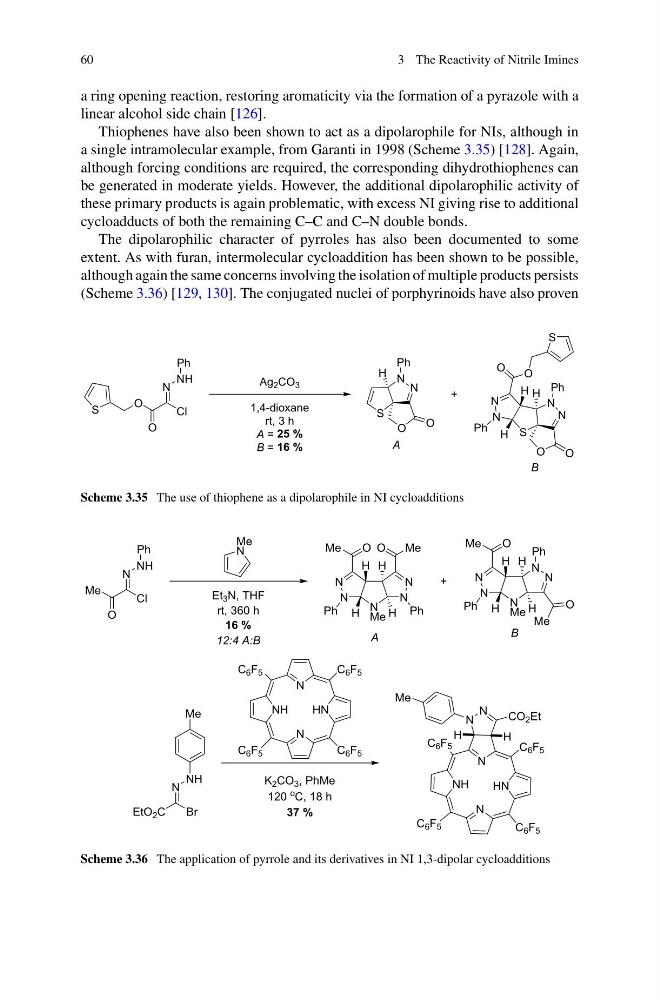
Thiophenes have also been shown to act as a dipolarophile for NIs, although in
a single intramolecular example, from Garanti in 1998 (Scheme 3.35) [128]. Again,
although forcing conditions are required, the corresponding dihydrothiophenes can
be generated in moderate yields. However, the additional dipolarophilic activity of
these primary products is again problematic, with excess NI giving rise to additional
cycloadducts of both the remaining C–C and C–N double bonds.
The dipolarophilic character of pyrroles has also been documented to some
extent. As with furan, intermolecular cycloaddition has been shown to be possible,
although again the same concerns involving the isolation of multiple products persists
(Scheme 3.36) [129, 130]. The conjugated nuclei of porphyrinoids have also proven
1,4-dioxane
rt, 3 h
A = 25 %
B = 16 %
N
NH
Ph
Cl
O
O
S
Ph
O
O
S
N
N
Ph
O
O
S
N
N
Ph
O
O
S
H
H
H
H
+
Ag 2 CO 3
A
B
N
N
Scheme 3.35 The use of thiophene as a dipolarophile in NI cycloadditions
Et 3 N, THF
rt, 360 h
16 %
12:4 A:B
N
NH
Ph
Cl
Me
O
Me
N
N
Me
N
N
N
N
Ph
Ph
H
H
H
H
O
Me
Me
O
N
Me
N
N
N N
Ph
H
H
H
H
O
Me
O
Me
Ph
+
HN
N
NH
N
C 6 F 5
C 6 F 5
C 6 F 5
C 6 F 5
N
NH
EtO 2 C
Br
Me
K 2 CO 3 , PhMe
120
o C, 18 h
37 %
HN
N
NH
N
C 6 F 5
C 6 F 5
C 6 F 5
C 6 F 5
N
N
CO 2 Et
Me
A
B
H
H
Scheme 3.36 The application of pyrrole and its derivatives in NI 1,3-dipolar cycloadditions
3 The Reactivity of Nitrile Imines
a ring opening reaction, restoring aromaticity via the formation of a pyrazole with a
linear alcohol side chain [126].
Thiophenes have also been shown to act as a dipolarophile for NIs, although in
a single intramolecular example, from Garanti in 1998 (Scheme 3.35) [128]. Again,
although forcing conditions are required, the corresponding dihydrothiophenes can
be generated in moderate yields. However, the additional dipolarophilic activity of
these primary products is again problematic, with excess NI giving rise to additional
cycloadducts of both the remaining C–C and C–N double bonds.
The dipolarophilic character of pyrroles has also been documented to some
extent. As with furan, intermolecular cycloaddition has been shown to be possible,
although again the same concerns involving the isolation of multiple products persists
(Scheme 3.36) [129, 130]. The conjugated nuclei of porphyrinoids have also proven
1,4-dioxane
rt, 3 h
A = 25 %
B = 16 %
N
NH
Ph
Cl
O
O
S
Ph
O
O
S
N
N
Ph
O
O
S
N
N
Ph
O
O
S
H
H
H
H
+
Ag 2 CO 3
A
B
N
N
Scheme 3.35 The use of thiophene as a dipolarophile in NI cycloadditions
Et 3 N, THF
rt, 360 h
16 %
12:4 A:B
N
NH
Ph
Cl
Me
O
Me
N
N
Me
N
N
N
N
Ph
Ph
H
H
H
H
O
Me
Me
O
N
Me
N
N
N N
Ph
H
H
H
H
O
Me
O
Me
Ph
+
HN
N
NH
N
C 6 F 5
C 6 F 5
C 6 F 5
C 6 F 5
N
NH
EtO 2 C
Br
Me
K 2 CO 3 , PhMe
120
o C, 18 h
37 %
HN
N
NH
N
C 6 F 5
C 6 F 5
C 6 F 5
C 6 F 5
N
N
CO 2 Et
Me
A
B
H
H
Scheme 3.36 The application of pyrrole and its derivatives in NI 1,3-dipolar cycloadditions