

3.1 1,3-Dipolar Cycloaddition
59
CsF, 18-crown-6, PhMe
rt, 12 h
84 %
N
NH
Ph
Cl
CO 2 (2 MPa)
F
N N
Ph
O
F
O
Scheme 3.33 A recent example of the synthesis of oxadiazolones using NIs and carbon dioxide
may be obtained in high yield using this approach, conditions require high pressures
and a vast excess of CO 2 gas due to the low reactivity of the C–O double bond as
a dipolarophile [124]. Furthermore, recent mechanistic investigation has questioned
the involvement of an NI intermediate in the process [125].
3.1.8 Heterocycles
While conventional hydrocarbon aromatic rings are inert to 1,3-dipolar
cycloaddition, numerous heterocyclic moieties have been shown to undergo reaction
with NIs. Both electron-rich and electron-deficient ring systems are known to act
as dipolarophiles, however, it should be noted that these are not optimal substrates.
Highly forcing reaction conditions are typically required, along with large excesses
of either the NI or the heterocycle.
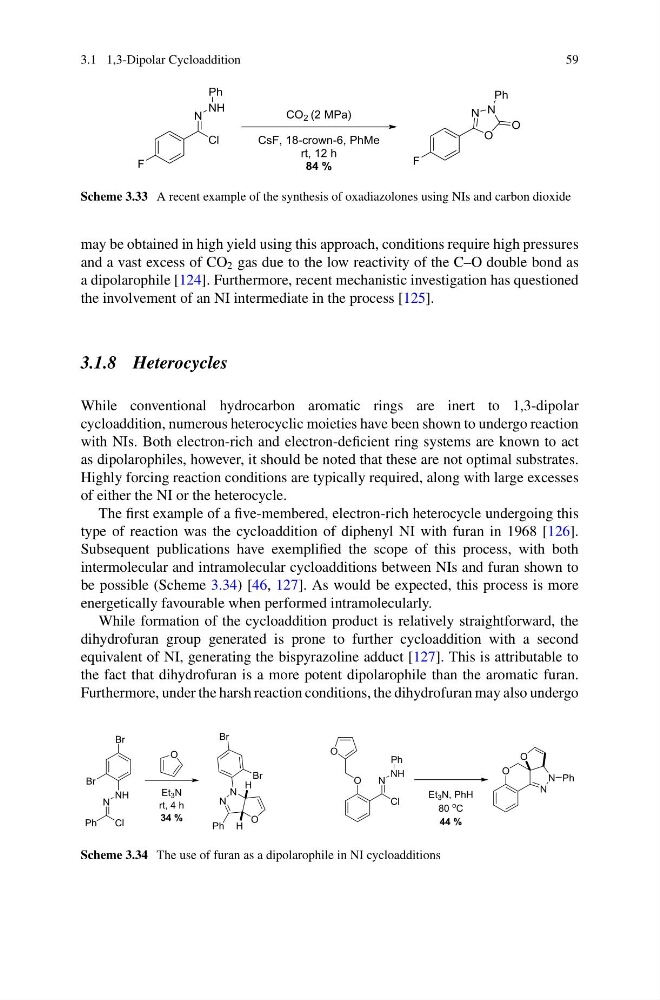
The first example of a five-membered, electron-rich heterocycle undergoing this
type of reaction was the cycloaddition of diphenyl NI with furan in 1968 [126].
Subsequent publications have exemplified the scope of this process, with both
intermolecular and intramolecular cycloadditions between NIs and furan shown to
be possible (Scheme 3.34) [46, 127]. As would be expected, this process is more
energetically favourable when performed intramolecularly.
While formation of the cycloaddition product is relatively straightforward, the
dihydrofuran group generated is prone to further cycloaddition with a second
equivalent of NI, generating the bispyrazoline adduct [127]. This is attributable to
the fact that dihydrofuran is a more potent dipolarophile than the aromatic furan.
Furthermore, under the harsh reaction conditions, the dihydrofuran may also undergo
Et 3 N
rt, 4 h
34 %
N
NH
Ph
Cl
Br
Br
O
N
N
Ph
Br
Br
O
Et 3 N, PhH
80
o C
44 %
N
NH
Ph
Cl
O
O
N
N Ph
O
O
H
H
Scheme 3.34 The use of furan as a dipolarophile in NI cycloadditions
59
CsF, 18-crown-6, PhMe
rt, 12 h
84 %
N
NH
Ph
Cl
CO 2 (2 MPa)
F
N N
Ph
O
F
O
Scheme 3.33 A recent example of the synthesis of oxadiazolones using NIs and carbon dioxide
may be obtained in high yield using this approach, conditions require high pressures
and a vast excess of CO 2 gas due to the low reactivity of the C–O double bond as
a dipolarophile [124]. Furthermore, recent mechanistic investigation has questioned
the involvement of an NI intermediate in the process [125].
3.1.8 Heterocycles
While conventional hydrocarbon aromatic rings are inert to 1,3-dipolar
cycloaddition, numerous heterocyclic moieties have been shown to undergo reaction
with NIs. Both electron-rich and electron-deficient ring systems are known to act
as dipolarophiles, however, it should be noted that these are not optimal substrates.
Highly forcing reaction conditions are typically required, along with large excesses
of either the NI or the heterocycle.
The first example of a five-membered, electron-rich heterocycle undergoing this
type of reaction was the cycloaddition of diphenyl NI with furan in 1968 [126].
Subsequent publications have exemplified the scope of this process, with both
intermolecular and intramolecular cycloadditions between NIs and furan shown to
be possible (Scheme 3.34) [46, 127]. As would be expected, this process is more
energetically favourable when performed intramolecularly.
While formation of the cycloaddition product is relatively straightforward, the
dihydrofuran group generated is prone to further cycloaddition with a second
equivalent of NI, generating the bispyrazoline adduct [127]. This is attributable to
the fact that dihydrofuran is a more potent dipolarophile than the aromatic furan.
Furthermore, under the harsh reaction conditions, the dihydrofuran may also undergo
Et 3 N
rt, 4 h
34 %
N
NH
Ph
Cl
Br
Br
O
N
N
Ph
Br
Br
O
Et 3 N, PhH
80
o C
44 %
N
NH
Ph
Cl
O
O
N
N Ph
O
O
H
H
Scheme 3.34 The use of furan as a dipolarophile in NI cycloadditions