

3.1 1,3-Dipolar Cycloaddition
53
N
Cl
NH
NOc 3 , DCM
rt, 24 h
ii. NaOMe, MeOH
rt, 5 h
94 %
O
O
Me
Cl
Cl
H
N
F
OMe
i.
N
F
OMe
N
N
OH
O
Me
Cl
Cl
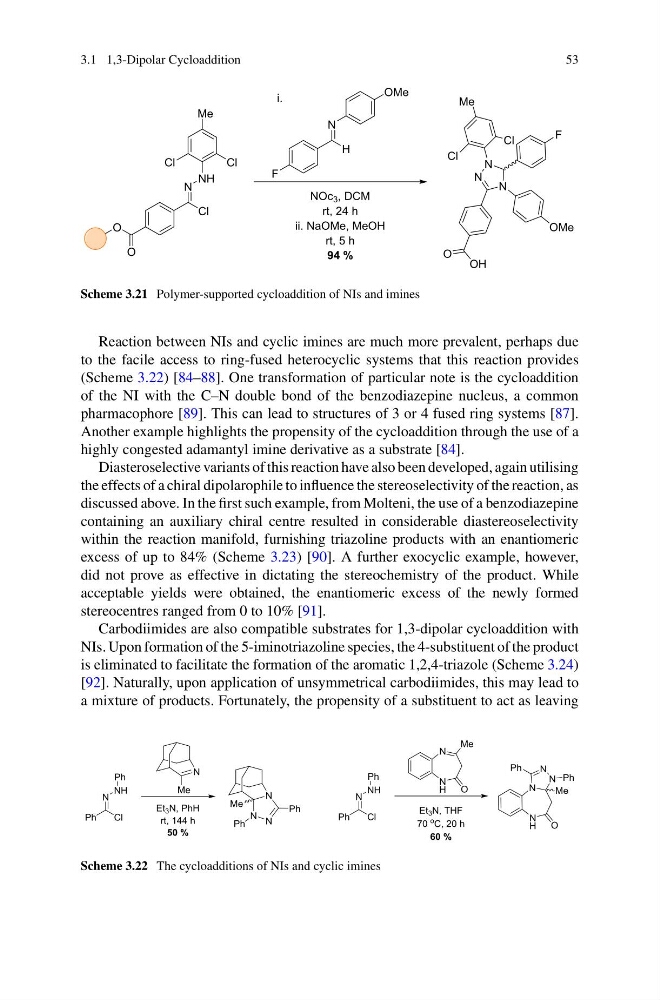
Scheme 3.21 Polymer-supported cycloaddition of NIs and imines
Reaction between NIs and cyclic imines are much more prevalent, perhaps due
to the facile access to ring-fused heterocyclic systems that this reaction provides
(Scheme 3.22) [84–88]. One transformation of particular note is the cycloaddition
of the NI with the C–N double bond of the benzodiazepine nucleus, a common
pharmacophore [89]. This can lead to structures of 3 or 4 fused ring systems [87].
Another example highlights the propensity of the cycloaddition through the use of a
highly congested adamantyl imine derivative as a substrate [84].
Diasteroselective variants of this reaction have also been developed, again utilising
the effects of a chiral dipolarophile to influence the stereoselectivity of the reaction, as
discussed above. In the first such example, from Molteni, the use of a benzodiazepine
containing an auxiliary chiral centre resulted in considerable diastereoselectivity
within the reaction manifold, furnishing triazoline products with an enantiomeric
excess of up to 84% (Scheme 3.23) [90]. A further exocyclic example, however,
did not prove as effective in dictating the stereochemistry of the product. While
acceptable yields were obtained, the enantiomeric excess of the newly formed
stereocentres ranged from 0 to 10% [91].
Carbodiimides are also compatible substrates for 1,3-dipolar cycloaddition with
NIs. Upon formation of the 5-iminotriazoline species, the 4-substituent of the product
is eliminated to facilitate the formation of the aromatic 1,2,4-triazole (Scheme 3.24)
[92]. Naturally, upon application of unsymmetrical carbodiimides, this may lead to
a mixture of products. Fortunately, the propensity of a substituent to act as leaving
N
Cl
NH
Ph
Ph
Et 3 N, PhH
rt, 144 h
50 %
N
Me
N
N N
Ph
Ph
Me
N
Cl
NH
Ph
Ph
Et 3 N, THF
70
o C, 20 h
60 %
N
H
N
O
Me
N
H
N
O
Me
N
N Ph
Ph
Scheme 3.22 The cycloadditions of NIs and cyclic imines
53
N
Cl
NH
NOc 3 , DCM
rt, 24 h
ii. NaOMe, MeOH
rt, 5 h
94 %
O
O
Me
Cl
Cl
H
N
F
OMe
i.
N
F
OMe
N
N
OH
O
Me
Cl
Cl
Scheme 3.21 Polymer-supported cycloaddition of NIs and imines
Reaction between NIs and cyclic imines are much more prevalent, perhaps due
to the facile access to ring-fused heterocyclic systems that this reaction provides
(Scheme 3.22) [84–88]. One transformation of particular note is the cycloaddition
of the NI with the C–N double bond of the benzodiazepine nucleus, a common
pharmacophore [89]. This can lead to structures of 3 or 4 fused ring systems [87].
Another example highlights the propensity of the cycloaddition through the use of a
highly congested adamantyl imine derivative as a substrate [84].
Diasteroselective variants of this reaction have also been developed, again utilising
the effects of a chiral dipolarophile to influence the stereoselectivity of the reaction, as
discussed above. In the first such example, from Molteni, the use of a benzodiazepine
containing an auxiliary chiral centre resulted in considerable diastereoselectivity
within the reaction manifold, furnishing triazoline products with an enantiomeric
excess of up to 84% (Scheme 3.23) [90]. A further exocyclic example, however,
did not prove as effective in dictating the stereochemistry of the product. While
acceptable yields were obtained, the enantiomeric excess of the newly formed
stereocentres ranged from 0 to 10% [91].
Carbodiimides are also compatible substrates for 1,3-dipolar cycloaddition with
NIs. Upon formation of the 5-iminotriazoline species, the 4-substituent of the product
is eliminated to facilitate the formation of the aromatic 1,2,4-triazole (Scheme 3.24)
[92]. Naturally, upon application of unsymmetrical carbodiimides, this may lead to
a mixture of products. Fortunately, the propensity of a substituent to act as leaving
N
Cl
NH
Ph
Ph
Et 3 N, PhH
rt, 144 h
50 %
N
Me
N
N N
Ph
Ph
Me
N
Cl
NH
Ph
Ph
Et 3 N, THF
70
o C, 20 h
60 %
N
H
N
O
Me
N
H
N
O
Me
N
N Ph
Ph
Scheme 3.22 The cycloadditions of NIs and cyclic imines