

3.1 1,3-Dipolar Cycloaddition
49
Cl
N NH
MeO 2 C
O
N
Me
Ph
N N
MeO 2 C
O
N
Me
Ph
H
Ag 2 CO 3
1,4-dioxane
rt, 96 h
86 %
70:30 dr
Cl
N
HN
Cl
O
O
O
Ag 2 CO 3
1,4-dioxane
rt, 30 h
66 %
dr not reported
N
N
Cl
O
O
O
N
N
Cl
O
O
O
H
H
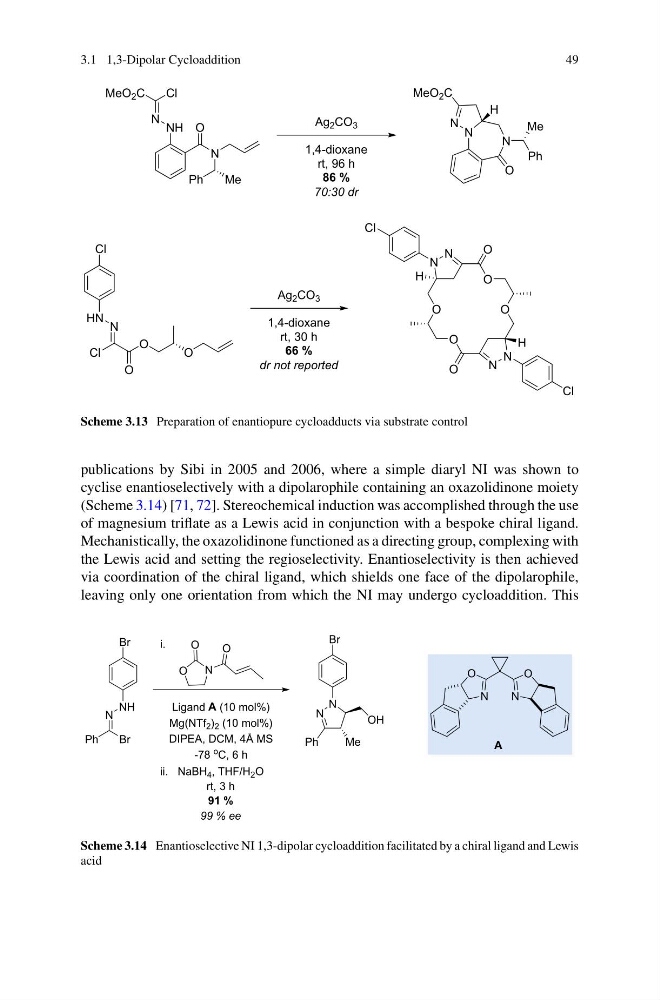
Scheme 3.13 Preparation of enantiopure cycloadducts via substrate control
publications by Sibi in 2005 and 2006, where a simple diaryl NI was shown to
cyclise enantioselectively with a dipolarophile containing an oxazolidinone moiety
(Scheme 3.14) [71, 72]. Stereochemical induction was accomplished through the use
of magnesium triflate as a Lewis acid in conjunction with a bespoke chiral ligand.
Mechanistically, the oxazolidinone functioned as a directing group, complexing with
the Lewis acid and setting the regioselectivity. Enantioselectivity is then achieved
via coordination of the chiral ligand, which shields one face of the dipolarophile,
leaving only one orientation from which the NI may undergo cycloaddition. This
Ligand A (10 mol%)
Mg(NTf 2 ) 2 (10 mol%)
DIPEA, DCM, 4Å MS
-78
o C, 6 h
O
N
O
O
Ph
Br
N
NH
Br
Ph
N
N
Br
OH
Me
O
N
N
O
NaBH 4 , THF/H 2 O
rt, 3 h
91 %
99 % ee
i.
ii.
A
Scheme 3.14 Enantioselective NI 1,3-dipolar cycloaddition facilitated by a chiral ligand and Lewis
acid
49
Cl
N NH
MeO 2 C
O
N
Me
Ph
N N
MeO 2 C
O
N
Me
Ph
H
Ag 2 CO 3
1,4-dioxane
rt, 96 h
86 %
70:30 dr
Cl
N
HN
Cl
O
O
O
Ag 2 CO 3
1,4-dioxane
rt, 30 h
66 %
dr not reported
N
N
Cl
O
O
O
N
N
Cl
O
O
O
H
H
Scheme 3.13 Preparation of enantiopure cycloadducts via substrate control
publications by Sibi in 2005 and 2006, where a simple diaryl NI was shown to
cyclise enantioselectively with a dipolarophile containing an oxazolidinone moiety
(Scheme 3.14) [71, 72]. Stereochemical induction was accomplished through the use
of magnesium triflate as a Lewis acid in conjunction with a bespoke chiral ligand.
Mechanistically, the oxazolidinone functioned as a directing group, complexing with
the Lewis acid and setting the regioselectivity. Enantioselectivity is then achieved
via coordination of the chiral ligand, which shields one face of the dipolarophile,
leaving only one orientation from which the NI may undergo cycloaddition. This
Ligand A (10 mol%)
Mg(NTf 2 ) 2 (10 mol%)
DIPEA, DCM, 4Å MS
-78
o C, 6 h
O
N
O
O
Ph
Br
N
NH
Br
Ph
N
N
Br
OH
Me
O
N
N
O
NaBH 4 , THF/H 2 O
rt, 3 h
91 %
99 % ee
i.
ii.
A
Scheme 3.14 Enantioselective NI 1,3-dipolar cycloaddition facilitated by a chiral ligand and Lewis
acid