

50
3 The Reactivity of Nitrile Imines
Ligand A (10 mol%)
Mg(ClO 4 ) 2 (12 mol%)
DIPEA, DCE
60
o C, 4 h
91 %
98 % ee
Cl
N
NH
Ph
Cl
N
Boc
O
t Bu
N
N Ph
Cl
N
Boc
O
t Bu
N
N
HN
NH
O
O
Et
Et Et
Et
Me
Me
O
O
A
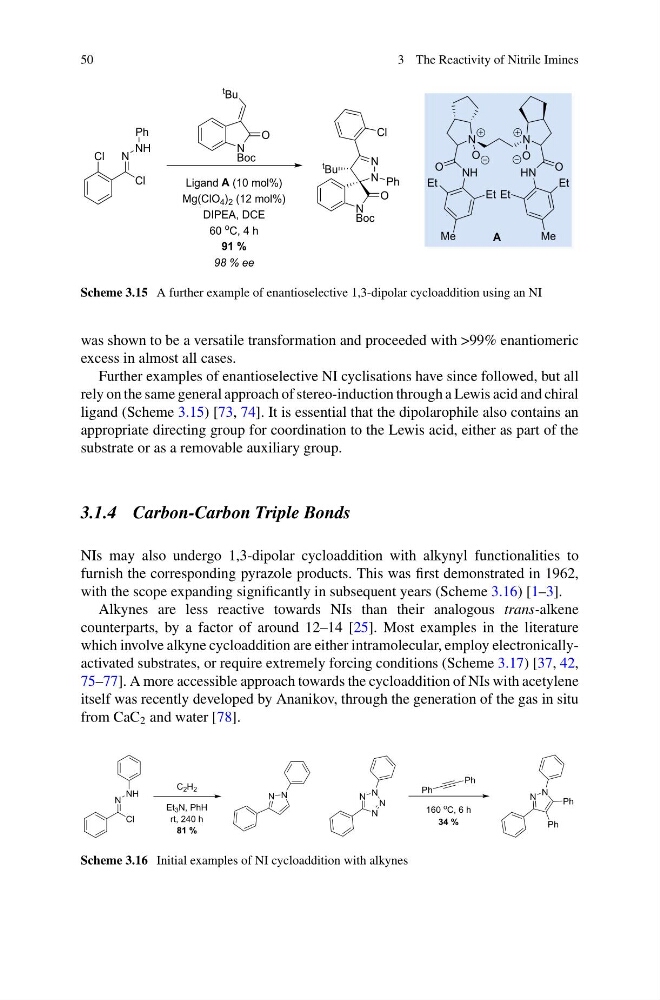
Scheme 3.15 A further example of enantioselective 1,3-dipolar cycloaddition using an NI
was shown to be a versatile transformation and proceeded with >99% enantiomeric
excess in almost all cases.
Further examples of enantioselective NI cyclisations have since followed, but all
rely on the same general approach of stereo-induction through a Lewis acid and chiral
ligand (Scheme 3.15) [73, 74]. It is essential that the dipolarophile also contains an
appropriate directing group for coordination to the Lewis acid, either as part of the
substrate or as a removable auxiliary group.
3.1.4 Carbon-Carbon Triple Bonds
NIs may also undergo 1,3-dipolar cycloaddition with alkynyl functionalities to
furnish the corresponding pyrazole products. This was first demonstrated in 1962,
with the scope expanding significantly in subsequent years (Scheme 3.16) [1–3].
Alkynes are less reactive towards NIs than their analogous trans-alkene
counterparts, by a factor of around 12–14 [25]. Most examples in the literature
which involve alkyne cycloaddition are either intramolecular, employ electronicallyactivated substrates, or require extremely forcing conditions (Scheme 3.17) [37, 42,
75–77]. A more accessible approach towards the cycloaddition of NIs with acetylene
itself was recently developed by Ananikov, through the generation of the gas in situ
from CaC 2 and water [78].
Et 3 N, PhH
rt, 240 h
81 %
Cl
N
NH
C 2 H 2
N N
160
o C, 6 h
34 %
N
N
N
N
N
N
Ph
Ph
Ph
Ph
Scheme 3.16 Initial examples of NI cycloaddition with alkynes
3 The Reactivity of Nitrile Imines
Ligand A (10 mol%)
Mg(ClO 4 ) 2 (12 mol%)
DIPEA, DCE
60
o C, 4 h
91 %
98 % ee
Cl
N
NH
Ph
Cl
N
Boc
O
t Bu
N
N Ph
Cl
N
Boc
O
t Bu
N
N
HN
NH
O
O
Et
Et Et
Et
Me
Me
O
O
A
Scheme 3.15 A further example of enantioselective 1,3-dipolar cycloaddition using an NI
was shown to be a versatile transformation and proceeded with >99% enantiomeric
excess in almost all cases.
Further examples of enantioselective NI cyclisations have since followed, but all
rely on the same general approach of stereo-induction through a Lewis acid and chiral
ligand (Scheme 3.15) [73, 74]. It is essential that the dipolarophile also contains an
appropriate directing group for coordination to the Lewis acid, either as part of the
substrate or as a removable auxiliary group.
3.1.4 Carbon-Carbon Triple Bonds
NIs may also undergo 1,3-dipolar cycloaddition with alkynyl functionalities to
furnish the corresponding pyrazole products. This was first demonstrated in 1962,
with the scope expanding significantly in subsequent years (Scheme 3.16) [1–3].
Alkynes are less reactive towards NIs than their analogous trans-alkene
counterparts, by a factor of around 12–14 [25]. Most examples in the literature
which involve alkyne cycloaddition are either intramolecular, employ electronicallyactivated substrates, or require extremely forcing conditions (Scheme 3.17) [37, 42,
75–77]. A more accessible approach towards the cycloaddition of NIs with acetylene
itself was recently developed by Ananikov, through the generation of the gas in situ
from CaC 2 and water [78].
Et 3 N, PhH
rt, 240 h
81 %
Cl
N
NH
C 2 H 2
N N
160
o C, 6 h
34 %
N
N
N
N
N
N
Ph
Ph
Ph
Ph
Scheme 3.16 Initial examples of NI cycloaddition with alkynes