

46
3 The Reactivity of Nitrile Imines
O
O
Ph
H
N
NH
Me
O
O 2 N
N
N
Me
O
O 2 N
O
O Ph
Chloramine-T, MeOH
70
o C
91 %
Br
N
NH
Et 3 N, DCM
rt 15 h
93 %
EtO 2 C
N
H
O
N
N
EtO 2 C
N
H
O
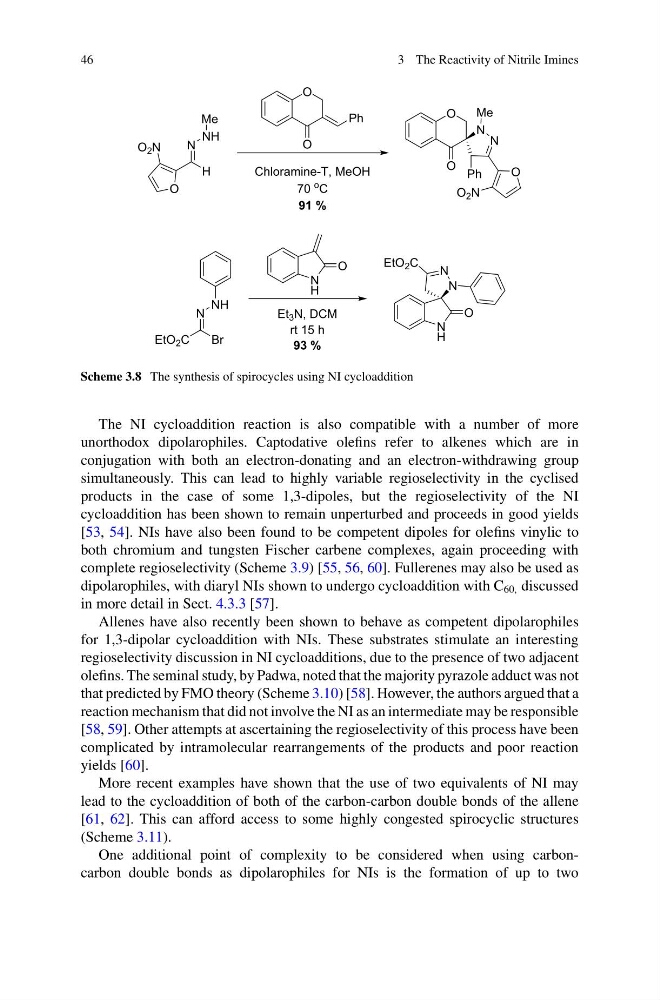
Scheme 3.8 The synthesis of spirocycles using NI cycloaddition
The NI cycloaddition reaction is also compatible with a number of more
unorthodox dipolarophiles. Captodative olefins refer to alkenes which are in
conjugation with both an electron-donating and an electron-withdrawing group
simultaneously. This can lead to highly variable regioselectivity in the cyclised
products in the case of some 1,3-dipoles, but the regioselectivity of the NI
cycloaddition has been shown to remain unperturbed and proceeds in good yields
[53, 54]. NIs have also been found to be competent dipoles for olefins vinylic to
both chromium and tungsten Fischer carbene complexes, again proceeding with
complete regioselectivity (Scheme 3.9) [55, 56, 60]. Fullerenes may also be used as
dipolarophiles, with diaryl NIs shown to undergo cycloaddition with C 60, discussed
in more detail in Sect. 4.3.3 [57].
Allenes have also recently been shown to behave as competent dipolarophiles
for 1,3-dipolar cycloaddition with NIs. These substrates stimulate an interesting
regioselectivity discussion in NI cycloadditions, due to the presence of two adjacent
olefins. The seminal study, by Padwa, noted that the majority pyrazole adduct was not
that predicted by FMO theory (Scheme 3.10) [58]. However, the authors argued that a
reaction mechanism that did not involve the NI as an intermediate may be responsible
[58, 59]. Other attempts at ascertaining the regioselectivity of this process have been
complicated by intramolecular rearrangements of the products and poor reaction
yields [60].
More recent examples have shown that the use of two equivalents of NI may
lead to the cycloaddition of both of the carbon-carbon double bonds of the allene
[61, 62]. This can afford access to some highly congested spirocyclic structures
(Scheme 3.11).
One additional point of complexity to be considered when using carboncarbon double bonds as dipolarophiles for NIs is the formation of up to two
3 The Reactivity of Nitrile Imines
O
O
Ph
H
N
NH
Me
O
O 2 N
N
N
Me
O
O 2 N
O
O Ph
Chloramine-T, MeOH
70
o C
91 %
Br
N
NH
Et 3 N, DCM
rt 15 h
93 %
EtO 2 C
N
H
O
N
N
EtO 2 C
N
H
O
Scheme 3.8 The synthesis of spirocycles using NI cycloaddition
The NI cycloaddition reaction is also compatible with a number of more
unorthodox dipolarophiles. Captodative olefins refer to alkenes which are in
conjugation with both an electron-donating and an electron-withdrawing group
simultaneously. This can lead to highly variable regioselectivity in the cyclised
products in the case of some 1,3-dipoles, but the regioselectivity of the NI
cycloaddition has been shown to remain unperturbed and proceeds in good yields
[53, 54]. NIs have also been found to be competent dipoles for olefins vinylic to
both chromium and tungsten Fischer carbene complexes, again proceeding with
complete regioselectivity (Scheme 3.9) [55, 56, 60]. Fullerenes may also be used as
dipolarophiles, with diaryl NIs shown to undergo cycloaddition with C 60, discussed
in more detail in Sect. 4.3.3 [57].
Allenes have also recently been shown to behave as competent dipolarophiles
for 1,3-dipolar cycloaddition with NIs. These substrates stimulate an interesting
regioselectivity discussion in NI cycloadditions, due to the presence of two adjacent
olefins. The seminal study, by Padwa, noted that the majority pyrazole adduct was not
that predicted by FMO theory (Scheme 3.10) [58]. However, the authors argued that a
reaction mechanism that did not involve the NI as an intermediate may be responsible
[58, 59]. Other attempts at ascertaining the regioselectivity of this process have been
complicated by intramolecular rearrangements of the products and poor reaction
yields [60].
More recent examples have shown that the use of two equivalents of NI may
lead to the cycloaddition of both of the carbon-carbon double bonds of the allene
[61, 62]. This can afford access to some highly congested spirocyclic structures
(Scheme 3.11).
One additional point of complexity to be considered when using carboncarbon double bonds as dipolarophiles for NIs is the formation of up to two