

3.1 1,3-Dipolar Cycloaddition
41
NI, as substitution of the C-terminus is less effective in raising the orbital energy
[24].
The relief of ring strain can also have a beneficial impact on the rate of an
NI cycloaddition reaction. Numerous examples in the literature document rate
increases of 20 to 50-fold when using strained cyclic systems relative to their linear
analogues [25–27]. Of particular note are the rapid reaction rates of cyclooctenes and
spiro[2.3]hex-1-ene, both of which offer substantial increases in cycloaddition rate
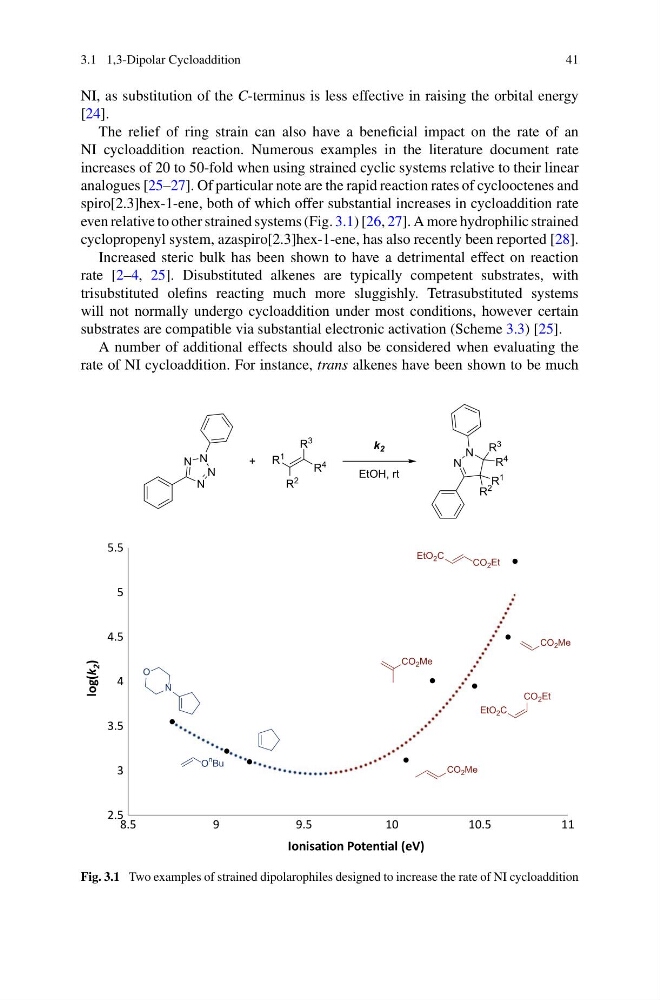
even relative to other strained systems (Fig. 3.1) [26, 27]. A more hydrophilic strained
cyclopropenyl system, azaspiro[2.3]hex-1-ene, has also recently been reported [28].
Increased steric bulk has been shown to have a detrimental effect on reaction
rate [2–4, 25]. Disubstituted alkenes are typically competent substrates, with
trisubstituted olefins reacting much more sluggishly. Tetrasubstituted systems
will not normally undergo cycloaddition under most conditions, however certain
substrates are compatible via substantial electronic activation (Scheme 3.3) [25].
A number of additional effects should also be considered when evaluating the
rate of NI cycloaddition. For instance, trans alkenes have been shown to be much
N
N
N
N
k 2
N
N
EtOH, rt
R
4
R
1
R
2
R
3
R
4
R
1
R
2
R
3
+
2.5
3
3.5
4
4.5
5
5.5
8.5
9
9.5
10
10.5
11
log(k
2 )
Ionisation Potential (eV)
N
O
O
n Bu
CO 2 Me
CO 2 Me
EtO 2 C
CO 2 Et
CO 2 Me
EtO 2 C
CO 2 Et
Fig. 3.1 Two examples of strained dipolarophiles designed to increase the rate of NI cycloaddition
41
NI, as substitution of the C-terminus is less effective in raising the orbital energy
[24].
The relief of ring strain can also have a beneficial impact on the rate of an
NI cycloaddition reaction. Numerous examples in the literature document rate
increases of 20 to 50-fold when using strained cyclic systems relative to their linear
analogues [25–27]. Of particular note are the rapid reaction rates of cyclooctenes and
spiro[2.3]hex-1-ene, both of which offer substantial increases in cycloaddition rate
even relative to other strained systems (Fig. 3.1) [26, 27]. A more hydrophilic strained
cyclopropenyl system, azaspiro[2.3]hex-1-ene, has also recently been reported [28].
Increased steric bulk has been shown to have a detrimental effect on reaction
rate [2–4, 25]. Disubstituted alkenes are typically competent substrates, with
trisubstituted olefins reacting much more sluggishly. Tetrasubstituted systems
will not normally undergo cycloaddition under most conditions, however certain
substrates are compatible via substantial electronic activation (Scheme 3.3) [25].
A number of additional effects should also be considered when evaluating the
rate of NI cycloaddition. For instance, trans alkenes have been shown to be much
N
N
N
N
k 2
N
N
EtOH, rt
R
4
R
1
R
2
R
3
R
4
R
1
R
2
R
3
+
2.5
3
3.5
4
4.5
5
5.5
8.5
9
9.5
10
10.5
11
log(k
2 )
Ionisation Potential (eV)
N
O
O
n Bu
CO 2 Me
CO 2 Me
EtO 2 C
CO 2 Et
CO 2 Me
EtO 2 C
CO 2 Et
Fig. 3.1 Two examples of strained dipolarophiles designed to increase the rate of NI cycloaddition