

2.4 Tetrazoles
21
800 °C may expel a second equivalent of nitrogen to yield fluorene [36]. Other publications have documented the formation of other indazolyl and indenyl compounds
using similar starting materials and reaction conditions, none of which would be
possible using more conventional approaches [37, 38].
The rate of tetrazole thermolysis is highly dependent on the C and N substituents
of the respective NI, and this has been studied by a handful of research groups
[39–42]. Rate of NI formation is most simply measured by iteratively incorporating
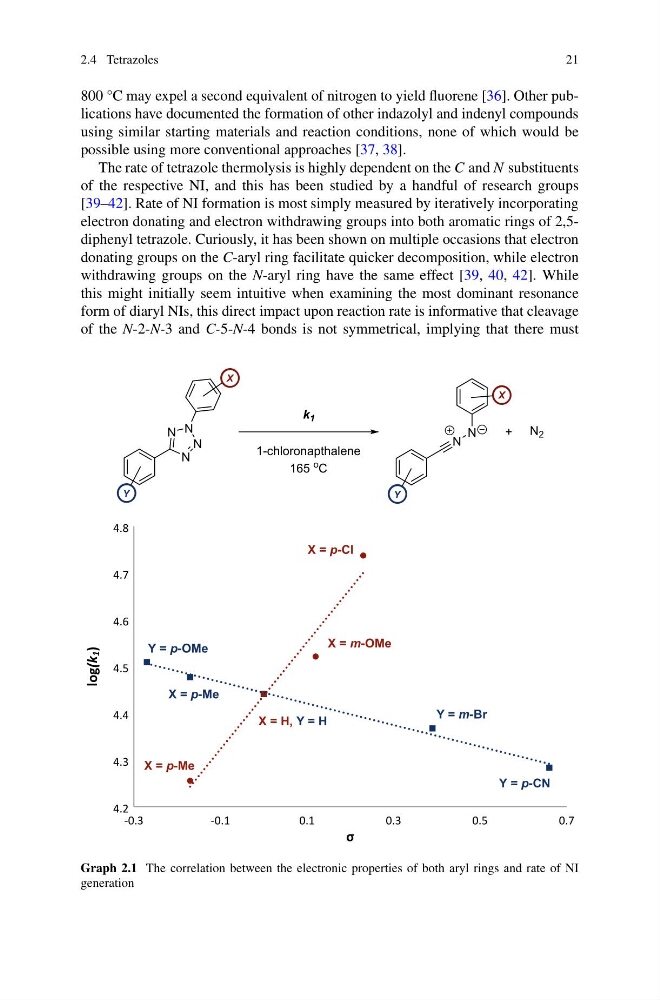
electron donating and electron withdrawing groups into both aromatic rings of 2,5diphenyl tetrazole. Curiously, it has been shown on multiple occasions that electron
donating groups on the C-aryl ring facilitate quicker decomposition, while electron
withdrawing groups on the N-aryl ring have the same effect [39, 40, 42]. While
this might initially seem intuitive when examining the most dominant resonance
form of diaryl NIs, this direct impact upon reaction rate is informative that cleavage
of the N-2-N-3 and C-5-N-4 bonds is not symmetrical, implying that there must
N
N
N
N
k 1
N
N
1-chloronapthalene
165
o C
N 2
+
X
Y
Y
X
4.2
4.3
4.4
4.5
4.6
4.7
4.8
-0.3
-0.1
0.1
0.3
0.5
0.7
σ
log(k
1 )
X = p-Cl
X = m-OMe
X = H, Y = H
X = p-Me
Y = p-OMe
X = p-Me
Y = m-Br
Y = p-CN
Graph 2.1 The correlation between the electronic properties of both aryl rings and rate of NI
generation
21
800 °C may expel a second equivalent of nitrogen to yield fluorene [36]. Other publications have documented the formation of other indazolyl and indenyl compounds
using similar starting materials and reaction conditions, none of which would be
possible using more conventional approaches [37, 38].
The rate of tetrazole thermolysis is highly dependent on the C and N substituents
of the respective NI, and this has been studied by a handful of research groups
[39–42]. Rate of NI formation is most simply measured by iteratively incorporating
electron donating and electron withdrawing groups into both aromatic rings of 2,5diphenyl tetrazole. Curiously, it has been shown on multiple occasions that electron
donating groups on the C-aryl ring facilitate quicker decomposition, while electron
withdrawing groups on the N-aryl ring have the same effect [39, 40, 42]. While
this might initially seem intuitive when examining the most dominant resonance
form of diaryl NIs, this direct impact upon reaction rate is informative that cleavage
of the N-2-N-3 and C-5-N-4 bonds is not symmetrical, implying that there must
N
N
N
N
k 1
N
N
1-chloronapthalene
165
o C
N 2
+
X
Y
Y
X
4.2
4.3
4.4
4.5
4.6
4.7
4.8
-0.3
-0.1
0.1
0.3
0.5
0.7
σ
log(k
1 )
X = p-Cl
X = m-OMe
X = H, Y = H
X = p-Me
Y = p-OMe
X = p-Me
Y = m-Br
Y = p-CN
Graph 2.1 The correlation between the electronic properties of both aryl rings and rate of NI
generation