

20
2 The Generation of Nitrile Imine Derivatives
2.4.1 Thermolysis
The degradation of 2,5-disubstituted tetrazoles was the first ever approach reported
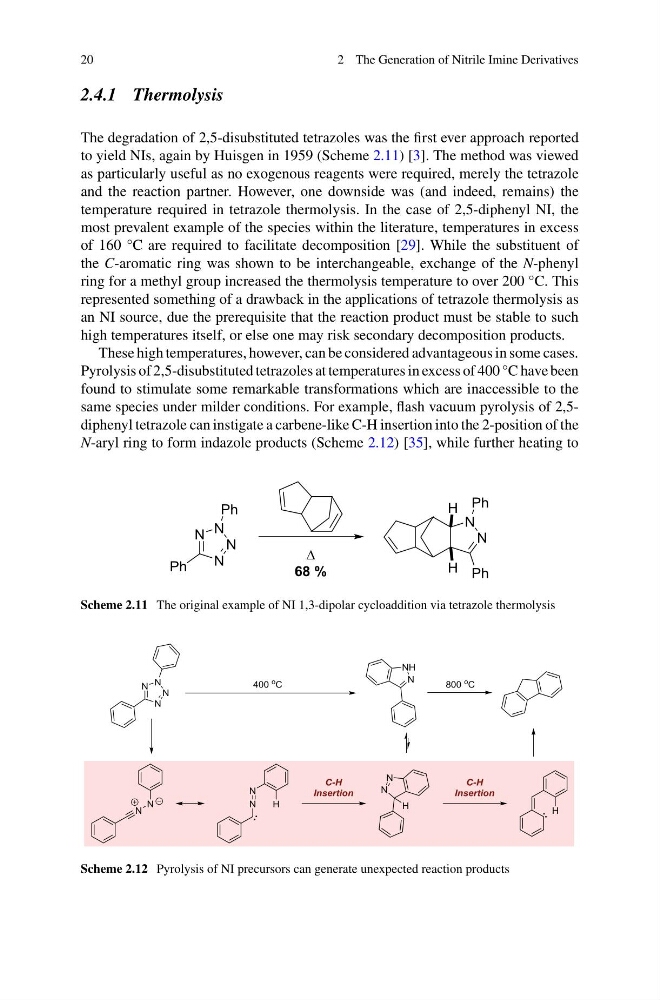
to yield NIs, again by Huisgen in 1959 (Scheme 2.11) [3]. The method was viewed
as particularly useful as no exogenous reagents were required, merely the tetrazole
and the reaction partner. However, one downside was (and indeed, remains) the
temperature required in tetrazole thermolysis. In the case of 2,5-diphenyl NI, the
most prevalent example of the species within the literature, temperatures in excess
of 160 °C are required to facilitate decomposition [29]. While the substituent of
the C-aromatic ring was shown to be interchangeable, exchange of the N-phenyl
ring for a methyl group increased the thermolysis temperature to over 200 °C. This
represented something of a drawback in the applications of tetrazole thermolysis as
an NI source, due the prerequisite that the reaction product must be stable to such
high temperatures itself, or else one may risk secondary decomposition products.
These high temperatures, however, can be considered advantageous in some cases.
Pyrolysis of 2,5-disubstituted tetrazoles at temperatures in excess of 400 °C have been
found to stimulate some remarkable transformations which are inaccessible to the
same species under milder conditions. For example, flash vacuum pyrolysis of 2,5diphenyl tetrazole can instigate a carbene-like C-H insertion into the 2-position of the
N-aryl ring to form indazole products (Scheme 2.12) [35], while further heating to
Ph
N
N
Ph
68 %
N
N
N
N
Ph
Ph
H
H
Scheme 2.11 The original example of NI 1,3-dipolar cycloaddition via tetrazole thermolysis
N
N
N
N
N
NH
400
o C
N
N
N
N
H
N
N
H
C-H
Insertion
H
800
o C
C-H
Insertion
Scheme 2.12 Pyrolysis of NI precursors can generate unexpected reaction products
2 The Generation of Nitrile Imine Derivatives
2.4.1 Thermolysis
The degradation of 2,5-disubstituted tetrazoles was the first ever approach reported
to yield NIs, again by Huisgen in 1959 (Scheme 2.11) [3]. The method was viewed
as particularly useful as no exogenous reagents were required, merely the tetrazole
and the reaction partner. However, one downside was (and indeed, remains) the
temperature required in tetrazole thermolysis. In the case of 2,5-diphenyl NI, the
most prevalent example of the species within the literature, temperatures in excess
of 160 °C are required to facilitate decomposition [29]. While the substituent of
the C-aromatic ring was shown to be interchangeable, exchange of the N-phenyl
ring for a methyl group increased the thermolysis temperature to over 200 °C. This
represented something of a drawback in the applications of tetrazole thermolysis as
an NI source, due the prerequisite that the reaction product must be stable to such
high temperatures itself, or else one may risk secondary decomposition products.
These high temperatures, however, can be considered advantageous in some cases.
Pyrolysis of 2,5-disubstituted tetrazoles at temperatures in excess of 400 °C have been
found to stimulate some remarkable transformations which are inaccessible to the
same species under milder conditions. For example, flash vacuum pyrolysis of 2,5diphenyl tetrazole can instigate a carbene-like C-H insertion into the 2-position of the
N-aryl ring to form indazole products (Scheme 2.12) [35], while further heating to
Ph
N
N
Ph
68 %
N
N
N
N
Ph
Ph
H
H
Scheme 2.11 The original example of NI 1,3-dipolar cycloaddition via tetrazole thermolysis
N
N
N
N
N
NH
400
o C
N
N
N
N
H
N
N
H
C-H
Insertion
H
800
o C
C-H
Insertion
Scheme 2.12 Pyrolysis of NI precursors can generate unexpected reaction products