

22
2 The Generation of Nitrile Imine Derivatives
be residual charges present at the transition state of the thermolysis of 2,5-diaryl
tetrazoles [39]. Indeed, Hammett plots of this reaction by Baldwin suggest that the
impact of substitution of the N-aromatic ring is around 5 times as influential over
reaction rate as substitution of the C-aryl ring, leading to the hypothesis that the
N-2-N-3 bond is the first to be broken, likely during the rate determining step of the
process (Graph 2.1) [40].
2.4.2 Photolysis
Photolysis of 2,5-disubsituted tetrazoles was first documented nearly a decade after
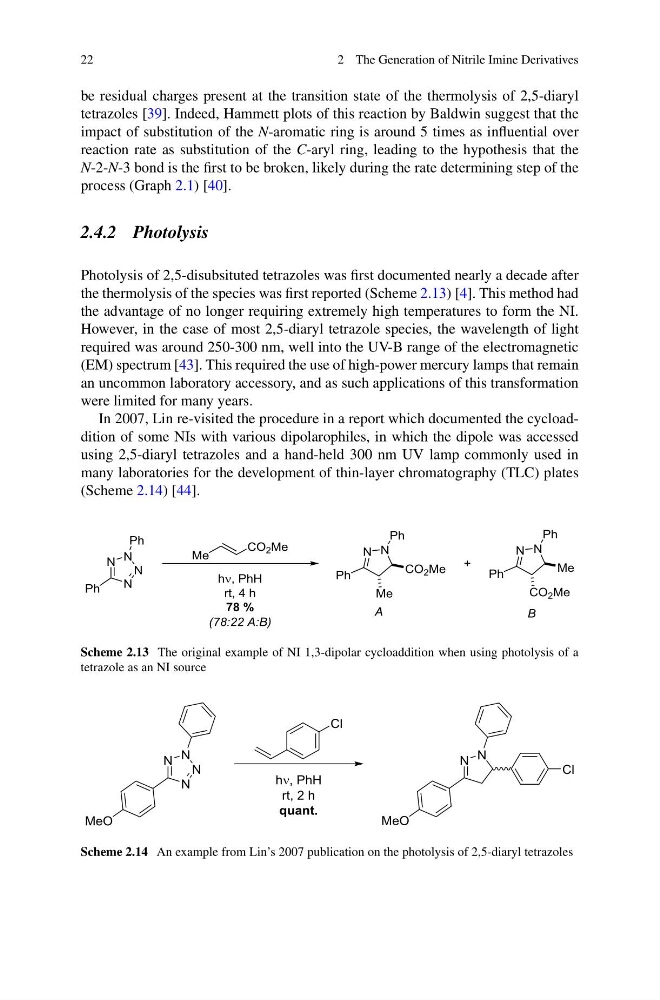
the thermolysis of the species was first reported (Scheme 2.13) [4]. This method had
the advantage of no longer requiring extremely high temperatures to form the NI.
However, in the case of most 2,5-diaryl tetrazole species, the wavelength of light
required was around 250-300 nm, well into the UV-B range of the electromagnetic
(EM) spectrum [43]. This required the use of high-power mercury lamps that remain
an uncommon laboratory accessory, and as such applications of this transformation
were limited for many years.
In 2007, Lin re-visited the procedure in a report which documented the cycloaddition of some NIs with various dipolarophiles, in which the dipole was accessed
using 2,5-diaryl tetrazoles and a hand-held 300 nm UV lamp commonly used in
many laboratories for the development of thin-layer chromatography (TLC) plates
(Scheme 2.14) [44].
h, PhH
rt, 4 h
78 %
(78:22 A:B)
N
N
N
N
Ph
Ph
Me
CO 2 Me
N N
Ph
Ph
Me
CO 2 Me
N N
Ph
Ph
CO 2 Me
Me
+
A
B
Scheme 2.13 The original example of NI 1,3-dipolar cycloaddition when using photolysis of a
tetrazole as an NI source
h, PhH
rt, 2 h
quant.
N
N
N
N
MeO
Cl
N N
MeO
Cl
Scheme 2.14 An example from Lin’s 2007 publication on the photolysis of 2,5-diaryl tetrazoles
2 The Generation of Nitrile Imine Derivatives
be residual charges present at the transition state of the thermolysis of 2,5-diaryl
tetrazoles [39]. Indeed, Hammett plots of this reaction by Baldwin suggest that the
impact of substitution of the N-aromatic ring is around 5 times as influential over
reaction rate as substitution of the C-aryl ring, leading to the hypothesis that the
N-2-N-3 bond is the first to be broken, likely during the rate determining step of the
process (Graph 2.1) [40].
2.4.2 Photolysis
Photolysis of 2,5-disubsituted tetrazoles was first documented nearly a decade after
the thermolysis of the species was first reported (Scheme 2.13) [4]. This method had
the advantage of no longer requiring extremely high temperatures to form the NI.
However, in the case of most 2,5-diaryl tetrazole species, the wavelength of light
required was around 250-300 nm, well into the UV-B range of the electromagnetic
(EM) spectrum [43]. This required the use of high-power mercury lamps that remain
an uncommon laboratory accessory, and as such applications of this transformation
were limited for many years.
In 2007, Lin re-visited the procedure in a report which documented the cycloaddition of some NIs with various dipolarophiles, in which the dipole was accessed
using 2,5-diaryl tetrazoles and a hand-held 300 nm UV lamp commonly used in
many laboratories for the development of thin-layer chromatography (TLC) plates
(Scheme 2.14) [44].
h, PhH
rt, 4 h
78 %
(78:22 A:B)
N
N
N
N
Ph
Ph
Me
CO 2 Me
N N
Ph
Ph
Me
CO 2 Me
N N
Ph
Ph
CO 2 Me
Me
+
A
B
Scheme 2.13 The original example of NI 1,3-dipolar cycloaddition when using photolysis of a
tetrazole as an NI source
h, PhH
rt, 2 h
quant.
N
N
N
N
MeO
Cl
N N
MeO
Cl
Scheme 2.14 An example from Lin’s 2007 publication on the photolysis of 2,5-diaryl tetrazoles