

140
4 Applications of Nitrile Imine Derivatives
Au
S
S
S
O
O
Br
O
O
Br
O
O
Br
Au
S
S
S
O
O
O
O
O
O
O
NAr
N
O
NAr
N
O
ArN N
N
N
N
O
O
O
O
O
O
O
O
Br
SH
EtOH
rt, 16 h
O
O
Br
O
O
Br
O
O
Br
O
N
O
O
O
h
DCM
rt, 1 h
Au
S
S
S
O
O
O
O
O
O
O
NAr
N
O
NAr
N
O
ArN N
N
N
N
O
O
O
O
O
O
O
O
O
O
O
O
O
O
O
O
O
O
Au
Au
S
S
S
O
O
O
O
O
O
O
N
N
NAr
N
O
N
N NAr
N
O
N
N
ArN N
=
=
=
Cl
C11H22
O
N
Me2
O2C
n
N3
O
O
O
O
O
O
n
n
n
n
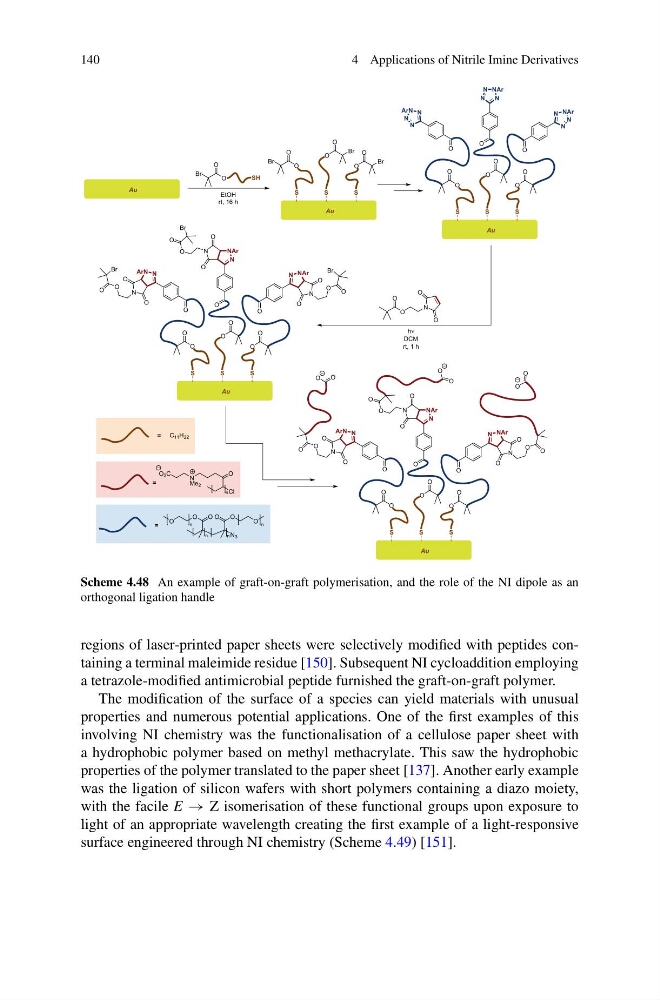
Scheme 4.48 An example of graft-on-graft polymerisation, and the role of the NI dipole as an
orthogonal ligation handle
regions of laser-printed paper sheets were selectively modified with peptides containing a terminal maleimide residue [150]. Subsequent NI cycloaddition employing
a tetrazole-modified antimicrobial peptide furnished the graft-on-graft polymer.
The modification of the surface of a species can yield materials with unusual
properties and numerous potential applications. One of the first examples of this
involving NI chemistry was the functionalisation of a cellulose paper sheet with
a hydrophobic polymer based on methyl methacrylate. This saw the hydrophobic
properties of the polymer translated to the paper sheet [137]. Another early example
was the ligation of silicon wafers with short polymers containing a diazo moiety,
with the facile E → Z isomerisation of these functional groups upon exposure to
light of an appropriate wavelength creating the first example of a light-responsive
surface engineered through NI chemistry (Scheme 4.49) [151].
4 Applications of Nitrile Imine Derivatives
Au
S
S
S
O
O
Br
O
O
Br
O
O
Br
Au
S
S
S
O
O
O
O
O
O
O
NAr
N
O
NAr
N
O
ArN N
N
N
N
O
O
O
O
O
O
O
O
Br
SH
EtOH
rt, 16 h
O
O
Br
O
O
Br
O
O
Br
O
N
O
O
O
h
DCM
rt, 1 h
Au
S
S
S
O
O
O
O
O
O
O
NAr
N
O
NAr
N
O
ArN N
N
N
N
O
O
O
O
O
O
O
O
O
O
O
O
O
O
O
O
O
O
Au
Au
S
S
S
O
O
O
O
O
O
O
N
N
NAr
N
O
N
N NAr
N
O
N
N
ArN N
=
=
=
Cl
C11H22
O
N
Me2
O2C
n
N3
O
O
O
O
O
O
n
n
n
n
Scheme 4.48 An example of graft-on-graft polymerisation, and the role of the NI dipole as an
orthogonal ligation handle
regions of laser-printed paper sheets were selectively modified with peptides containing a terminal maleimide residue [150]. Subsequent NI cycloaddition employing
a tetrazole-modified antimicrobial peptide furnished the graft-on-graft polymer.
The modification of the surface of a species can yield materials with unusual
properties and numerous potential applications. One of the first examples of this
involving NI chemistry was the functionalisation of a cellulose paper sheet with
a hydrophobic polymer based on methyl methacrylate. This saw the hydrophobic
properties of the polymer translated to the paper sheet [137]. Another early example
was the ligation of silicon wafers with short polymers containing a diazo moiety,
with the facile E → Z isomerisation of these functional groups upon exposure to
light of an appropriate wavelength creating the first example of a light-responsive
surface engineered through NI chemistry (Scheme 4.49) [151].