

4.3 Materials Chemistry
141
N
N (E)
i PrO
Si
O
OH
O
Si(OEt)2
(EtO)2Si
HN
NH
O
O
N
N
NPh
N
N
N
NPh
N
Si
O
OH
O
Si(OEt)2
(EtO)2Si
HN
H
N
O
O
NPh
N
NPh
N
N
O
O
N
O
O
N
N
(E)
i PrO
N
N (Z)
i
PrO
Si
O
OH
O
Si(OEt)2
(EtO)2Si
HN
H
N
O
O
NPh
N
NPh
N
N
O
O
N
O
O
N
N
(Z)
O i Pr
h (290-315 nm)
CHCl3
rt, 0.5 h
h (310-400 nm)
rt, 0.5 h
rt, 24 h
Photoresponsive
Surface
N
O
O
N
N
i PrO
=
O
O
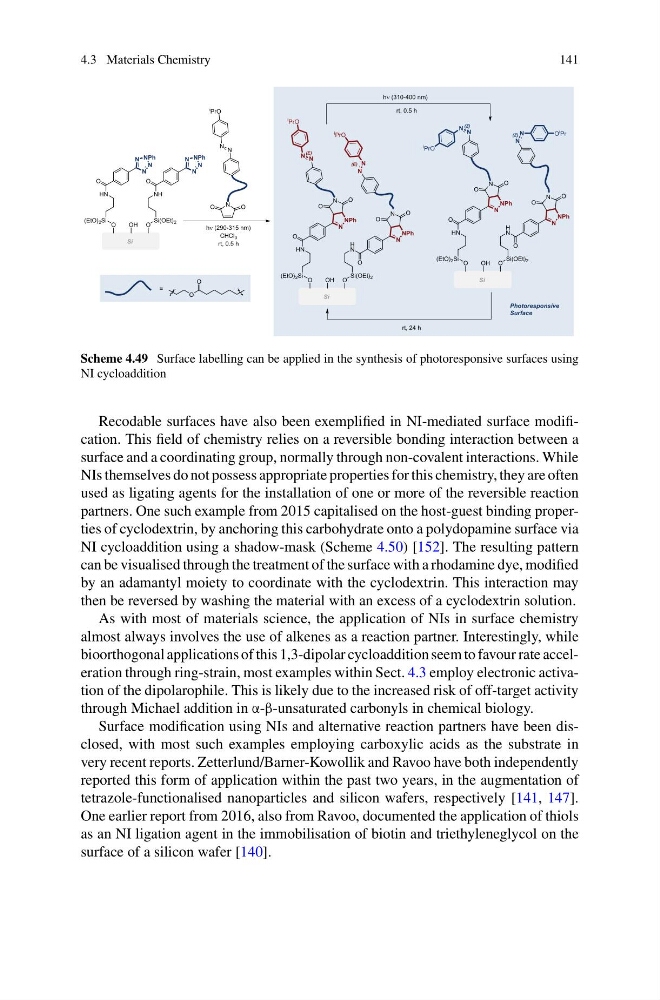
Scheme 4.49 Surface labelling can be applied in the synthesis of photoresponsive surfaces using
NI cycloaddition
Recodable surfaces have also been exemplified in NI-mediated surface modification. This field of chemistry relies on a reversible bonding interaction between a
surface and a coordinating group, normally through non-covalent interactions. While
NIs themselves do not possess appropriate properties for this chemistry, they are often
used as ligating agents for the installation of one or more of the reversible reaction
partners. One such example from 2015 capitalised on the host-guest binding properties of cyclodextrin, by anchoring this carbohydrate onto a polydopamine surface via
NI cycloaddition using a shadow-mask (Scheme 4.50) [152]. The resulting pattern
can be visualised through the treatment of the surface with a rhodamine dye, modified
by an adamantyl moiety to coordinate with the cyclodextrin. This interaction may
then be reversed by washing the material with an excess of a cyclodextrin solution.
As with most of materials science, the application of NIs in surface chemistry
almost always involves the use of alkenes as a reaction partner. Interestingly, while
bioorthogonal applications of this 1,3-dipolar cycloaddition seem to favour rate acceleration through ring-strain, most examples within Sect. 4.3 employ electronic activation of the dipolarophile. This is likely due to the increased risk of off-target activity
through Michael addition in α-β-unsaturated carbonyls in chemical biology.
Surface modification using NIs and alternative reaction partners have been disclosed, with most such examples employing carboxylic acids as the substrate in
very recent reports. Zetterlund/Barner-Kowollik and Ravoo have both independently
reported this form of application within the past two years, in the augmentation of
tetrazole-functionalised nanoparticles and silicon wafers, respectively [141, 147].
One earlier report from 2016, also from Ravoo, documented the application of thiols
as an NI ligation agent in the immobilisation of biotin and triethyleneglycol on the
surface of a silicon wafer [140].
141
N
N (E)
i PrO
Si
O
OH
O
Si(OEt)2
(EtO)2Si
HN
NH
O
O
N
N
NPh
N
N
N
NPh
N
Si
O
OH
O
Si(OEt)2
(EtO)2Si
HN
H
N
O
O
NPh
N
NPh
N
N
O
O
N
O
O
N
N
(E)
i PrO
N
N (Z)
i
PrO
Si
O
OH
O
Si(OEt)2
(EtO)2Si
HN
H
N
O
O
NPh
N
NPh
N
N
O
O
N
O
O
N
N
(Z)
O i Pr
h (290-315 nm)
CHCl3
rt, 0.5 h
h (310-400 nm)
rt, 0.5 h
rt, 24 h
Photoresponsive
Surface
N
O
O
N
N
i PrO
=
O
O
Scheme 4.49 Surface labelling can be applied in the synthesis of photoresponsive surfaces using
NI cycloaddition
Recodable surfaces have also been exemplified in NI-mediated surface modification. This field of chemistry relies on a reversible bonding interaction between a
surface and a coordinating group, normally through non-covalent interactions. While
NIs themselves do not possess appropriate properties for this chemistry, they are often
used as ligating agents for the installation of one or more of the reversible reaction
partners. One such example from 2015 capitalised on the host-guest binding properties of cyclodextrin, by anchoring this carbohydrate onto a polydopamine surface via
NI cycloaddition using a shadow-mask (Scheme 4.50) [152]. The resulting pattern
can be visualised through the treatment of the surface with a rhodamine dye, modified
by an adamantyl moiety to coordinate with the cyclodextrin. This interaction may
then be reversed by washing the material with an excess of a cyclodextrin solution.
As with most of materials science, the application of NIs in surface chemistry
almost always involves the use of alkenes as a reaction partner. Interestingly, while
bioorthogonal applications of this 1,3-dipolar cycloaddition seem to favour rate acceleration through ring-strain, most examples within Sect. 4.3 employ electronic activation of the dipolarophile. This is likely due to the increased risk of off-target activity
through Michael addition in α-β-unsaturated carbonyls in chemical biology.
Surface modification using NIs and alternative reaction partners have been disclosed, with most such examples employing carboxylic acids as the substrate in
very recent reports. Zetterlund/Barner-Kowollik and Ravoo have both independently
reported this form of application within the past two years, in the augmentation of
tetrazole-functionalised nanoparticles and silicon wafers, respectively [141, 147].
One earlier report from 2016, also from Ravoo, documented the application of thiols
as an NI ligation agent in the immobilisation of biotin and triethyleneglycol on the
surface of a silicon wafer [140].