

4.3 Materials Chemistry
139
of which were modified to include a maleimide functional handle to facilitate NI
cycloaddition [145].
The surfaces of nanoparticles are also amenable to functionalisation through NI
chemistry. The first example of this was reported in 2015, with the modification of
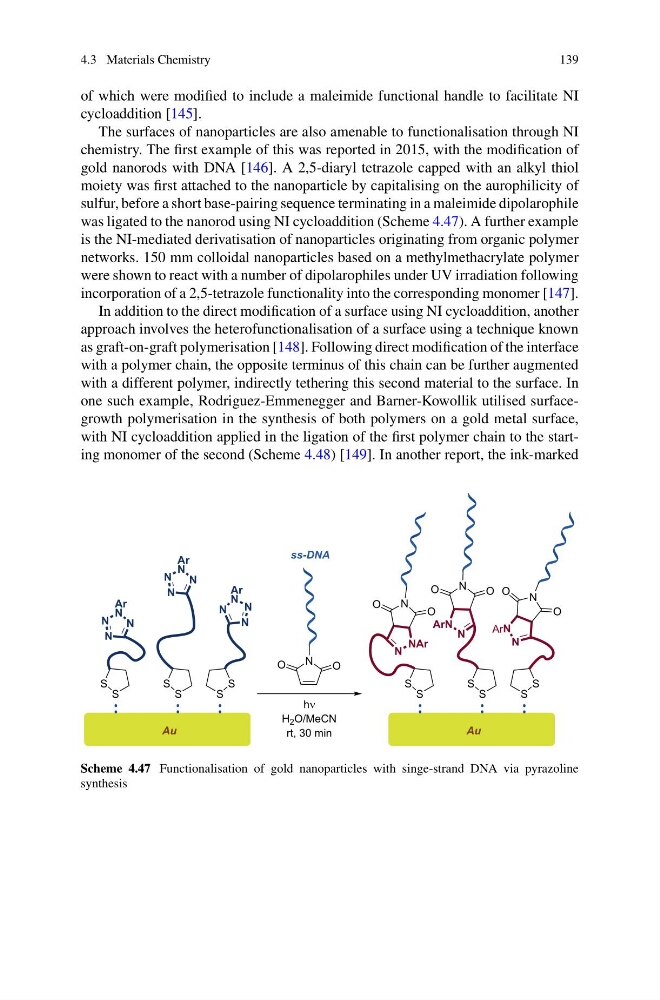
gold nanorods with DNA [146]. A 2,5-diaryl tetrazole capped with an alkyl thiol
moiety was first attached to the nanoparticle by capitalising on the aurophilicity of
sulfur, before a short base-pairing sequence terminating in a maleimide dipolarophile
was ligated to the nanorod using NI cycloaddition (Scheme 4.47). A further example
is the NI-mediated derivatisation of nanoparticles originating from organic polymer
networks. 150 mm colloidal nanoparticles based on a methylmethacrylate polymer
were shown to react with a number of dipolarophiles under UV irradiation following
incorporation of a 2,5-tetrazole functionality into the corresponding monomer [147].
In addition to the direct modification of a surface using NI cycloaddition, another
approach involves the heterofunctionalisation of a surface using a technique known
as graft-on-graft polymerisation [148]. Following direct modification of the interface
with a polymer chain, the opposite terminus of this chain can be further augmented
with a different polymer, indirectly tethering this second material to the surface. In
one such example, Rodriguez-Emmenegger and Barner-Kowollik utilised surfacegrowth polymerisation in the synthesis of both polymers on a gold metal surface,
with NI cycloaddition applied in the ligation of the first polymer chain to the starting monomer of the second (Scheme 4.48) [149]. In another report, the ink-marked
Au
S
S
N
N
Ar
N
N
N
O
O
h
H 2 O/MeCN
rt, 30 min
S
S
N
N
Ar
N
N
S
S
N
N
Ar
N
N
Au
S
S
S
S
S
S
NAr
N
N
O
O
ArN
N
N
O
O
ArN
N
N
O
O
ss-DNA
Scheme 4.47 Functionalisation of gold nanoparticles with singe-strand DNA via pyrazoline
synthesis
139
of which were modified to include a maleimide functional handle to facilitate NI
cycloaddition [145].
The surfaces of nanoparticles are also amenable to functionalisation through NI
chemistry. The first example of this was reported in 2015, with the modification of
gold nanorods with DNA [146]. A 2,5-diaryl tetrazole capped with an alkyl thiol
moiety was first attached to the nanoparticle by capitalising on the aurophilicity of
sulfur, before a short base-pairing sequence terminating in a maleimide dipolarophile
was ligated to the nanorod using NI cycloaddition (Scheme 4.47). A further example
is the NI-mediated derivatisation of nanoparticles originating from organic polymer
networks. 150 mm colloidal nanoparticles based on a methylmethacrylate polymer
were shown to react with a number of dipolarophiles under UV irradiation following
incorporation of a 2,5-tetrazole functionality into the corresponding monomer [147].
In addition to the direct modification of a surface using NI cycloaddition, another
approach involves the heterofunctionalisation of a surface using a technique known
as graft-on-graft polymerisation [148]. Following direct modification of the interface
with a polymer chain, the opposite terminus of this chain can be further augmented
with a different polymer, indirectly tethering this second material to the surface. In
one such example, Rodriguez-Emmenegger and Barner-Kowollik utilised surfacegrowth polymerisation in the synthesis of both polymers on a gold metal surface,
with NI cycloaddition applied in the ligation of the first polymer chain to the starting monomer of the second (Scheme 4.48) [149]. In another report, the ink-marked
Au
S
S
N
N
Ar
N
N
N
O
O
h
H 2 O/MeCN
rt, 30 min
S
S
N
N
Ar
N
N
S
S
N
N
Ar
N
N
Au
S
S
S
S
S
S
NAr
N
N
O
O
ArN
N
N
O
O
ArN
N
N
O
O
ss-DNA
Scheme 4.47 Functionalisation of gold nanoparticles with singe-strand DNA via pyrazoline
synthesis