

136
4 Applications of Nitrile Imine Derivatives
N
N
NO 2
Me 2 N
Et 3 N, NMP
W, 170 °C, 1 h
or
Et 3 N, NMP
170 °C, 6 d
Cl
N
NH
Me 2 N
NO 2
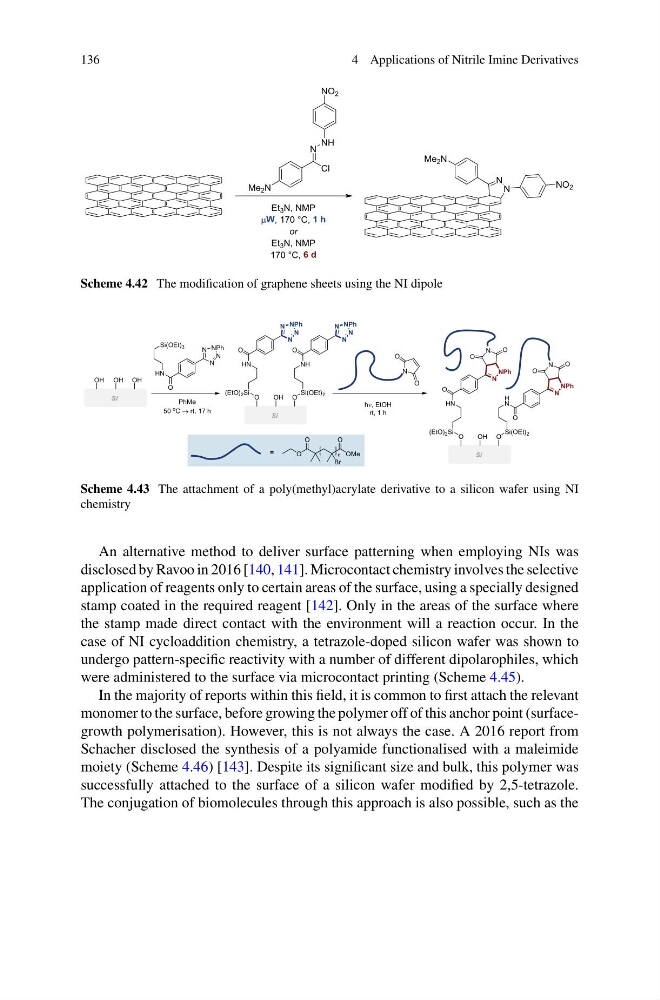
Scheme 4.42 The modification of graphene sheets using the NI dipole
Si
OH
N
N
NPh
N
O
HN
PhMe
50 o C rt, 17 h
OH
OH
Si(OEt)3
Si
O
OH
O
Si(OEt)2
(EtO)2Si
HN
NH
O
O
N
N
NPh
N
N
N
NPh
N
N
O
O
h, EtOH
rt, 1 h
Si
O
OH
O
Si(OEt)2
(EtO)2Si
HN
H
N
O
O
NPh
N
NPh
N
N
O
O
N
O
O
=
O
O
Br
OMe
O
n
Scheme 4.43 The attachment of a poly(methyl)acrylate derivative to a silicon wafer using NI
chemistry
An alternative method to deliver surface patterning when employing NIs was
disclosed by Ravoo in 2016 [140, 141]. Microcontact chemistry involves the selective
application of reagents only to certain areas of the surface, using a specially designed
stamp coated in the required reagent [142]. Only in the areas of the surface where
the stamp made direct contact with the environment will a reaction occur. In the
case of NI cycloaddition chemistry, a tetrazole-doped silicon wafer was shown to
undergo pattern-specific reactivity with a number of different dipolarophiles, which
were administered to the surface via microcontact printing (Scheme 4.45).
In the majority of reports within this field, it is common to first attach the relevant
monomer to the surface, before growing the polymer off of this anchor point (surfacegrowth polymerisation). However, this is not always the case. A 2016 report from
Schacher disclosed the synthesis of a polyamide functionalised with a maleimide
moiety (Scheme 4.46) [143]. Despite its significant size and bulk, this polymer was
successfully attached to the surface of a silicon wafer modified by 2,5-tetrazole.
The conjugation of biomolecules through this approach is also possible, such as the
4 Applications of Nitrile Imine Derivatives
N
N
NO 2
Me 2 N
Et 3 N, NMP
W, 170 °C, 1 h
or
Et 3 N, NMP
170 °C, 6 d
Cl
N
NH
Me 2 N
NO 2
Scheme 4.42 The modification of graphene sheets using the NI dipole
Si
OH
N
N
NPh
N
O
HN
PhMe
50 o C rt, 17 h
OH
OH
Si(OEt)3
Si
O
OH
O
Si(OEt)2
(EtO)2Si
HN
NH
O
O
N
N
NPh
N
N
N
NPh
N
N
O
O
h, EtOH
rt, 1 h
Si
O
OH
O
Si(OEt)2
(EtO)2Si
HN
H
N
O
O
NPh
N
NPh
N
N
O
O
N
O
O
=
O
O
Br
OMe
O
n
Scheme 4.43 The attachment of a poly(methyl)acrylate derivative to a silicon wafer using NI
chemistry
An alternative method to deliver surface patterning when employing NIs was
disclosed by Ravoo in 2016 [140, 141]. Microcontact chemistry involves the selective
application of reagents only to certain areas of the surface, using a specially designed
stamp coated in the required reagent [142]. Only in the areas of the surface where
the stamp made direct contact with the environment will a reaction occur. In the
case of NI cycloaddition chemistry, a tetrazole-doped silicon wafer was shown to
undergo pattern-specific reactivity with a number of different dipolarophiles, which
were administered to the surface via microcontact printing (Scheme 4.45).
In the majority of reports within this field, it is common to first attach the relevant
monomer to the surface, before growing the polymer off of this anchor point (surfacegrowth polymerisation). However, this is not always the case. A 2016 report from
Schacher disclosed the synthesis of a polyamide functionalised with a maleimide
moiety (Scheme 4.46) [143]. Despite its significant size and bulk, this polymer was
successfully attached to the surface of a silicon wafer modified by 2,5-tetrazole.
The conjugation of biomolecules through this approach is also possible, such as the