

124
4 Applications of Nitrile Imine Derivatives
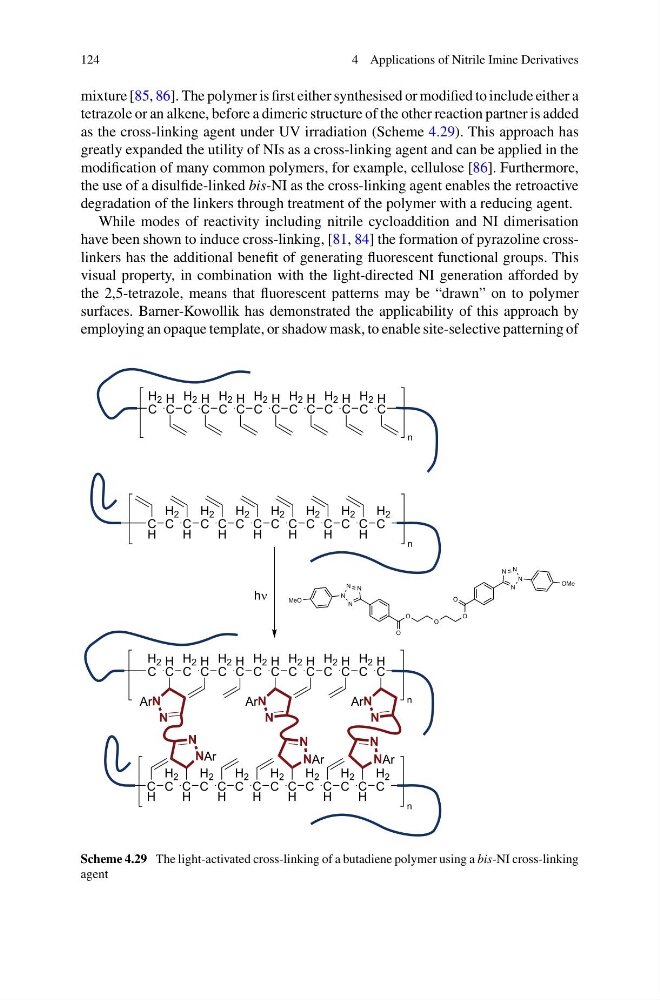
mixture [85, 86]. The polymer is first either synthesised or modified to include either a
tetrazole or an alkene, before a dimeric structure of the other reaction partner is added
as the cross-linking agent under UV irradiation (Scheme 4.29). This approach has
greatly expanded the utility of NIs as a cross-linking agent and can be applied in the
modification of many common polymers, for example, cellulose [86]. Furthermore,
the use of a disulfide-linked bis-NI as the cross-linking agent enables the retroactive
degradation of the linkers through treatment of the polymer with a reducing agent.
While modes of reactivity including nitrile cycloaddition and NI dimerisation
have been shown to induce cross-linking, [81, 84] the formation of pyrazoline crosslinkers has the additional benefit of generating fluorescent functional groups. This
visual property, in combination with the light-directed NI generation afforded by
the 2,5-tetrazole, means that fluorescent patterns may be “drawn” on to polymer
surfaces. Barner-Kowollik has demonstrated the applicability of this approach by
employing an opaque template, or shadow mask, to enable site-selective patterning of
O
O
O
O
O
N
N
N
N
N N
N
N
OMe
MeO
C
H
H 2
C C
H
H 2
C C
H
H 2
C C
H
H 2
C C
H
H 2
C C
H
H 2
C C
H
H 2
C
H
C
H 2
C
H
C
H 2
C
H
C
H 2
C
H
C
H 2
C
H
C
H 2
C
H
C
H 2
C
H
C
H 2
C
n
n
C
H
H 2
C C
H
H 2
C C
H
H 2
C C
H
H 2
C C
H
H 2
C C
H
H 2
C C
H
H 2
C
H
C
H 2
C
H
C
H 2
C
H
C
H 2
C
H
C
H 2
C
H
C
H 2
C
H
C
H 2
C
H
C
H 2
C
n
n
ArN
N
NAr
N
ArN
N
NAr
N
ArN
N
NAr
N
h
Scheme 4.29 The light-activated cross-linking of a butadiene polymer using a bis-NI cross-linking
agent
4 Applications of Nitrile Imine Derivatives
mixture [85, 86]. The polymer is first either synthesised or modified to include either a
tetrazole or an alkene, before a dimeric structure of the other reaction partner is added
as the cross-linking agent under UV irradiation (Scheme 4.29). This approach has
greatly expanded the utility of NIs as a cross-linking agent and can be applied in the
modification of many common polymers, for example, cellulose [86]. Furthermore,
the use of a disulfide-linked bis-NI as the cross-linking agent enables the retroactive
degradation of the linkers through treatment of the polymer with a reducing agent.
While modes of reactivity including nitrile cycloaddition and NI dimerisation
have been shown to induce cross-linking, [81, 84] the formation of pyrazoline crosslinkers has the additional benefit of generating fluorescent functional groups. This
visual property, in combination with the light-directed NI generation afforded by
the 2,5-tetrazole, means that fluorescent patterns may be “drawn” on to polymer
surfaces. Barner-Kowollik has demonstrated the applicability of this approach by
employing an opaque template, or shadow mask, to enable site-selective patterning of
O
O
O
O
O
N
N
N
N
N N
N
N
OMe
MeO
C
H
H 2
C C
H
H 2
C C
H
H 2
C C
H
H 2
C C
H
H 2
C C
H
H 2
C C
H
H 2
C
H
C
H 2
C
H
C
H 2
C
H
C
H 2
C
H
C
H 2
C
H
C
H 2
C
H
C
H 2
C
H
C
H 2
C
n
n
C
H
H 2
C C
H
H 2
C C
H
H 2
C C
H
H 2
C C
H
H 2
C C
H
H 2
C C
H
H 2
C
H
C
H 2
C
H
C
H 2
C
H
C
H 2
C
H
C
H 2
C
H
C
H 2
C
H
C
H 2
C
H
C
H 2
C
n
n
ArN
N
NAr
N
ArN
N
NAr
N
ArN
N
NAr
N
h
Scheme 4.29 The light-activated cross-linking of a butadiene polymer using a bis-NI cross-linking
agent