

4.3 Materials Chemistry
125
materials such as cellulose (further explored in Sect. 4.3.4) [85]. The same author has
also exemplified the use of laser-writing on tetrazole and acrylamide-functionalised
microparticles, selectively generating the fluorescent pyrazolines in specific areas of
the macromolecule [87].
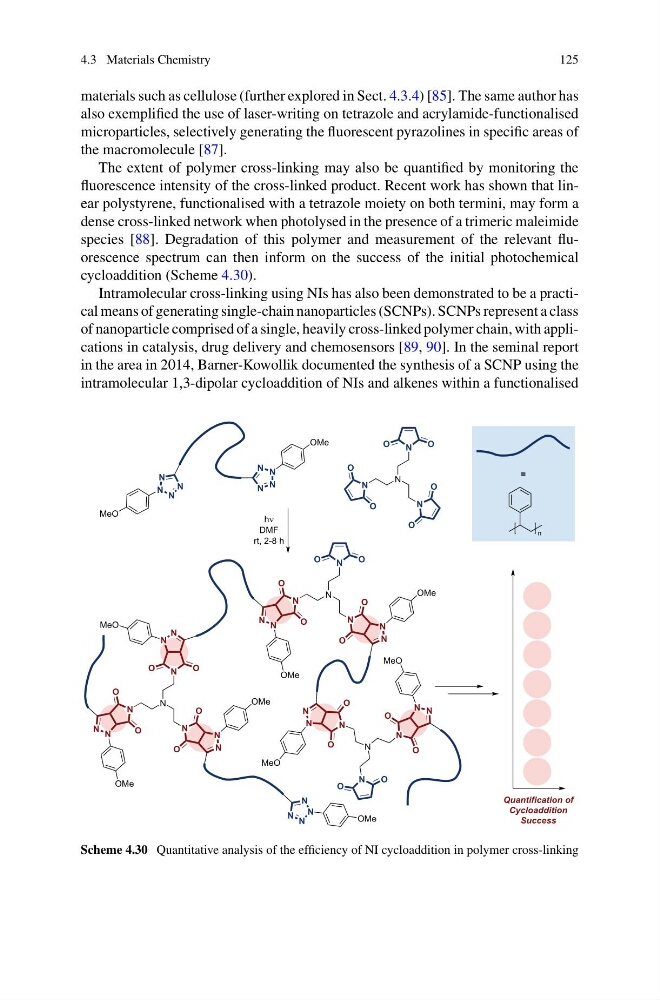
The extent of polymer cross-linking may also be quantified by monitoring the
fluorescence intensity of the cross-linked product. Recent work has shown that linear polystyrene, functionalised with a tetrazole moiety on both termini, may form a
dense cross-linked network when photolysed in the presence of a trimeric maleimide
species [88]. Degradation of this polymer and measurement of the relevant fluorescence spectrum can then inform on the success of the initial photochemical
cycloaddition (Scheme 4.30).
Intramolecular cross-linking using NIs has also been demonstrated to be a practical means of generating single-chain nanoparticles (SCNPs). SCNPs represent a class
of nanoparticle comprised of a single, heavily cross-linked polymer chain, with applications in catalysis, drug delivery and chemosensors [89, 90]. In the seminal report
in the area in 2014, Barner-Kowollik documented the synthesis of a SCNP using the
intramolecular 1,3-dipolar cycloaddition of NIs and alkenes within a functionalised
N N
N
N
OMe
N
N
N
O
O
O
O
h
DMF
rt, 2-8 h
=
n
N
O
O
N N
N
N
OMe
N
N
N
N
MeO
N
N
N
O
O
O
O
N
O
O
N N
N
N
N
N
OMe
MeO
OMe
N
N
N
O
O
O
O
N
O
O
N N
N
N
OMe
OMe
N
N
N
O
O
O
O
N
O
O
N
N
N
N
MeO
MeO
Quantification of
Cycloaddition
Success
Scheme 4.30 Quantitative analysis of the efficiency of NI cycloaddition in polymer cross-linking
125
materials such as cellulose (further explored in Sect. 4.3.4) [85]. The same author has
also exemplified the use of laser-writing on tetrazole and acrylamide-functionalised
microparticles, selectively generating the fluorescent pyrazolines in specific areas of
the macromolecule [87].
The extent of polymer cross-linking may also be quantified by monitoring the
fluorescence intensity of the cross-linked product. Recent work has shown that linear polystyrene, functionalised with a tetrazole moiety on both termini, may form a
dense cross-linked network when photolysed in the presence of a trimeric maleimide
species [88]. Degradation of this polymer and measurement of the relevant fluorescence spectrum can then inform on the success of the initial photochemical
cycloaddition (Scheme 4.30).
Intramolecular cross-linking using NIs has also been demonstrated to be a practical means of generating single-chain nanoparticles (SCNPs). SCNPs represent a class
of nanoparticle comprised of a single, heavily cross-linked polymer chain, with applications in catalysis, drug delivery and chemosensors [89, 90]. In the seminal report
in the area in 2014, Barner-Kowollik documented the synthesis of a SCNP using the
intramolecular 1,3-dipolar cycloaddition of NIs and alkenes within a functionalised
N N
N
N
OMe
N
N
N
O
O
O
O
h
DMF
rt, 2-8 h
=
n
N
O
O
N N
N
N
OMe
N
N
N
N
MeO
N
N
N
O
O
O
O
N
O
O
N N
N
N
N
N
OMe
MeO
OMe
N
N
N
O
O
O
O
N
O
O
N N
N
N
OMe
OMe
N
N
N
O
O
O
O
N
O
O
N
N
N
N
MeO
MeO
Quantification of
Cycloaddition
Success
Scheme 4.30 Quantitative analysis of the efficiency of NI cycloaddition in polymer cross-linking