

4.3 Materials Chemistry
123
Cross-linking in polymers is important as it can drastically alter the properties of the
product. Control over the cross-linking process is similarly crucial, as a means of
influencing the extent of alterations made to the polymer. Photolytic NI generation
is highly beneficial in this regard, as the use of a focused light source can afford
exquisite control over the sites of reaction. Cross-linking can also be expensive, as
it normally requires an additional step in the manufacturing process using a “crosslinking agent”. However, early incorporation of 2,5-tetrazoles can negate the need
for such an agent.
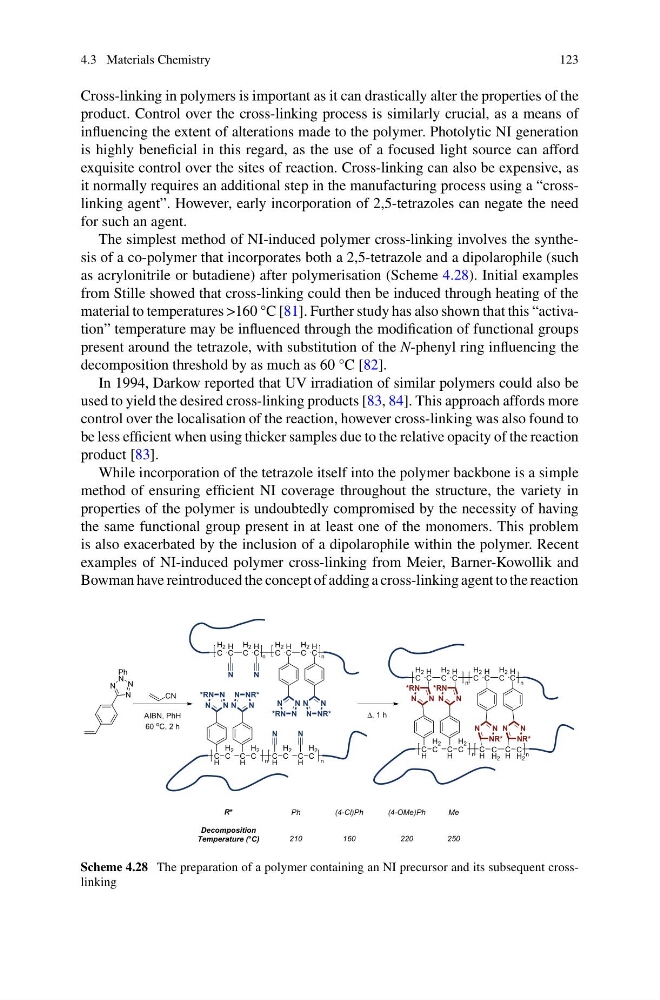
The simplest method of NI-induced polymer cross-linking involves the synthesis of a co-polymer that incorporates both a 2,5-tetrazole and a dipolarophile (such
as acrylonitrile or butadiene) after polymerisation (Scheme 4.28). Initial examples
from Stille showed that cross-linking could then be induced through heating of the
material to temperatures >160 °C [81]. Further study has also shown that this “activation” temperature may be influenced through the modification of functional groups
present around the tetrazole, with substitution of the N-phenyl ring influencing the
decomposition threshold by as much as 60 °C [82].
In 1994, Darkow reported that UV irradiation of similar polymers could also be
used to yield the desired cross-linking products [83, 84]. This approach affords more
control over the localisation of the reaction, however cross-linking was also found to
be less efficient when using thicker samples due to the relative opacity of the reaction
product [83].
While incorporation of the tetrazole itself into the polymer backbone is a simple
method of ensuring efficient NI coverage throughout the structure, the variety in
properties of the polymer is undoubtedly compromised by the necessity of having
the same functional group present in at least one of the monomers. This problem
is also exacerbated by the inclusion of a dipolarophile within the polymer. Recent
examples of NI-induced polymer cross-linking from Meier, Barner-Kowollik and
Bowman have reintroduced the concept of adding a cross-linking agent to the reaction
AIBN, PhH
60
o C, 2 h
N
N
Ph
N
N
CN
C
H
H 2
C C
H
H 2
C
N
N
*RN
N
N
NR*
N
N
C
H
H 2
C C
H
H 2
C
N
N
n
n
Δ, 1 h
C
H
H 2
C C
H
H 2
C
N
*RN
N
N
*RN
N
C
H
C
H 2
C
H
C
H 2
n
n
H
C
H 2
C
H
C
H 2
C
N
NR*
N
N
NR*
N
H
C
H 2
C
H
C
H 2
C
n
n
H
C
H 2
C
H
C
H 2
C
N
N NR*
N
N
*RN N
N
H
C
H 2
C
H
C
H 2
C
N
N
n
n
R*
Decomposition
Temperature (°C)
Ph
210
(4-Cl)Ph
160
(4-OMe)Ph
220
Me
250
Scheme 4.28 The preparation of a polymer containing an NI precursor and its subsequent crosslinking
123
Cross-linking in polymers is important as it can drastically alter the properties of the
product. Control over the cross-linking process is similarly crucial, as a means of
influencing the extent of alterations made to the polymer. Photolytic NI generation
is highly beneficial in this regard, as the use of a focused light source can afford
exquisite control over the sites of reaction. Cross-linking can also be expensive, as
it normally requires an additional step in the manufacturing process using a “crosslinking agent”. However, early incorporation of 2,5-tetrazoles can negate the need
for such an agent.
The simplest method of NI-induced polymer cross-linking involves the synthesis of a co-polymer that incorporates both a 2,5-tetrazole and a dipolarophile (such
as acrylonitrile or butadiene) after polymerisation (Scheme 4.28). Initial examples
from Stille showed that cross-linking could then be induced through heating of the
material to temperatures >160 °C [81]. Further study has also shown that this “activation” temperature may be influenced through the modification of functional groups
present around the tetrazole, with substitution of the N-phenyl ring influencing the
decomposition threshold by as much as 60 °C [82].
In 1994, Darkow reported that UV irradiation of similar polymers could also be
used to yield the desired cross-linking products [83, 84]. This approach affords more
control over the localisation of the reaction, however cross-linking was also found to
be less efficient when using thicker samples due to the relative opacity of the reaction
product [83].
While incorporation of the tetrazole itself into the polymer backbone is a simple
method of ensuring efficient NI coverage throughout the structure, the variety in
properties of the polymer is undoubtedly compromised by the necessity of having
the same functional group present in at least one of the monomers. This problem
is also exacerbated by the inclusion of a dipolarophile within the polymer. Recent
examples of NI-induced polymer cross-linking from Meier, Barner-Kowollik and
Bowman have reintroduced the concept of adding a cross-linking agent to the reaction
AIBN, PhH
60
o C, 2 h
N
N
Ph
N
N
CN
C
H
H 2
C C
H
H 2
C
N
N
*RN
N
N
NR*
N
N
C
H
H 2
C C
H
H 2
C
N
N
n
n
Δ, 1 h
C
H
H 2
C C
H
H 2
C
N
*RN
N
N
*RN
N
C
H
C
H 2
C
H
C
H 2
n
n
H
C
H 2
C
H
C
H 2
C
N
NR*
N
N
NR*
N
H
C
H 2
C
H
C
H 2
C
n
n
H
C
H 2
C
H
C
H 2
C
N
N NR*
N
N
*RN N
N
H
C
H 2
C
H
C
H 2
C
N
N
n
n
R*
Decomposition
Temperature (°C)
Ph
210
(4-Cl)Ph
160
(4-OMe)Ph
220
Me
250
Scheme 4.28 The preparation of a polymer containing an NI precursor and its subsequent crosslinking