

4.3 Materials Chemistry
121
scope to include bis-olefins as the “B-B” component, which generated fluorescent
pyrazoline-linked polymers [70].
A significant development in NI polymerisation chemistry was the application
of tetrazoles as an NI source, due to the lack of exogenous reagents required to
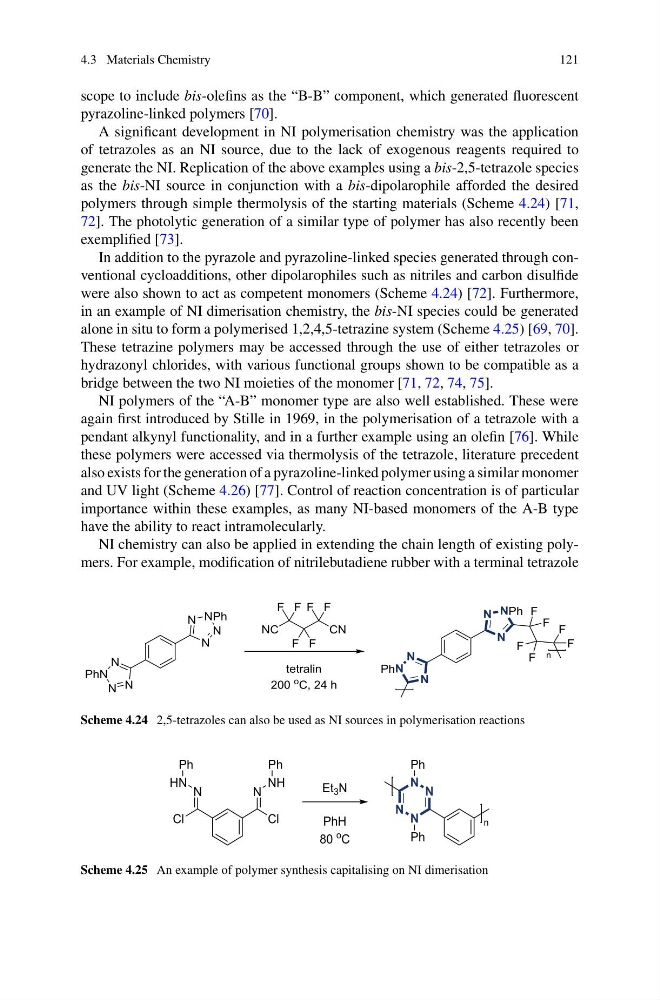
generate the NI. Replication of the above examples using a bis-2,5-tetrazole species
as the bis-NI source in conjunction with a bis-dipolarophile afforded the desired
polymers through simple thermolysis of the starting materials (Scheme 4.24) [71,
72]. The photolytic generation of a similar type of polymer has also recently been
exemplified [73].
In addition to the pyrazole and pyrazoline-linked species generated through conventional cycloadditions, other dipolarophiles such as nitriles and carbon disulfide
were also shown to act as competent monomers (Scheme 4.24) [72]. Furthermore,
in an example of NI dimerisation chemistry, the bis-NI species could be generated
alone in situ to form a polymerised 1,2,4,5-tetrazine system (Scheme 4.25) [69, 70].
These tetrazine polymers may be accessed through the use of either tetrazoles or
hydrazonyl chlorides, with various functional groups shown to be compatible as a
bridge between the two NI moieties of the monomer [71, 72, 74, 75].
NI polymers of the “A-B” monomer type are also well established. These were
again first introduced by Stille in 1969, in the polymerisation of a tetrazole with a
pendant alkynyl functionality, and in a further example using an olefin [76]. While
these polymers were accessed via thermolysis of the tetrazole, literature precedent
also exists for the generation of a pyrazoline-linked polymer using a similar monomer
and UV light (Scheme 4.26) [77]. Control of reaction concentration is of particular
importance within these examples, as many NI-based monomers of the A-B type
have the ability to react intramolecularly.
NI chemistry can also be applied in extending the chain length of existing polymers. For example, modification of nitrilebutadiene rubber with a terminal tetrazole
tetralin
200
o
C, 24 h
N
PhN
N N
N
N
NPh
N
NC
CN
F
F
F
F
F
F
N
PhN
N
N
NPh
N
F
F
F
F
F
F
n
Scheme 4.24 2,5-tetrazoles can also be used as NI sources in polymerisation reactions
PhH
80
o C
Cl
HN N
Cl
N
NH
Ph
Ph
Et 3 N
N N
Ph
N N
Ph
n
Scheme 4.25 An example of polymer synthesis capitalising on NI dimerisation
121
scope to include bis-olefins as the “B-B” component, which generated fluorescent
pyrazoline-linked polymers [70].
A significant development in NI polymerisation chemistry was the application
of tetrazoles as an NI source, due to the lack of exogenous reagents required to
generate the NI. Replication of the above examples using a bis-2,5-tetrazole species
as the bis-NI source in conjunction with a bis-dipolarophile afforded the desired
polymers through simple thermolysis of the starting materials (Scheme 4.24) [71,
72]. The photolytic generation of a similar type of polymer has also recently been
exemplified [73].
In addition to the pyrazole and pyrazoline-linked species generated through conventional cycloadditions, other dipolarophiles such as nitriles and carbon disulfide
were also shown to act as competent monomers (Scheme 4.24) [72]. Furthermore,
in an example of NI dimerisation chemistry, the bis-NI species could be generated
alone in situ to form a polymerised 1,2,4,5-tetrazine system (Scheme 4.25) [69, 70].
These tetrazine polymers may be accessed through the use of either tetrazoles or
hydrazonyl chlorides, with various functional groups shown to be compatible as a
bridge between the two NI moieties of the monomer [71, 72, 74, 75].
NI polymers of the “A-B” monomer type are also well established. These were
again first introduced by Stille in 1969, in the polymerisation of a tetrazole with a
pendant alkynyl functionality, and in a further example using an olefin [76]. While
these polymers were accessed via thermolysis of the tetrazole, literature precedent
also exists for the generation of a pyrazoline-linked polymer using a similar monomer
and UV light (Scheme 4.26) [77]. Control of reaction concentration is of particular
importance within these examples, as many NI-based monomers of the A-B type
have the ability to react intramolecularly.
NI chemistry can also be applied in extending the chain length of existing polymers. For example, modification of nitrilebutadiene rubber with a terminal tetrazole
tetralin
200
o
C, 24 h
N
PhN
N N
N
N
NPh
N
NC
CN
F
F
F
F
F
F
N
PhN
N
N
NPh
N
F
F
F
F
F
F
n
Scheme 4.24 2,5-tetrazoles can also be used as NI sources in polymerisation reactions
PhH
80
o C
Cl
HN N
Cl
N
NH
Ph
Ph
Et 3 N
N N
Ph
N N
Ph
n
Scheme 4.25 An example of polymer synthesis capitalising on NI dimerisation