

116
4 Applications of Nitrile Imine Derivatives
and the epidermal growth factor receptor. Again, an NI-carboxylic acid interaction
was found to be responsible for the reactivity of this species.
This broad reactivity profile between NIs and native amino acid residues has also
found application in phenotypic screening, whereby incorporation of an NI precursor
within the structure of a bioactive molecule may facilitate the identification of the
protein with which the compound exhibits an effect. This was first employed by
Ding and Li in 2017, in the implication of numerous proteins as potential targets
of two small molecules exhibiting antiproliferative effects in cancer cell lines [59].
Degradation studies of the ligated targets identified an aspartate residue as a suspected
site of conjugation for the NI.
4.2.3 Peptide Stapling
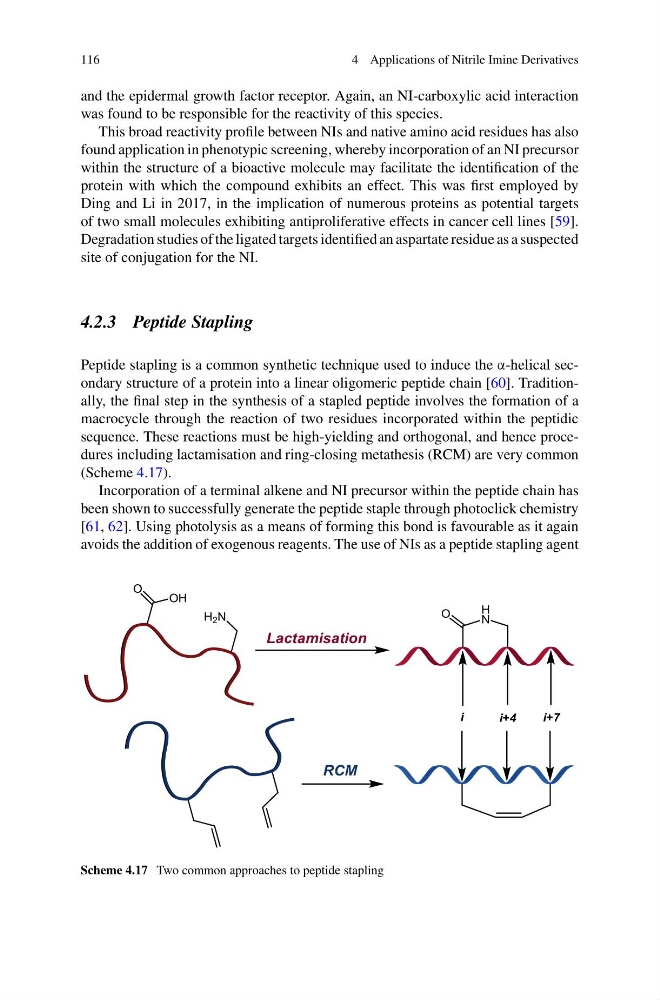
Peptide stapling is a common synthetic technique used to induce the α-helical secondary structure of a protein into a linear oligomeric peptide chain [60]. Traditionally, the final step in the synthesis of a stapled peptide involves the formation of a
macrocycle through the reaction of two residues incorporated within the peptidic
sequence. These reactions must be high-yielding and orthogonal, and hence procedures including lactamisation and ring-closing metathesis (RCM) are very common
(Scheme 4.17).
Incorporation of a terminal alkene and NI precursor within the peptide chain has
been shown to successfully generate the peptide staple through photoclick chemistry
[61, 62]. Using photolysis as a means of forming this bond is favourable as it again
avoids the addition of exogenous reagents. The use of NIs as a peptide stapling agent
O
OH
H
N
O
H 2 N
Lactamisation
i
i+4
i+7
RCM
Scheme 4.17 Two common approaches to peptide stapling
4 Applications of Nitrile Imine Derivatives
and the epidermal growth factor receptor. Again, an NI-carboxylic acid interaction
was found to be responsible for the reactivity of this species.
This broad reactivity profile between NIs and native amino acid residues has also
found application in phenotypic screening, whereby incorporation of an NI precursor
within the structure of a bioactive molecule may facilitate the identification of the
protein with which the compound exhibits an effect. This was first employed by
Ding and Li in 2017, in the implication of numerous proteins as potential targets
of two small molecules exhibiting antiproliferative effects in cancer cell lines [59].
Degradation studies of the ligated targets identified an aspartate residue as a suspected
site of conjugation for the NI.
4.2.3 Peptide Stapling
Peptide stapling is a common synthetic technique used to induce the α-helical secondary structure of a protein into a linear oligomeric peptide chain [60]. Traditionally, the final step in the synthesis of a stapled peptide involves the formation of a
macrocycle through the reaction of two residues incorporated within the peptidic
sequence. These reactions must be high-yielding and orthogonal, and hence procedures including lactamisation and ring-closing metathesis (RCM) are very common
(Scheme 4.17).
Incorporation of a terminal alkene and NI precursor within the peptide chain has
been shown to successfully generate the peptide staple through photoclick chemistry
[61, 62]. Using photolysis as a means of forming this bond is favourable as it again
avoids the addition of exogenous reagents. The use of NIs as a peptide stapling agent
O
OH
H
N
O
H 2 N
Lactamisation
i
i+4
i+7
RCM
Scheme 4.17 Two common approaches to peptide stapling