

4.2 Bioorthogonal Chemistry
115
others [54–56]. In all of these reports, the NI dipole was found to combine with an
acidic amino acid moiety in close proximity to the active site. Within these studies,
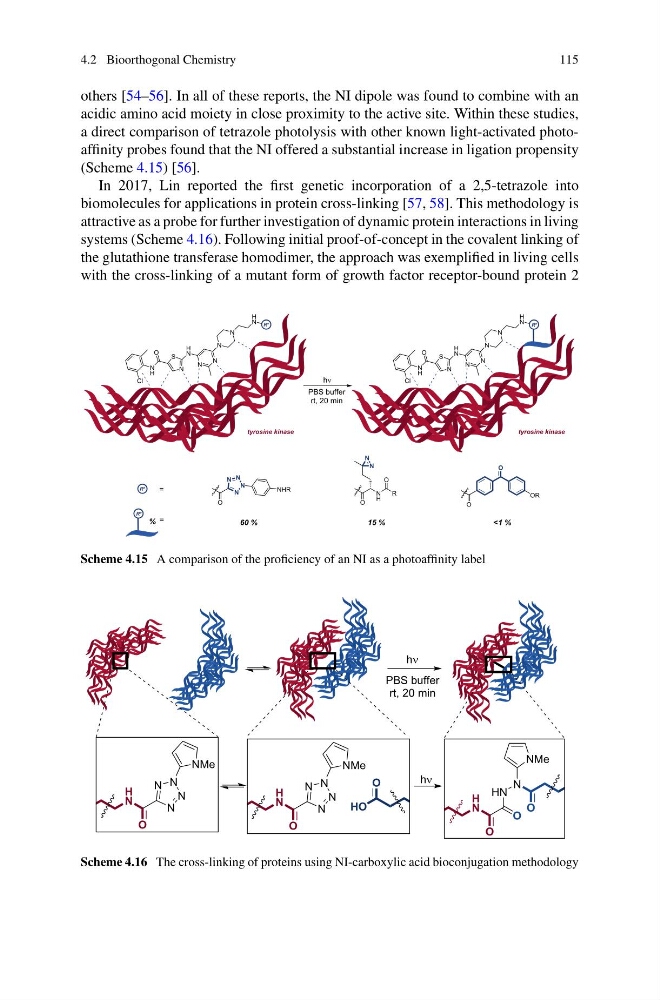
a direct comparison of tetrazole photolysis with other known light-activated photoaffinity probes found that the NI offered a substantial increase in ligation propensity
(Scheme 4.15) [56].
In 2017, Lin reported the first genetic incorporation of a 2,5-tetrazole into
biomolecules for applications in protein cross-linking [57, 58]. This methodology is
attractive as a probe for further investigation of dynamic protein interactions in living
systems (Scheme 4.16). Following initial proof-of-concept in the covalent linking of
the glutathione transferase homodimer, the approach was exemplified in living cells
with the cross-linking of a mutant form of growth factor receptor-bound protein 2
R*
PBS buffer
rt, 20 min
h
N
N
N
N
H
N
H
N
N
S
N
H
O
Cl
R*
N
N
N
N
H
N
H
N
N
S
N
H
O
Cl
R*
=
%
5
1
%
0
6
%
R*
=
O
N
N
N
N
NHR
O
N
H
R
O
N
N
O
O
OR
<1 %
tyrosine kinase
tyrosine kinase
Scheme 4.15 A comparison of the proficiency of an NI as a photoaffinity label
PBS buffer
rt, 20 min
H
N
O
N
N
N
N
NMe
HO
O
H
N
O
N
HN
NMe
O
O
H
N
O
N
N
N
N
NMe
h
h
Scheme 4.16 The cross-linking of proteins using NI-carboxylic acid bioconjugation methodology
115
others [54–56]. In all of these reports, the NI dipole was found to combine with an
acidic amino acid moiety in close proximity to the active site. Within these studies,
a direct comparison of tetrazole photolysis with other known light-activated photoaffinity probes found that the NI offered a substantial increase in ligation propensity
(Scheme 4.15) [56].
In 2017, Lin reported the first genetic incorporation of a 2,5-tetrazole into
biomolecules for applications in protein cross-linking [57, 58]. This methodology is
attractive as a probe for further investigation of dynamic protein interactions in living
systems (Scheme 4.16). Following initial proof-of-concept in the covalent linking of
the glutathione transferase homodimer, the approach was exemplified in living cells
with the cross-linking of a mutant form of growth factor receptor-bound protein 2
R*
PBS buffer
rt, 20 min
h
N
N
N
N
H
N
H
N
N
S
N
H
O
Cl
R*
N
N
N
N
H
N
H
N
N
S
N
H
O
Cl
R*
=
%
5
1
%
0
6
%
R*
=
O
N
N
N
N
NHR
O
N
H
R
O
N
N
O
O
OR
<1 %
tyrosine kinase
tyrosine kinase
Scheme 4.15 A comparison of the proficiency of an NI as a photoaffinity label
PBS buffer
rt, 20 min
H
N
O
N
N
N
N
NMe
HO
O
H
N
O
N
HN
NMe
O
O
H
N
O
N
N
N
N
NMe
h
h
Scheme 4.16 The cross-linking of proteins using NI-carboxylic acid bioconjugation methodology