

114
4 Applications of Nitrile Imine Derivatives
4.2.2 Bioconjugative Reactions
In the past few years, the reactivity of the NI with various nucleophiles in a bioconjugative manner has also risen to prominence, provoking discussion of the true
bioorthogonality of the photoclick process. This topic was first discussed by Zhao
in 2013, who reported that NIs may still form nucleophilic adducts with a number
of amino acid residues, even in the presence of reactive dipolarophiles [52]. Further
evidence was provided by Nallani in 2015, who reported significant by-product formation during attempts to ligate a PEG-ylated NI to bovine beta-lactoglobulin [53].
The investigators tentatively assigned this unknown derivative as the cycloaddition
product between the NI and tryptophan residues. Conclusive evidence was provided
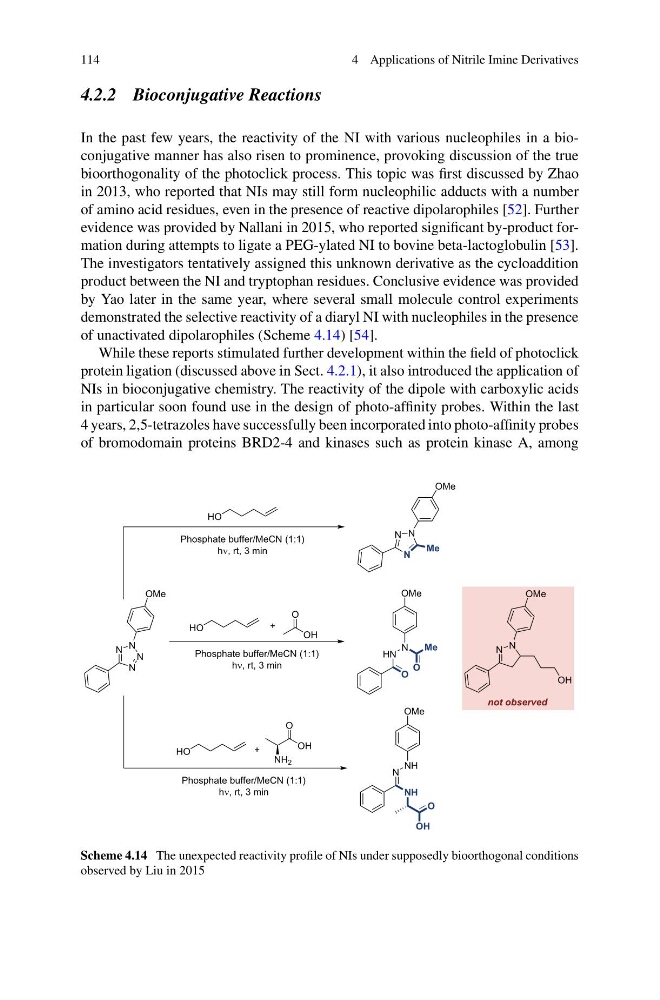
by Yao later in the same year, where several small molecule control experiments
demonstrated the selective reactivity of a diaryl NI with nucleophiles in the presence
of unactivated dipolarophiles (Scheme 4.14) [54].
While these reports stimulated further development within the field of photoclick
protein ligation (discussed above in Sect. 4.2.1), it also introduced the application of
NIs in bioconjugative chemistry. The reactivity of the dipole with carboxylic acids
in particular soon found use in the design of photo-affinity probes. Within the last
4 years, 2,5-tetrazoles have successfully been incorporated into photo-affinity probes
of bromodomain proteins BRD2-4 and kinases such as protein kinase A, among
Phosphate buffer/MeCN (1:1)
h, rt, 3 min
HO
O
OH
HN
O
N
OMe
O
Me
+
N
N
N
N
OMe
Phosphate buffer/MeCN (1:1)
h, rt, 3 min
HO
N N
OMe
N
Me
Phosphate buffer/MeCN (1:1)
h, rt, 3 min
HO
N
NH
OMe
NH
NH 2
O
OH
+
OH
O
N N
OMe
OH
not observed
Scheme 4.14 The unexpected reactivity profile of NIs under supposedly bioorthogonal conditions
observed by Liu in 2015
4 Applications of Nitrile Imine Derivatives
4.2.2 Bioconjugative Reactions
In the past few years, the reactivity of the NI with various nucleophiles in a bioconjugative manner has also risen to prominence, provoking discussion of the true
bioorthogonality of the photoclick process. This topic was first discussed by Zhao
in 2013, who reported that NIs may still form nucleophilic adducts with a number
of amino acid residues, even in the presence of reactive dipolarophiles [52]. Further
evidence was provided by Nallani in 2015, who reported significant by-product formation during attempts to ligate a PEG-ylated NI to bovine beta-lactoglobulin [53].
The investigators tentatively assigned this unknown derivative as the cycloaddition
product between the NI and tryptophan residues. Conclusive evidence was provided
by Yao later in the same year, where several small molecule control experiments
demonstrated the selective reactivity of a diaryl NI with nucleophiles in the presence
of unactivated dipolarophiles (Scheme 4.14) [54].
While these reports stimulated further development within the field of photoclick
protein ligation (discussed above in Sect. 4.2.1), it also introduced the application of
NIs in bioconjugative chemistry. The reactivity of the dipole with carboxylic acids
in particular soon found use in the design of photo-affinity probes. Within the last
4 years, 2,5-tetrazoles have successfully been incorporated into photo-affinity probes
of bromodomain proteins BRD2-4 and kinases such as protein kinase A, among
Phosphate buffer/MeCN (1:1)
h, rt, 3 min
HO
O
OH
HN
O
N
OMe
O
Me
+
N
N
N
N
OMe
Phosphate buffer/MeCN (1:1)
h, rt, 3 min
HO
N N
OMe
N
Me
Phosphate buffer/MeCN (1:1)
h, rt, 3 min
HO
N
NH
OMe
NH
NH 2
O
OH
+
OH
O
N N
OMe
OH
not observed
Scheme 4.14 The unexpected reactivity profile of NIs under supposedly bioorthogonal conditions
observed by Liu in 2015